Deutschland
Joiners Berlin – Professional Woodworking & Furniture Making
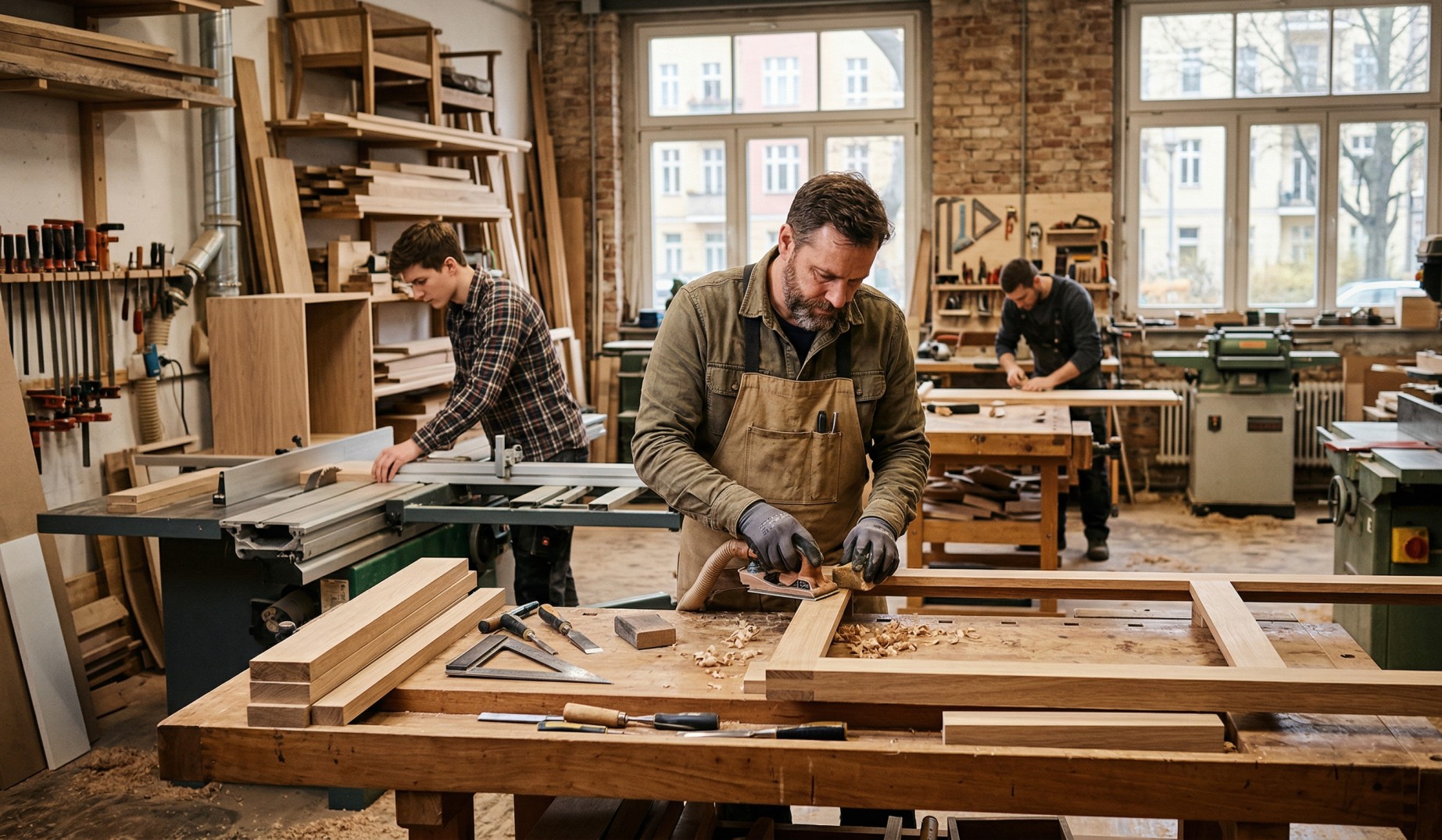
Berlin offers a diverse landscape of joinery firms – usually called ‘Tischlereien’ in the capital –, ranging from traditional craftsmanship to modern production techniques. The city combines centuries-old craft traditions with innovative approaches to woodworking.
Whether bespoke furniture, fitted kitchens or elaborate restoration work – Berlin joineries cover the entire spectrum of woodworking. These businesses stand out for their high quality standards and bespoke solutions, which are particularly in demand in Berlin's period buildings with their high ceilings and uneven walls.
For finding reliable specialist firms across all trades, our guide Tradespeople in Berlin – Find reliable specialist firms for all trades provides comprehensive guidance.
Range of services offered by joineries in Berlin
Berlin joineries offer a comprehensive range of services for private and commercial customers. From planning through workshop production to on-site installation, they handle every step professionally.
The range extends from simple repairs to complex interior fit-out projects. Many businesses have specialised in particular areas such as listed building conservation, shopfitting or modern office furnishings.
Main services at a glance:
- Bespoke furniture and fitted wardrobes
- Kitchen and bathroom furniture
- Windows and doors
- Parquet and flooring
- Staircases and railings
- Restoration of historic furniture and doors
- Shopfitting and exhibition stands
- Office furnishings
Bespoke furniture and custom furniture making
Bespoke furniture is very popular in Berlin, as it can be optimally adapted to the often awkwardly shaped living spaces. Joineries develop individual solutions for every room – from fitted wardrobes under sloping ceilings to room dividers in a Berliner Zimmer.
Planning usually takes place in close collaboration with the customer. Modern CAD programmes allow precise visualisation of the planned furniture before production.
Space-saving solutions such as loft beds, multifunctional shelving systems or custom-made wardrobes for alcoves and sloping ceilings are particularly popular.
Fitted kitchens and bathroom furniture
Fitted kitchens are one of the top disciplines in joinery. Berlin firms plan and build complete kitchens to individual requirements and spatial conditions – an alternative to off-the-shelf kitchens when the floor plan or design calls for special solutions.
Modern kitchens combine functionality with aesthetic appeal. The focus is on integrating appliances and intelligent storage solutions.
For bathroom furniture, the emphasis is on moisture-resistant materials and well-thought-out use of space. Vanity units and mirror cabinets are adapted to the millimetre to fit the given space.
Windows, doors and interior fit-out
Historic buildings in Berlin often require special solutions for windows and doors. Joineries restore listed box-sash windows and double doors or produce faithful replicas – often a requirement in conservation and heritage protection areas.
Modern windows and doors must meet high standards for thermal insulation and burglary protection. Berlin joineries use high-quality fittings and multiple glazing, for which funding is available as part of energy-efficiency renovation schemes.
For interior fit-outs, firms implement complete room concepts. This includes wall cladding, ceiling design and the integration of lighting elements. Our article on Renovation in Berlin shows how joiners, painters and electricians work together during a refurbishment.
Material selection and sustainability
Sustainability is becoming increasingly important for joineries in Berlin. Many firms use FSC- or PEFC-certified timber from sustainable forestry, often sourced from Brandenburg.
Native wood types such as oak, beech and pine are the main focus. They offer not only ecological benefits but also short transport distances and proven processing properties. Reclaimed timber from demolished buildings is also increasingly being reused.
Popular wood types in Berlin:
- Oak: robust and durable
- Beech: hard and versatile
- Pine: affordable and easy to work with, typical for Brandenburg-style floorboards
- Walnut: elegant and decorative
- Maple: light and evenly structured
- Cherry: warm and elegant
Pricing and cost planning
Prices at Berlin joineries vary depending on the scope of the project, choice of materials and complexity of the work. A transparent cost breakdown is standard practice among reputable firms.
Repairs and installations are usually charged in 2026 at 60 to 100 euros net per hour. Bespoke furniture costs roughly 800 to 2,500 euros per running metre of cupboard front depending on the design, with simple shelving costing correspondingly less.
Complete kitchens from a joiner usually range between 12,000 and 35,000 euros, depending on size, appliances and the materials chosen. Detailed planning helps avoid cost pitfalls. Our article on Tradespeople's prices in Berlin gives an overview of hourly rates across all trades. For work carried out in your own home, 20 per cent of labour costs, up to 1,200 euros per year, can be deducted from tax.
Choosing the right joinery
Several factors should be considered when choosing a joinery in Berlin. References and reviews provide insight into the quality of the work.
A personal consultation allows you to assess the firm's expertise and understanding of your wishes. Reputable firms provide detailed quotes with no hidden costs and give realistic delivery times – good workshops are often booked out several weeks to months in advance.
Viewing previously completed projects or the workshop itself can provide additional reassurance. Entry in the Berlin Chamber of Trade's register of craftspeople, a master craftsman's certificate and membership of the joiners' guild all point to professionalism.
Modern production techniques at Berlin joineries
Many Berlin joineries have invested in modern CNC machines and computer-controlled production equipment. These enable precise processing and significantly shorten production times.
3D planning and visualisations help customers experience their future furniture before it is even made. Requests for changes can thus be factored in at an early stage.
The combination of traditional craftsmanship and modern technology characterises the Berlin joinery scene. Craft skills remain essential for quality and bespoke solutions – especially for restorations and one-off pieces.
Frequently Asked Questions about joineries in Berlin
How much does a fitted wardrobe from a joiner cost in Berlin?
Depending on material and design, around 800 to 2,500 euros per running metre of front, including planning and installation. Lacquered fronts and solid wood are at the upper end of the range.
Tischler or Schreiner – what's the difference?
None in terms of the trade: in Berlin and northern Germany the profession is called ‘Tischler’, while in southern Germany it's called ‘Schreiner’. The training and services are identical.
How long does it take to make bespoke furniture?
From planning to installation, usually six to twelve weeks, longer if the workshop is busy. Enquire early, especially before a house move or renovation.
Are joiners allowed to renew listed windows?
Yes, specialist firms restore box-sash windows or produce replicas in keeping with heritage requirements. The work must be agreed in advance with the district's heritage conservation authority.
How can I recognise a good joinery?
By a master craftsman's certificate and entry in the register of craftspeople, their own workshop, reference projects, a detailed written quote and honest information about delivery times.
Also worth reading: Tradespeople in Berlin – Find reliable specialist firms for all trades as well as further articles on our Germany page.
Jonas Klein