Deutschland
What Do Wooden Acoustic Panels Do? WoodUpp Models Noticeably Reduce Reverberation
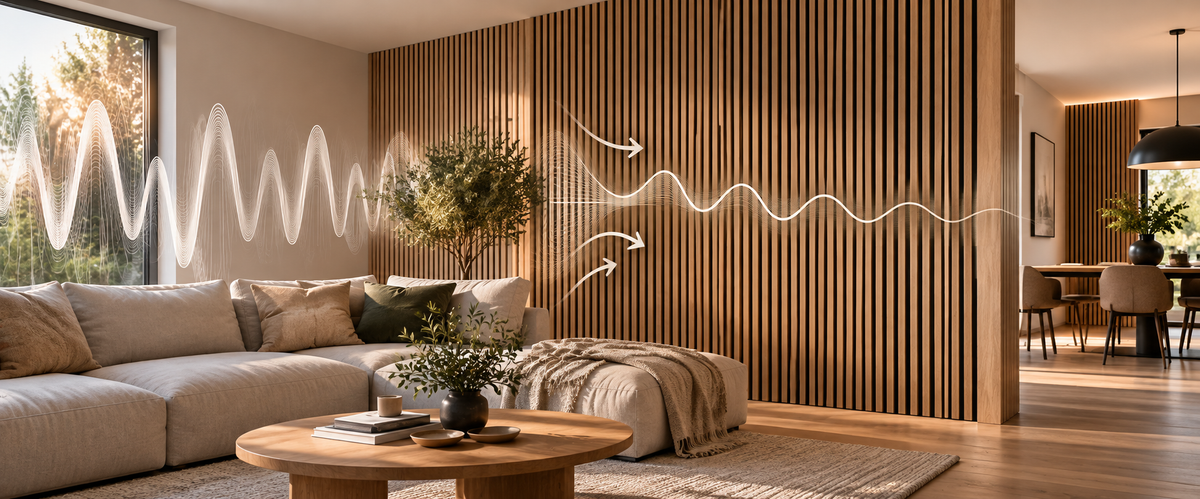
Wooden acoustic panels are increasingly common in modern homes and workplaces. They combine a clean, contemporary look with practical benefits for room acoustics, creating a calm, pleasant atmosphere. WoodUpp models stand out for their carefully chosen materials, precise workmanship and coherent design. These panels help to noticeably reduce echo and reverberation, which boosts wellbeing in a room. Below, we explain how acoustically effective wooden panels work, what to look out for when choosing them and how to use them to best effect.
How Wooden Acoustic Panels Affect a Room
In many interiors, smooth surfaces and hard floors create an irritating reverberation. This can make conversation harder and spoil the overall feel of a room. Wooden acoustic panels offer an effective solution by absorbing sound waves and significantly reducing reverberation. The effect sets in mainly above about 500 Hz. At 125 to 250 Hz, absorption is much lower, because a 125 Hz wave is around 2.7 m long, while a 21 mm panel is very thin by comparison.
WoodUpp combines MDF wood slats with a felt backing made from recycled material. This combination of materials absorbs sound and brings more calm to everyday life, particularly noticeable in open-plan living areas, home offices or meeting rooms.
With wooden acoustic panels you can specifically improve speech clarity and enhance the listening experience. Depending on how they are fitted, the sound absorption can be increased further, for example by adding mineral wool behind the panels.
What to Look Out for When Choosing
When choosing acoustic panels, material quality and construction play an essential role. WoodUpp panels consist of MDF wood slats mounted on an acoustic felt backing about 9 mm thick. Various standard sizes are available, from 60 × 60 cm to 300 × 60 cm, so rooms of different sizes can be designed flexibly. Rating follows ISO 11654: Class A stands for αw 0.90 to 1.00, Class C for 0.60 to 0.75 and Class D for 0.30 to 0.55. Typical dimensions are 600 mm wide and 2,400 or 3,000 mm long, with a total thickness of about 19 to 22 mm and a weight of around 7 to 11 kg per square metre.
The panel dimensions should suit the wall or ceiling area you have in mind. Different surface options, such as natural wood finishes, foil coatings or coloured versions, also offer plenty of scope for personalising a room. The size of the slats matters too: at around 27 mm wide and about 13 mm deep, they strike a balanced ratio between design and function.
Before buying, it is worth checking whether additional insulation such as mineral wool behind the panels makes sense. This can further improve sound insulation, especially in noisy rooms. A cavity of around 45 mm can raise the αw value from about 0.35 with direct mounting to about 0.60. With additional mineral wool, values of around 0.90 are possible in documented systems. You should also check the fire classification under EN 13501-1. B-s1,d0 means limited contribution to fire, low smoke production and no burning droplets, whereas D-s2,d2 is rated considerably lower.
Using Acoustic Panels Effectively
Acoustic panels suit many areas of the home or workplace. In the living room, they support clearer sound when watching TV and make conversations more pleasant. In home offices they reduce distracting background noise, which is especially helpful on phone calls or video conferences.
In hallways or stairwells, too, reverberation problems can be effectively eased with suitable panels. Fitting them to a wall or ceiling is straightforward, so specific zones can be acoustically optimised. Different designs add visual accents and contribute to a pleasant overall atmosphere in the room.
WoodUpp's range includes suitable solutions for both open-plan spaces and smaller rooms, each with a focus on high-quality workmanship and harmonious design.

Max Schmidt
Lokaler Experte