Emden
Verborgene Schätze: Geheimtipps in Emden
Emden is often underestimated — yet this seaport town at the mouth of the Ems hides genuine gems that even many Ostfriesland connoisseurs have yet to discover. Anyone looking beyond the well-trodden paths will find plenty here.
Part of the reason is that Emden rarely tops anyone's Ostfriesland wish list. Those heading to the north-west tend to think first of the islands, of Greetsiel with its twin windmills, or the endless dykes of the Krummhörn. Emden, meanwhile, is seen by many as a working town: harbour, shipyard, car shipments, ferry traffic to Borkum. Yet it's precisely this down-to-earth character that makes the town so surprising. Those who stay rather than pass through discover a port town with a distinctive blend of maritime grit, Dutch-influenced history and a surprisingly lively cultural scene. And above all, plenty of quiet corners that tour groups have yet to find.
We've gathered together the loveliest of these quiet spots — places where you experience Emden not as somewhere you pass through, but as a town with its own character.
The Alter Binnenhafen: morning light and flat-bottomed boats
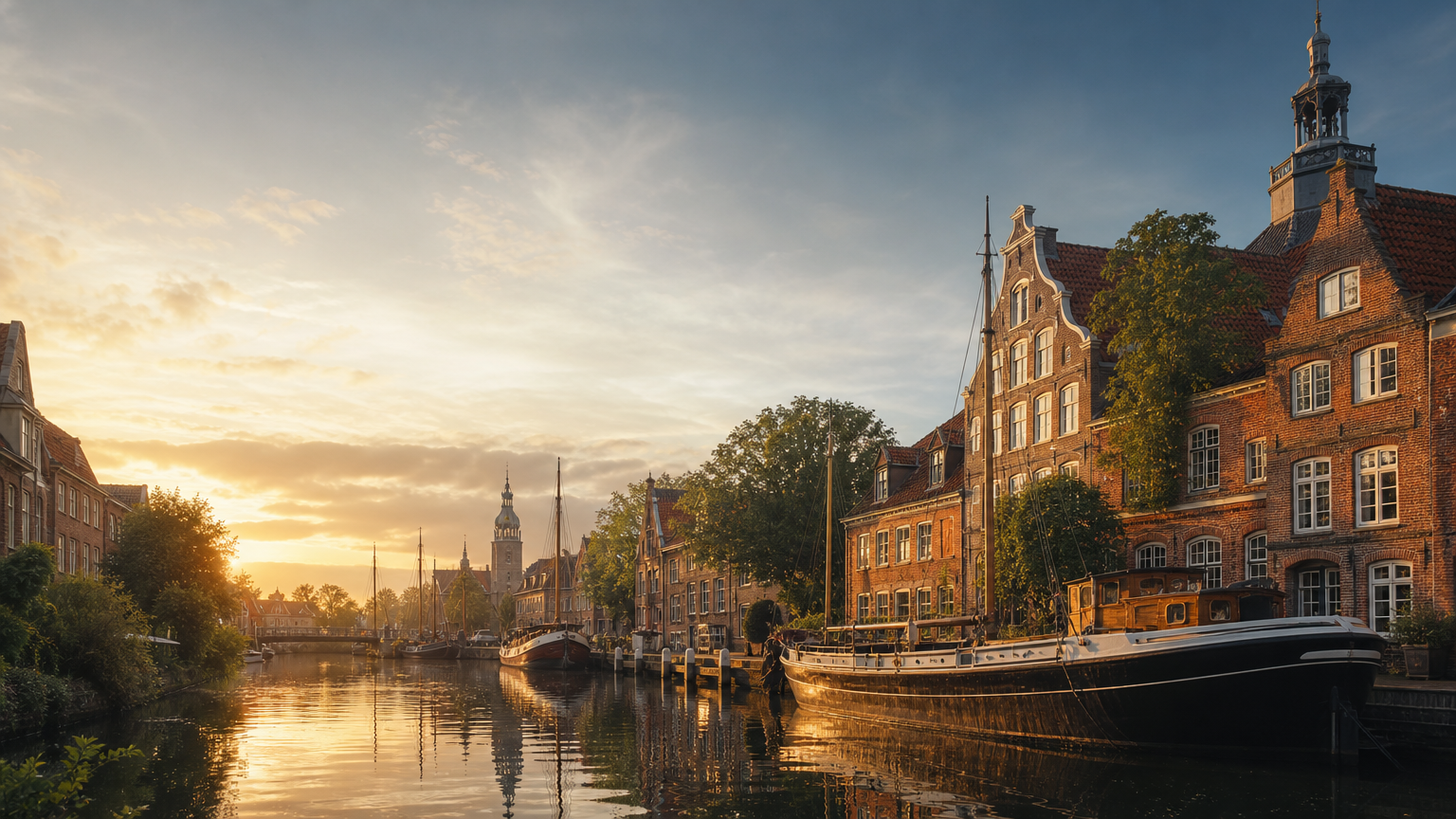
Let's start at the Alter Binnenhafen. While most visitors head straight for the town hall or the Große Kirche, a stroll along the disused harbour basin is well worth your time. Historic flat-bottomed boats lie moored here, lovingly restored and now serving as floating holiday flats. A coffee by the quay while the morning sun bathes the water in golden light — this is Emden at its most beautiful.
What makes this spot so special is its pace. While ships are being loaded and unloaded further out in the main harbour, an almost village-like calm reigns over the Binnenhafen. The water lies still, gulls perch on the bollards, and between the masts of the traditional boats you hear nothing but the rigging clattering in the wind. It's one of the few places where you can see the town's history laid out quite literally before you: for centuries, Emden was one of northern Europe's most important ports, at times even more significant than Hamburg. The flat-bottomed boats are a reminder of that era — built shallow so they could manoeuvre through the shallow waters of the Wadden Sea and the canals.
A tip for your visit: come early. Between seven and nine in the morning the light is at its most beautiful, the town is still asleep, and you'll often have the quay entirely to yourself. If you fancy extending the walk, follow the waterways further towards the Ratsdelft, where the museum ships are moored. Photographers will find the town's best shots here — reflections in the still water, historic rigging set against a modern backdrop.
The Emder Wall: a green ring around the old town
A real insider tip is the Emder Wall. The old fortification encircles the old town like a green ring, offering several kilometres of shaded footpaths, hidden meadows and viewpoints from which you can take in the town's skyline. Especially in early summer, when the rhododendrons are in full bloom, the Wall is a little paradise — and often completely deserted.
The Wall is a relic from an era when Emden was one of the most heavily fortified towns in the region. In the 16th and 17th centuries, as the town grew rapidly thanks to trade and the arrival of Dutch religious refugees, it was protected by a ring of bastions and moats. Militarily, the structure has long since been retired — but as a landscape feature, it's a stroke of luck. Instead of a ring of concrete, a green belt now surrounds the old town, with mature trees, winding paths and ever-surprising views.
The lovely thing about it is that the Wall works as a small circular walk. Walking it in full takes you round the old town in a good hour or so, giving you a sense of the town's structure that you'd never get from the streets alone. Along the way, it's worth straying from the main paths now and then — behind hedges and embankments you'll find meadows and benches where you can sit alone even on a lovely weekend. Families with children will find plenty of space to run around, joggers a varied loop free of traffic, and birdwatchers will also get their money's worth thanks to the old trees and stretches of water.
Early summer is without doubt the best time to visit. When the rhododendrons bloom, the Wall turns into a sea of colour you wouldn't expect in a port town. But autumn has its own charm too, when the leaves turn and morning mist hangs over the moats.
Coffee break in the museum courtyard
Anyone interested in culture shouldn't visit the Ostfriesisches Landesmuseum for the permanent exhibition alone. The courtyard is home to a café that serves seasonal specialities in a historic setting. The homemade East Frisian tea with Kluntje and Wolkje is particularly authentic here — and reasonably priced too.
If you're not familiar with East Frisian tea culture, do ask someone to explain the ceremony — it's more than just a hot drink. First, the Kluntje goes into the glass, a coarse white rock sugar that crackles softly as the tea is poured over it. Then comes the strong black tea, traditionally an East Frisian blend with a high Assam content. And finally the Wolkje: a spoonful of cream, carefully trickled in along the edge of the glass so it unfurls in the tea like a little cloud. You don't stir it — that's part of the ritual. The result is a flavour experience in three layers: first the cream, then the strong tea, and finally the sweetness of the sugar. Incidentally, Ostfriesland has the highest per-capita tea consumption in the world, and East Frisian tea culture has been recognised as intangible cultural heritage.
The museum's courtyard is the perfect setting for this break. Enclosed by historic walls, it's sheltered from the wind — no small consideration on the coast. Even on days when a stiff breeze is blowing outside, you can sit here remarkably well protected. And since many visitors don't even know the café exists, you'll usually find a free table even in peak season.
Die Knock: wide open space, wind and Wadden Sea
For nature lovers, Die Knock is an essential detour. This headland at the westernmost point of the Ems estuary offers sweeping views over the Wadden Sea and, on a clear day, as far as the neighbouring islands. The drive along the narrow dyke roads is an experience in itself. From summer 2026, guided mudflat walks at sunset will be offered here for the first time — an unforgettable experience.
Die Knock is the place where you understand why people have been building dykes here for centuries. The horizon is unobstructed, the sky fills two-thirds of your field of vision, and the wind sweeps in unchecked off the Ems. There's no viewing platform, no visitor centre, no souvenir stall — and that's exactly the point. You stand on the dyke, watching freighters head towards the Netherlands on one side and the flat marshland stretch out on the other, with the rare feeling of truly standing at the edge of something.
Getting the timing right matters, since the Wadden Sea is a place that transforms completely twice a day. At high tide, the flats lie under water and look like a lake; at low tide, the seabed lies exposed, criss-crossed by tidal channels, with lugworms, shellfish and flocks of birds foraging for food. It's well worth checking the tide table before you set off.
A clear safety note: the mudflats are not a place for a casual stroll. The tides come in faster than newcomers expect, tidal channels can fill unnoticed behind you, and when fog rolls in you can lose your bearings frighteningly quickly. Mudflat walks should therefore only ever be undertaken with local, trained guides — never on your own. This is exactly why guided tours, such as the planned sunset walks, are so valuable: they combine the experience with the necessary safety and knowledge of an ecosystem that forms part of the UNESCO World Natural Heritage. Sturdy footwear (or bare feet, which is better still), weatherproof clothing and a windproof jacket are essential in any case.
The Dutch legacy: Emden's second language
One aspect that many visitors only notice on closer inspection is Emden's close ties to the Netherlands. The border lies just a few kilometres away, and historically it was even more permeable than it is today. In the 16th century, thousands of Dutch religious refugees came to Emden — bringing trade connections, craftsmanship and capital with them, and turning the town for a few decades into one of northern Europe's most prosperous ports.
This influence is still noticeable today. It shows in the architecture with its distinctive gables, in street and place names, in the hydraulic engineering of the canals and waterways running through the townscape, and in a certain matter-of-fact manner familiar from the neighbouring country. Anyone walking through the old town with their eyes open will keep spotting details that look more like Groningen than northern Germany.
If you have the time, you can experience this connection first-hand too: a day trip across the border is easily done from Emden, whether by bike along the dykes, by car or by boat. And conversely, for many Dutch people, popping over to Emden for a spot of shopping or an afternoon of tea has long been part of the weekend routine. This lived two-way connection is one of the things that sets Emden apart from other German coastal towns — and one you won't find reflected in any guidebook ranking.
Practical tips for your visit
Emden is superbly suited to exploring on foot or by bike. The old town is compact, and the flat surrounding countryside makes cycling pleasant even for less experienced riders. If you want to visit Die Knock or the surrounding dyke villages, you'll often have a nicer time on a bike than in a car — the narrow dyke roads aren't built for traffic, but for taking things slow.
The best time to visit the places described here is between May and September. Early summer scores with the rhododendrons blooming on the Wall and long, bright evenings; late summer with milder water and quieter paths. But winter has its own appeal too: when storms sweep in over the Ems and the town retreats into its tea rooms, you may experience Ostfriesland at its most authentic.
One last piece of advice: don't over-plan. Emden's charm doesn't lie in a checklist of sights, but in the moments in between — coffee by the quay, a bench on the Wall, the view over the mudflats as the light begins to change.
Away from the well-worn tourist trails, Emden reveals its true character: rugged, charming and full of little surprises.
Further reading
- Beste Cafés in Emden https://www.diebestenderstadt.de/emden/beste-caf%C3%A9s-in-emden
- Beste asiatische Restaurants in Emden https://www.diebestenderstadt.de/emden/beste-asiatische-restaurants-in-emden
- Beste Bars in Emden https://www.diebestenderstadt.de/emden/beste-bars-in-emden
- Beste Eiscafés in Emden https://www.diebestenderstadt.de/emden/beste-eiscaf%C3%A9s-in-emden

Lena Hoffmann
Lena hat nach ihrer Ausbildung in der Hotellerie das Schreiben für sich entdeckt. Seit sechs Jahren testet sie Restaurants, Cafés und Weinbars — immer auf der Suche nach ehrlichem Handwerk statt Hochglanz. Ihr Motto: Die besten Lokale erkennt man an der Stammkundschaft, nicht an der Speisekarte.