Hamburg
Sustainable Shopping in Hamburg
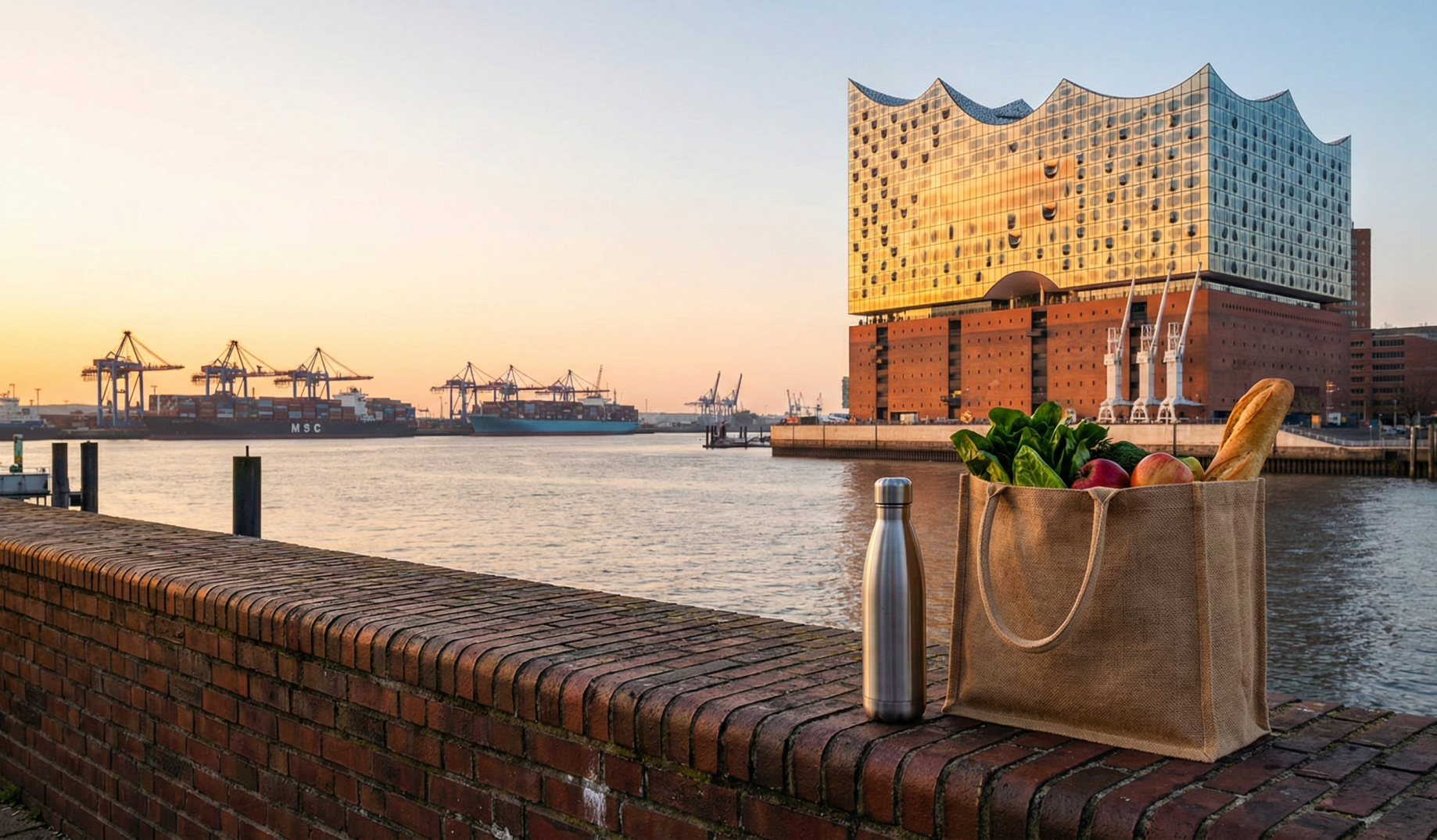
Moin Hamburg! Anyone who thinks of our proud metropolis in the north immediately has the smell of salty North Sea air in their nose, hears the rough tooting of the gigantic container ships on the Elbe and sees the majestic swans making their rounds on the Binnenalster. Hamburg is a city whose soul is inseparably linked to water. But it is precisely this deep connection with the seas and rivers that inevitably brings home to us the most dramatic ecological crisis of our time: the massive pollution of our oceans by plastic waste. The images of floating islands of plastic and entangled marine animals have long since entered our collective consciousness. In a city that prides itself on being the "gateway to the world", the sense of responsibility for that very world is therefore growing continuously. The classic weekly shop in conventional supermarkets, however, is often a real plastic nightmare. Every cucumber is shrink-wrapped individually in film, apples rest on polystyrene trays, and the organic muesli comes in a plastic bag that is in turn wrapped in a printed cardboard box. The result is an overflowing yellow recycling bag at the end of every week and the frustrating feeling of being part of an unstoppable waste machine.
But in the lively, creative districts of the Hanseatic city, a powerful, forward-looking counter-movement has formed in recent years. The zero-waste scene in Hamburg is flourishing and impressively proves that a modern, urban life is possible without gigantic mountains of waste. package-free shops are long since no longer tiny, dusty niche projects for die-hard eco-warriors. They have developed into ultra-modern, aesthetically appealing and professionally run feel-good havens that are revolutionising sustainable shopping in Hamburg. It is about far more than simply doing without packaging; it is a conscious return to the true value of food, a celebration of regional produce and a deep commitment to a functioning circular economy. This immensely detailed, wide-ranging guide takes you on an in-depth journey through the multifaceted package-free landscape of the Hanseatic city. We explore the philosophy behind loose shopping, roam the different districts in search of the best addresses and show you how these shops not only protect our environment but also radically slow down and enrich the way we consume.
The Psychology and Philosophy of Package-Free Consumption: A Return to Sensuality
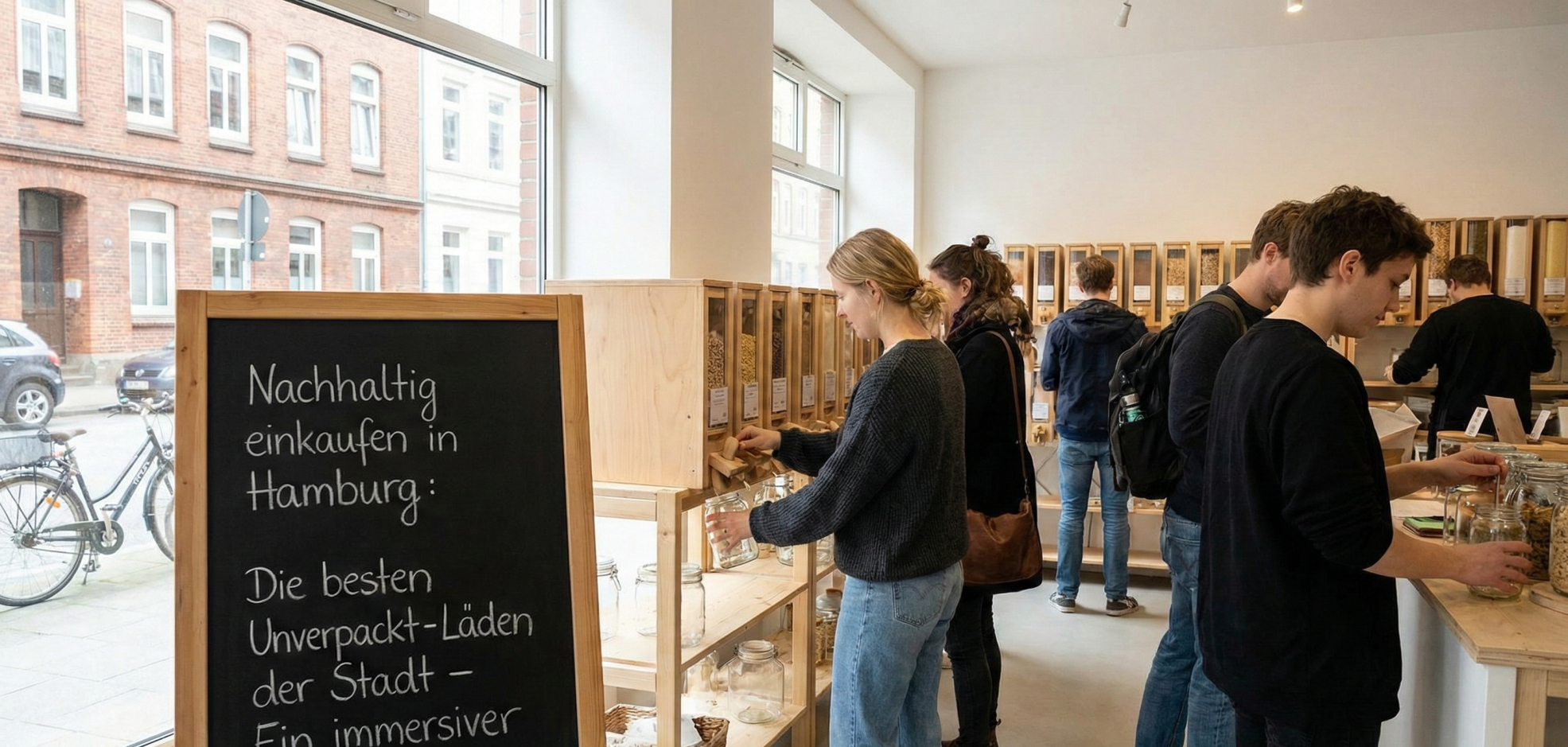
To truly grasp the immense appeal of Hamburg's package-free shops, you must first understand the deeper philosophy and the psychological effects of zero-waste shopping. When we enter a conventional supermarket, our senses are immediately attacked by a loud, colourful and aggressive cacophony of marketing messages, garish logos and artificial lighting. The actual food disappears behind layers of glossy plastic and printed cardboard. Often we no longer buy food but promises printed on packaging by marketing departments. Shopping in a package-free shop, by contrast, forces us into a radical, healing change of mindset. Here there are no screaming advertising slogans vying for our attention. The stars in these shops are the food itself. The transparency of the large glass containers and dispensers, the so-called gravity bins, reveals the honest, unvarnished texture of the products. You see the countless shades of red, yellow and black lentils, you recognise the character of different types of rice and you can judge the quality of nuts and dried fruit with the naked eye before you have paid a single cent for them.
This act of shopping is deeply sensual and satisfying. The gentle rustle as oats trickle from the dispenser into the storage jar you have brought, the intense, unadulterated scent of spices that rises to your nose when the large stainless steel containers are opened, and the satisfying feeling of holding the exact weight of your food in your hands: all of this turns shopping from a tiresome chore into a mindful ritual. Added to this is the immense psychological liberation: anyone who makes plastic-free shopping in Hamburg part of their routine very quickly feels the oppressive burden of constantly producing waste fall away. The moment when you come home after a big shop, put your full, beautiful jars on the shelf and in the end do not have to throw anything, absolutely nothing, into the bin is a moment of pure triumph over the throwaway society. Beyond that, this system forces us to critically question our actual needs. As you are no longer tied to preset 500-gram packs, you buy exactly the 70 grams of that exotic spice you need for a particular recipe. This not only saves a great deal of money but is also the most effective weapon against rampant food waste, which has reached gigantic proportions in Western societies. It is a form of consumption that shows respect for nature's resources and the hard work of producers.
Stückgut in Ottensen and St. Pauli: The Bold Pioneers of Hamburg's Zero-Waste Movement
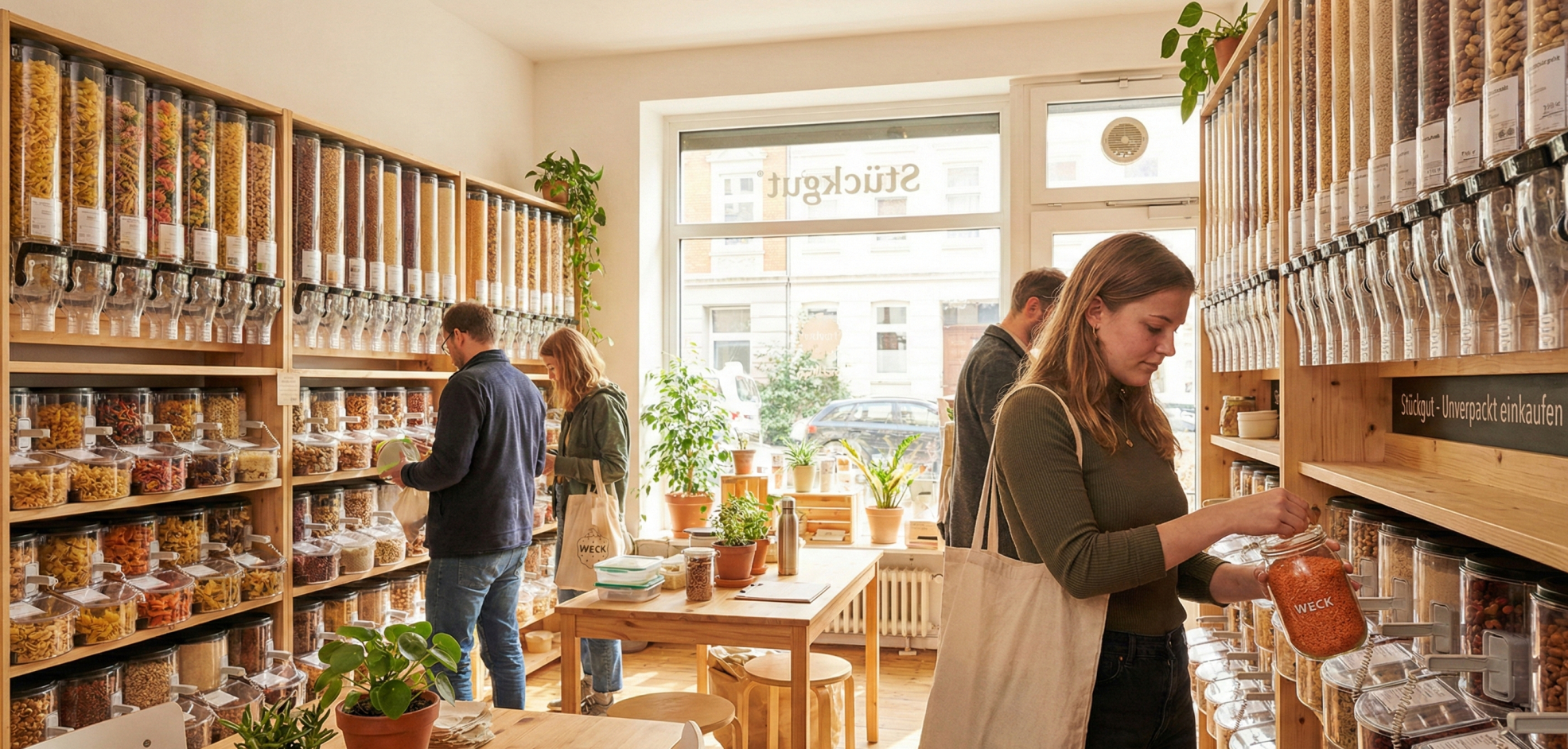
When telling the story of the package-free movement in the Hanseatic city, you inevitably have to begin with "Stückgut". The founders of this concept store were absolute pioneers who dared to take the bold step when the concept was still in its infancy in Germany. Starting in the heart of the lively Ottensen district, shaped by a strong neighbourhood culture, Stückgut has not only proved that a package-free supermarket can work economically but has also contributed significantly to normalising this way of shopping. By now its success has led to a second, equally popular branch in bustling St. Pauli. When you cross the threshold of Stückgut, you are immediately enveloped by an atmosphere that leaves the sterile character of large supermarket chains miles behind. The premises are characterised by warm, light wood, clean lines and a perfect, calming order. The walls are lined with hundreds of dispensers that look like an artful mosaic wall of food.
The range at Stückgut has an impressive depth and breadth that makes it easy to do a family's entire weekly shop here. You find not only a huge selection of staple foods but also fresh, regional vegetables, hand-baked bread from local organic bakers and an exquisite selection of loose teas and coffee beans. But Stückgut is far more than a mere supply station. The shops have developed into genuine social hubs in their respective districts. The staff are not simply there to take the money but act as passionate ambassadors for sustainability. They take the time to patiently explain the weighing process (the so-called tare principle) to first-time visitors, advise on choosing the best grains or discuss the ingredients of natural cosmetics. For people who drop by spontaneously and have no containers of their own with them, cleaned jars donated by the neighbourhood are always ready, a wonderful example of solidarity in action. Stückgut has proved that shopping sustainably in Hamburg does not mean going without but is a gain in community, aesthetics and uncompromising quality.
Bio lose in Eimsbüttel: Neighbourhood Cosiness Meets Uncompromising Organic Quality
In the heart of Eimsbüttel, one of Hamburg's most popular and family-friendly districts, on the busy Osterstraße, there is a shop that has raised package-free shopping to a new level of quality: "Bio lose". The name of the shop is not a mere description but an unshakeable promise to customers. While other loose-goods shops sometimes add conventional products to their range to push down prices, Bio lose is committed to uncompromising, certified organic quality. This shop proves that the ideals of zero waste and organic, pesticide-free farming complement each other perfectly and together form the spearhead of a genuine consumer turnaround. The customers in Eimsbüttel, who traditionally place great value on healthy eating and ecological responsibility, have long since made this place their culinary living room.
The atmosphere in Bio lose recalls the loving, personal service of a traditional corner shop, catapulted into modern times. The space is bright, friendly and radiates a deep calm that immediately lets you wind down after a stressful working day. The range of dry goods is overwhelming, but the real jewel of this shop is its strong focus on regional produce and freshness. The owners cultivate close, personal relationships with farmers and producers from the Altes Land, the Vierlande and the immediate surroundings in Schleswig-Holstein. This not only saves plastic packaging but also guarantees extremely short transport routes, which minimises the CO2 footprint of every single item of food. An absolute highlight for many regulars is the great package-free fresh counter. Here you can have the finest regional cheeses, fresh antipasti and delicious olives filled directly into your own tubs or stainless steel boxes, a service that at conventional supermarket counters often fails because of strict (and often misinterpreted) hygiene regulations and a flood of coated paper. Anyone who shops at Bio lose not only supports the idea of waste reduction but actively promotes regional organic farming around the Hanseatic city.
Twelve Monkeys on St. Pauli: Vegan Consistency and Subcultural Kiez Charm
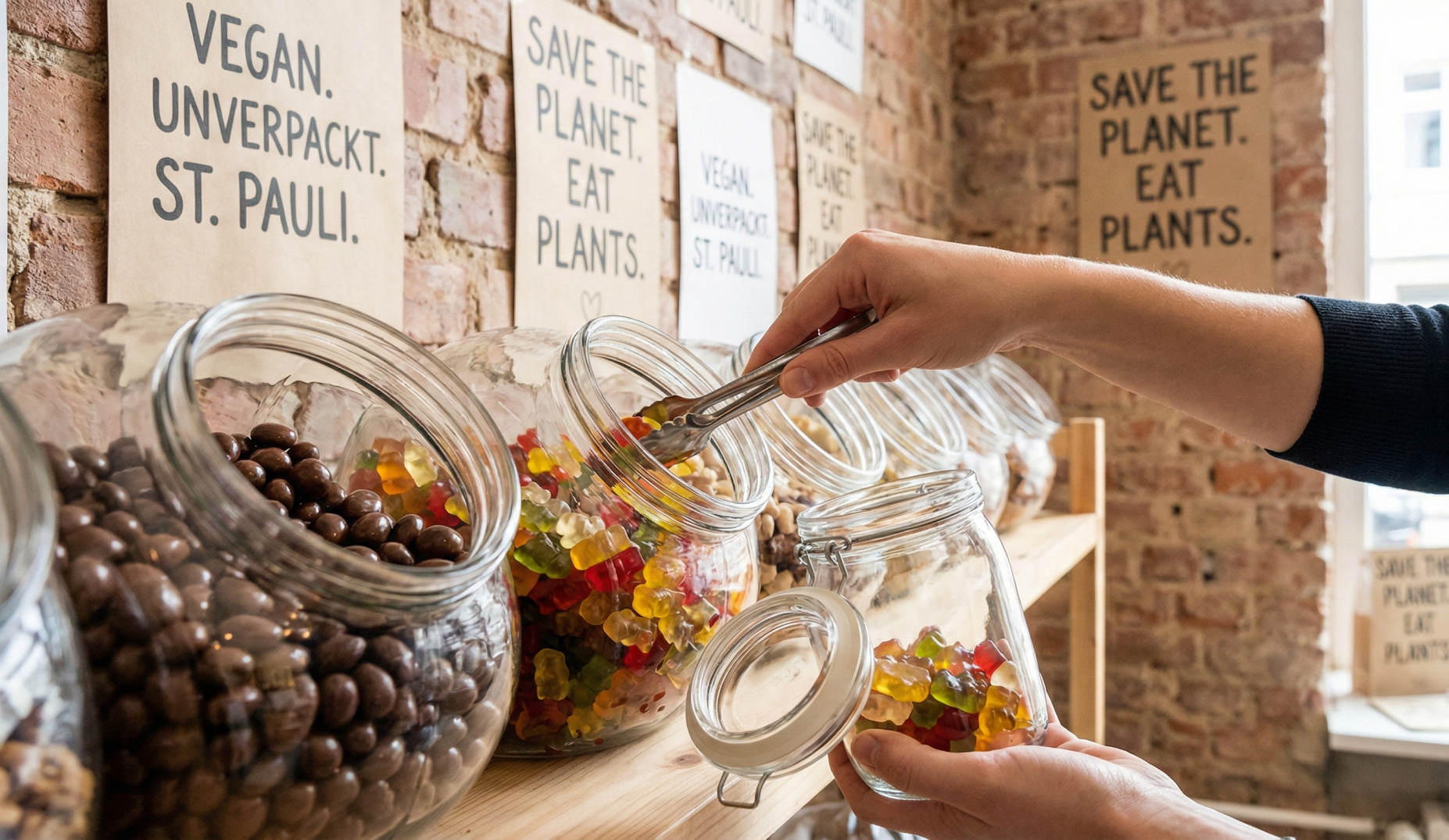
If you go looking in Hamburg for the most radical and innovative concepts, the path leads inevitably to St. Pauli. This district, known far beyond the borders of Germany for its Reeperbahn, its lively subculture and its pronounced political activism, is home to a package-free shop that has few equals worldwide: "Twelve Monkeys – Vegankrams". Originally founded as Germany's first purely vegan supermarket, the team drew the logical conclusion and consistently switched the concept to zero waste. The philosophy behind it is perfectly clear: anyone who, for ethical or ecological reasons, decides against the exploitation of animals and lives vegan generally does not want the environment destroyed by gigantic amounts of plastic waste either. Twelve Monkeys unites these two massive sustainability movements under one roof and thus creates an absolutely safe haven for conscious consumers.
The vibe in this shop is through and through St. Pauli: it is somewhat louder, more colourful, more unconventional and gloriously nonconformist. The walls are often adorned with small works of art by local artists, and the atmosphere is shaped by a deep, almost familial solidarity. Probably the biggest and most liberating advantage for people who live vegan here is the absolute peace of mind. In conventional supermarkets, or even in other package-free shops, vegans often have to laboriously study tiny ingredient lists or ask the staff whether animal-derived processing aids were used in production. At Twelve Monkeys this stress disappears completely: everything you fill into your jars here is one hundred per cent plant-based. The range goes far beyond simple oats and pasta. The shop is famous for its incredible selection of vegan specialities that you can otherwise hardly find loose. From a huge wall of package-free vegan fruit gums to special plant-based protein powders, fine nutritional yeast flakes and vegan chocolates and baking ingredients, nothing is left to be desired. Twelve Monkeys proves that vegan enjoyment and absolute waste avoidance can go hand in hand, wrapped in the unmistakable, rough charm of the Hamburg Kiez.
Monger Store & Deli in Hoheluft: When Sustainable Consumption Meets Scandinavian Design Aesthetics
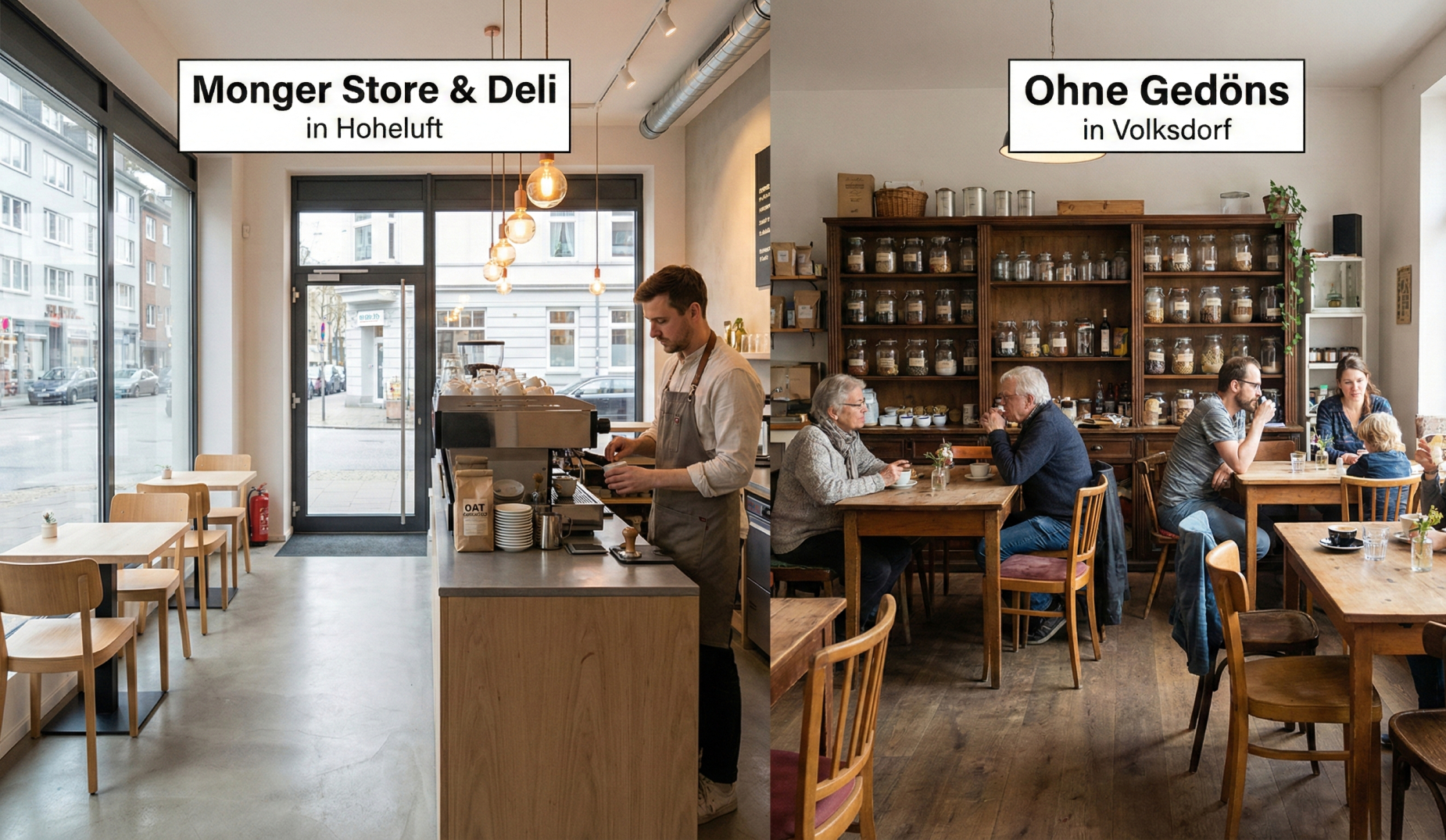
For a long time the environmental movement, and the early organic shops in particular, was saddled with the stubborn cliché of scratchy jumpers, jute bags and a certain visual dreariness. That radical sustainability, zero waste and the highest aesthetic standards of modern design need not be contradictions is proved in breathtaking fashion by the "Monger Store & Deli" in the elegant district of Hoheluft-West. This shop has taken the concept of package-free shopping and run it through the filter of modern, minimalist Scandinavian design. The result is a concept store furnished so incredibly stylishly and harmoniously that it would fit effortlessly into the pages of the leading international architecture and lifestyle magazines. Monger thus reaches precisely the target group that wants a sustainable lifestyle but does not want to give up urban elegance and an exclusive shopping experience.
The space impresses with clean lines, subtle colours, lots of glass, fine wood and lighting that stages every single item of food like a small work of art. The range of loose foods is carefully and highly curated, with an extreme focus on artisan quality and special culinary experiences. Alongside the absolute basics you find outstanding olive oils, rare spice blends, fine broken chocolate and a selection of coffee beans that makes every barista's heart beat faster. What sets Monger apart, however, is the superb combination of a package-free shop and a high-quality deli. The integrated café offers a fantastic selection of plant-based lunch bowls, homemade vegan cakes and outstanding speciality coffees. This fusion makes Monger a place to linger. You do not rush through the aisles here to stock up on supplies; you celebrate the shop. You meet friends here for an oat cappuccino, work on your laptop for an hour and, quite incidentally, fill your jars completely relaxed and in beautiful surroundings with the best ingredients for dinner. Monger Store & Deli proves that shopping sustainably in Hamburg can be an absolute lifestyle factor.
Ohne Gedöns in Volksdorf and the Streubar in Barmbek: Zero Waste Conquers the Districts
A decisive indicator that the zero-waste movement has not remained an elitist, hip fad of the central trendy districts is its successful expansion into Hamburg's surrounding, highly mixed districts. If you leave the urban bustle behind and travel to Volksdorf in the green north-east, you come across "Ohne Gedöns". The name of this charming shop is a wonderful piece of Hanseatic understatement and at the same time the perfect mission statement. Located in the heart of the Walddörfer, this shop has brought plastic-free shopping into a village-like, family setting. Things are unfussy, honest and deeply down-to-earth here. The atmosphere is like a good friend's living room. They know the regulars by name, take endless time for a good chat at the till and give advice with great passion. Ohne Gedöns also has a cosy café area, which has made the shop an important social meeting point in the district. Families, senior citizens and young couples buy their loose organic food here as a matter of course, as if there had never been any other way of consuming.
A different but equally important urban contrast is provided by the "Streubar" in dynamic Barmbek, historically shaped more by the working class. The Streubar has proved that package-free shops work not only in villa districts but also in areas that value pragmatism, good prices and clear functionality. The shop in Barmbek-Nord is bright, extremely easy to navigate and perfectly tuned to an efficient weekly shop. The range is fantastically extensive and leaves practically nothing to be desired. The Streubar sees itself, however, not merely as a retailer but as an active place of education and encounter for sustainability in practice. Through regular, well-attended workshops on topics such as "making your own natural cosmetics", "fermentation for beginners" or information evenings on avoiding waste in everyday life, the Streubar team empowers the neighbourhood to regain control over its consumption. Shops like Ohne Gedöns and the Streubar are the true silent heroes of Hamburg's zero-waste scene, because they carry the idea into the breadth of society and anchor plastic-free shopping deep in ordinary Hamburg everyday life.
Beyond Food: The Plastic-Free Revolution in the Bathroom and Around the House
When people talk about package-free shopping, their first thoughts almost always revolve around muesli, pasta and rice. A closer look into your bin at home, however, quickly reveals that a massive, often ignored share of our daily plastic waste arises not in the kitchen at all but in the bathroom and the cleaning cupboard under the sink. Hamburg's package-free shops recognised this long ago and have developed into true pioneers of non-food sustainability. Anyone who enters the drugstore corner of a well-stocked loose-goods shop for the first time enters a world of innovation with the potential to turn our everyday lives completely upside down. The madness of conventional shampoos and shower gels, which often consist of eighty per cent water and are transported around half the world in thick plastic bottles, ends here.
In their place come solid, highly concentrated alternatives. The shelves smell intensely of the essential oils in solid shampoos, so-called shower bars and hand-boiled soaps, often made in tiny regional workshops around Hamburg. A single such bar easily replaces up to three large plastic bottles, goes extremely far, is perfect for hand luggage when travelling and is kinder to waterways, as it is mostly free of microplastics and questionable silicones. Daily dental hygiene too can be made completely waste-free here: instead of tubes that are hard to recycle, there are small, effective toothpaste tablets that you simply chew in your mouth before brushing with a compostable toothbrush made of fast-growing bamboo.
Even greater savings potential lies hidden in household cleaners. In shops such as Stückgut or the Streubar there are gigantic stainless steel barrels from which you can draw liquid laundry detergent, washing-up liquid, all-purpose cleaner and fabric softener directly into the empty plastic bottles you have brought from home. It is a fascinating form of direct recycling. But the absolute supreme discipline of sustainable housekeeping is the do-it-yourself (DIY) corner. The shops offer all the essential building blocks, pure bicarbonate of soda, washing soda, citric acid, curd soap and acetic essence, in loose form. With these few completely natural and biodegradable ingredients and the help of recipe cards provided, you can make almost all specialist cleaners yourself for a fraction of a cent. This reclaiming of old knowledge not only makes you independent of the chemical industry but also cleans the home effectively without burdening Hamburg's waterways with aggressive surfactants.
Hamburg's Weekly Markets and the Legendary Isemarkt: The Historic Tradition of Package-Free Shopping
For all the enthusiasm for the modern, innovative zero-waste boutiques and concept stores, we must not forget that package-free shopping in Hamburg is not an invention of the 21st century but has a deeply rooted, centuries-old historic tradition. Before supermarkets and plastic packaging conquered the world, shopping at the market was the absolute norm. Fortunately, Hamburg has one of the liveliest, most varied and highest-quality weekly market cultures in all of Europe. These markets are the natural, historic allies of the modern package-free shops and complement their dry range perfectly with fresh, seasonal produce straight from the producer. Anyone who wants to close the loop of sustainable shopping in Hamburg cannot avoid a visit to the market.
The undisputed king among these markets is the legendary Isemarkt in Eppendorf. Twice a week, on Tuesdays and Fridays, the space of almost a kilometre under the historic steel viaduct of the U3 underground line turns into a pulsating, loud and colourful open-air department store. Sheltered from typical Hamburg foul weather, hundreds of traders from the metropolitan region, the Altes Land and the Lüneburg Heath offer their wares here. Shopping at the Isemarkt, or at the equally charming markets on the Goldbekufer in Winterhude or the Spritzenplatz in Altona, is a lesson in direct communication. If you step up to the stall here with your own jute bags, tubs and beeswax wraps and ask politely, "Could you please put the apples and the piece of mountain cheese straight in here?", you rarely get surprised looks, but usually an approving nod. The traders have long been used to it and appreciate customers who want to avoid waste. Here you do not shop anonymously; you talk to the farmer about this year's apple harvest, get advice from the cheese seller and support the local economy in the most direct way. The combination of the modern dry range of the package-free shops and the regional freshness of Hamburg's weekly markets is the ultimate, absolutely unbeatable recipe for a truly sustainable, healthy and enjoyable life in the Hanseatic city.
Conclusion: The Plastic-Free Turnaround Starts Right Here and Now
The in-depth journey through Hamburg's multifaceted package-free landscape impressively proves that a more sustainable, plastic-free lifestyle is long since no longer an unattainable utopia. The Hanseatic city has created an infrastructure that enables every single citizen to make a massive contribution to protecting the environment immediately, without big detours and without loss of quality of life. From the pioneering, communal beginnings in Ottensen through the stylish, design-oriented elegance in Hoheluft to the pragmatic supply in Barmbek, the network of zero-waste concepts is densely woven and highly professional. Each of these shops is far more than a place of pure consumption; they are beacons of hope, places of education for a more conscious use of resources and living proof that economic success and ecological responsibility can go hand in hand.
Switching to package-free shopping does not require a radical break overnight, which often only leads to frustration. It is a steady, exciting voyage of discovery. It may begin with replacing lugging heavy water bottles by drinking Hamburg tap water, next swapping the plastic toothbrush for a bamboo version and finally plucking up the courage to take the first, curious step into a package-free shop armed with a few empty jam jars. Every single plastic bag saved through this step, every gram of microplastic that is not washed into the Elbe, is a magnificent victory for our global ecosystem. Hamburg makes it easy for us to be pioneers in our own everyday lives. The shelves are full, the scales are tared and the dedicated shop owners are just waiting to accompany you on this liberating path. Pack your bags, grab your jars and become part of this wonderful, quiet culinary revolution. The future of shopping is loose, it is honest and it begins right now, in the middle of Hamburg.

Sarah Müller
Reise- und Lifestyle-Journalistin