Hamburg
Street Food Markets in Hamburg: Where the Food Tastes Best
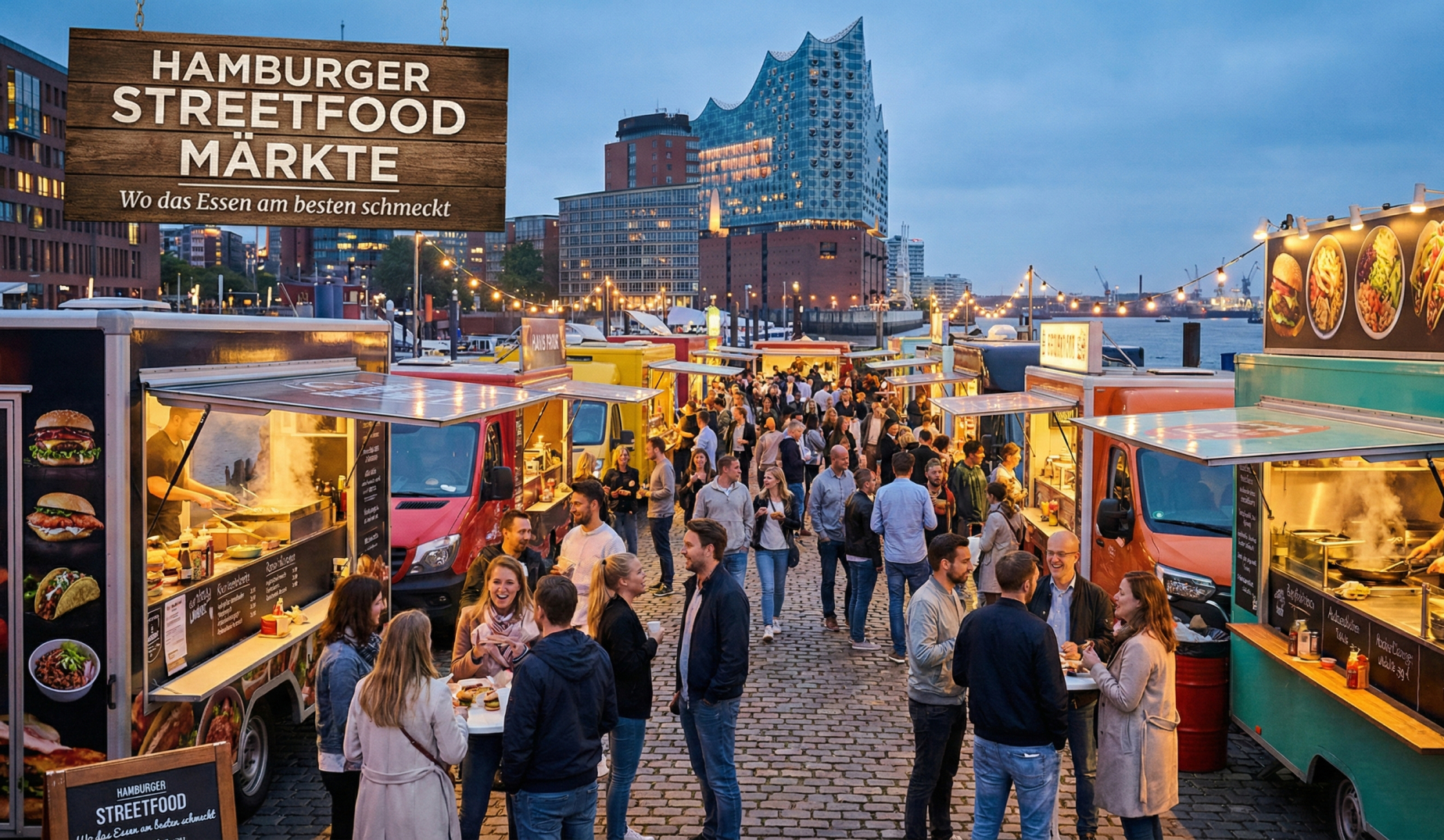
Moin and welcome to the bubbling, steaming and aromatic heart of the north! The Hanseatic city of Hamburg, once known primarily for its cool-headed merchants, its rugged harbour and traditional fish dishes, has undergone an almost explosive culinary metamorphosis. Anyone strolling today through the streets, across the squares and along the canals of the Elbe metropolis witnesses a remarkable gastronomic revolution. Street food in Hamburg is long since no longer just the fish roll wolfed down standing up at the Landungsbrücken or the currywurst thrown into greasy cardboard after a night of partying on the Kiez. It has grown into an art form of its own, a serious branch of gastronomy that bundles creativity, craft and cosmopolitanism into a few square metres in converted delivery vans and historic Airstreams.
The development of Hamburg's best street food markets reflects the soul of the city: it is international, a little nonconformist, rooted in craft and above all incredibly diverse. The influences from all over the world that were washed into the city through the harbour over the centuries now manifest themselves in Korean bao buns, authentic Mexican tacos, Peruvian ceviche and vegan burgers that make even hardened carnivores rave. Anyone who wants to taste the true, present-day Hamburg does not book a table at a sterile star-rated restaurant, but mingles with the crowd at the city's numerous food markets. This guide takes you on a profound, sensory journey to the places where the pans sizzle, the grills smoke and the city's real culinary trends are born.
The Urban Heartbeat: St. Pauli Nachtmarkt and the Spielbudenplatz
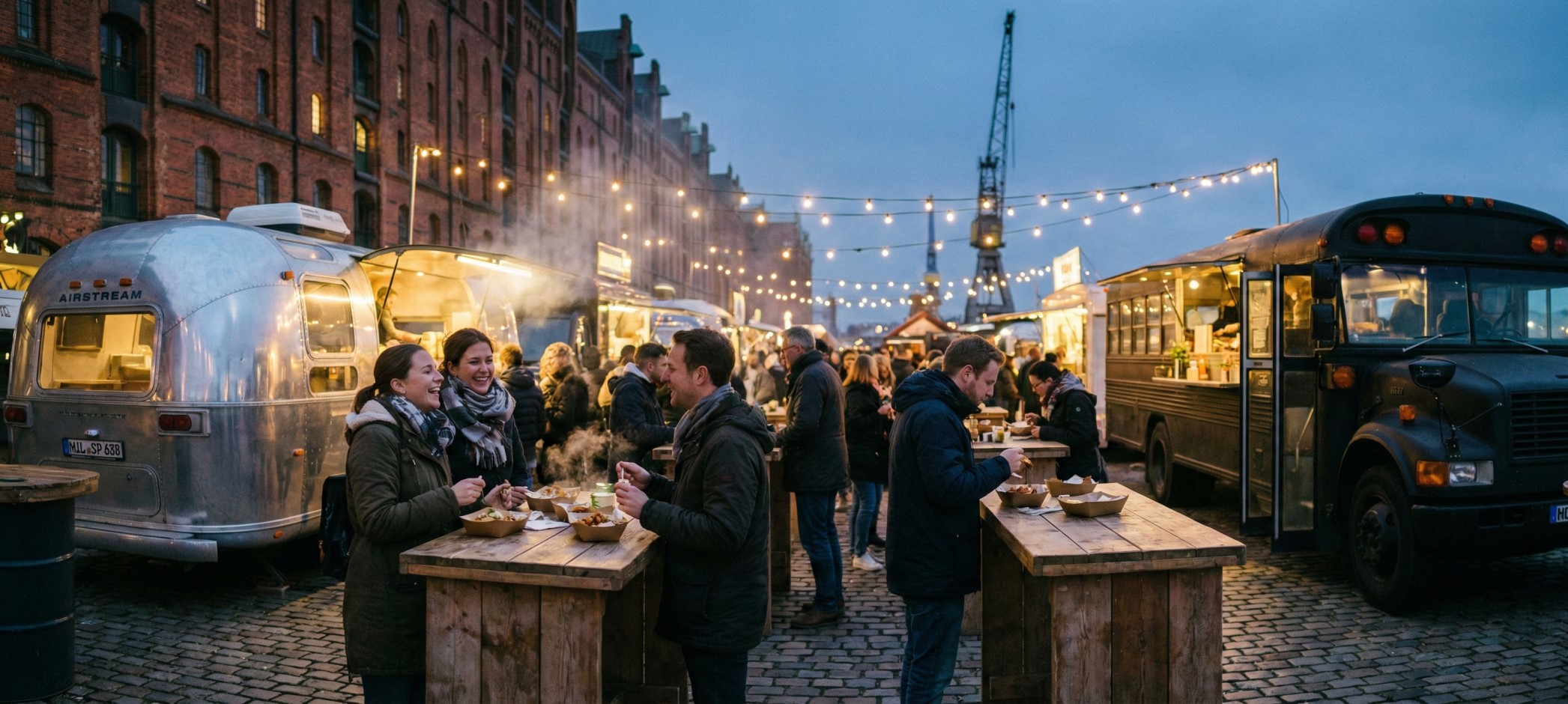
When Wednesday evening settles over the Reeperbahn and the garish neon signs of the clubs, theatres and bars slowly awaken, the historic Spielbudenplatz turns into the epicentre of Hamburg's street food culture. The St. Pauli Nachtmarkt is a phenomenon known far beyond the city limits. Here the classic weekly market, where residents buy fresh fruit, regional vegetables from farmers in the Alte Land or cheese specialities, merges seamlessly with a pulsating open-air restaurant. You step onto the square and are immediately enveloped in a cacophony of smells and sounds. The hiss of hot fat in which crispy falafel balls are being fried mingles with the scent of charcoal, on which thick, juicy beef patties for gourmet burgers are sizzling.
The mix of visitors at this particular street food market in Hamburg is as diverse as the district itself. Here, bankers in tailored suits ringing in the end of their working day stand next to students, Kiez originals and curious tourists. You join the queues in front of the food trucks, exchange glances and recommendations and enjoy the most urban form of dining. The culinary range is breathtaking. While at one end of the square a food truck from the region layers hand-pulled pork into soft brioche buns and drizzles it with a smoky, homemade barbecue sauce, just a few metres further on a start-up serves vegan Thai curries that taste so authentic you would think you were at a night market in Bangkok. Particular highlights are the seasonal special events that take over the Spielbudenplatz. The traditional "Angrillen" (the first barbecue of the year) in spring turns the area into a paradise for BBQ lovers, while the "Vegane Straßenfest" in summer proves how innovative and full of flavour plant-based cooking can be, far from all clichés. The large, multi-day food truck festivals that take place right here several times a year then attract dozens of the best kitchens on wheels from all over Germany and turn St. Pauli into the undisputed mecca for street food enthusiasts. If you want to extend the evening afterwards, you will find some of the best bars in Hamburg within easy walking distance around the Kiez.
Refined Pleasures Under the Steel Viaduct: The Isemarkt
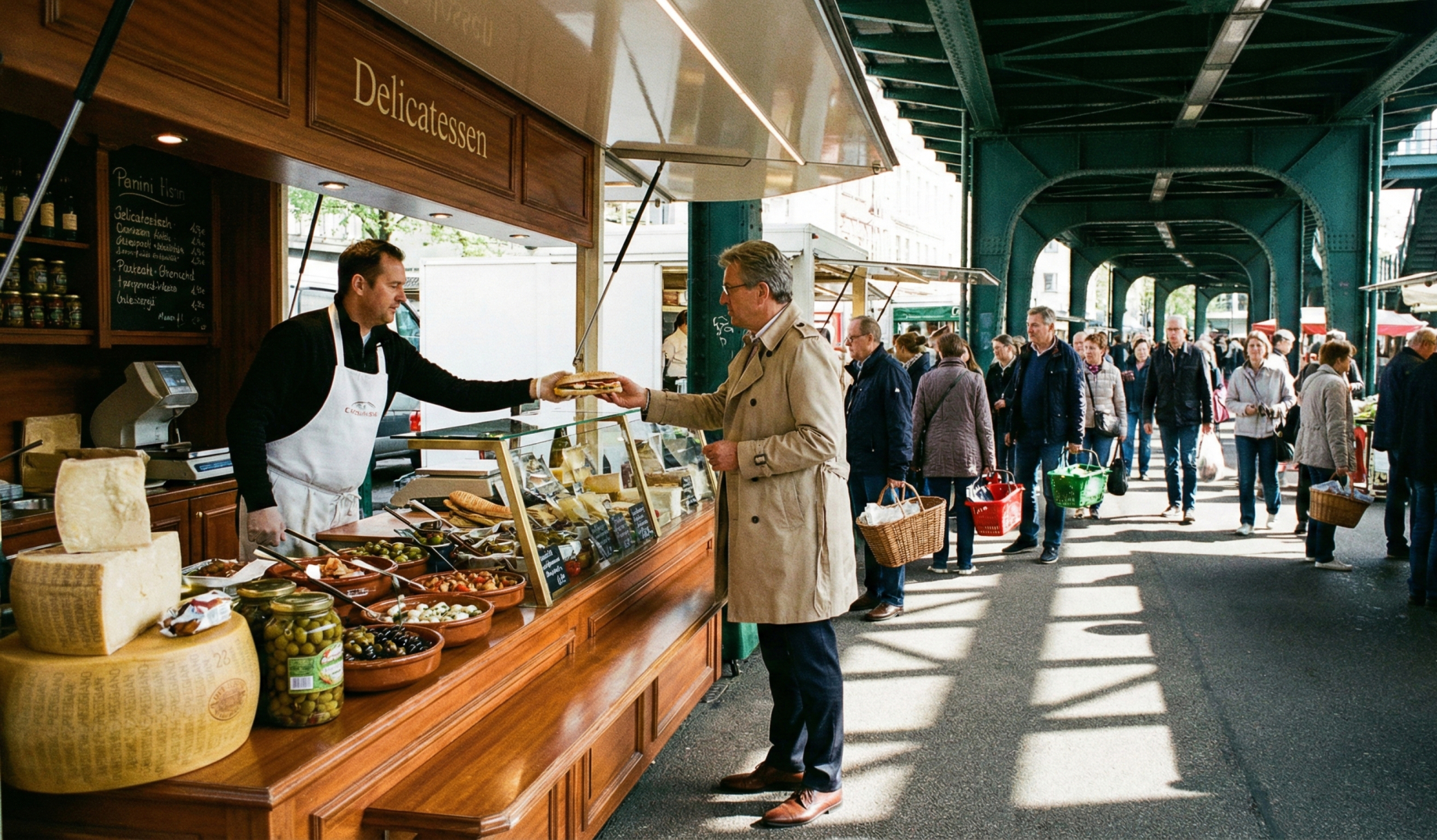
A contrast as great as it could be to the rugged charm of St. Pauli is found in the upmarket districts of Eppendorf and Harvestehude. Here, sheltered beneath the monumental steel elevated viaduct of the U3 underground line, the Isemarkt stretches out twice a week. At almost a kilometre long, it is considered the longest open-air market in Europe and is an absolute institution. Although at its core it is a classic weekly market for the finest weekly shop, it has quietly become one of the most exclusive places for street food in Hamburg. The setting is unique: overhead, the yellow underground train rattles past at regular intervals, while down on the asphalt there is a busy but always refined bustle.
Anyone visiting the Isemarkt at lunchtime embarks on a delicatessen expedition. The street food experience here is shaped less by loud food trucks with garish logos than by long-established traders and specialised producers who offer their high-quality goods for eating on the spot. You stroll past stands that open freshly caught oysters, which you enjoy in style with a glass of ice-cold Chablis or champagne right at the standing table. There is a scent of freshly baked sourdough bread from local organic bakers, of oriental spices and of roasted coffee. An absolute must for foodies are the Italian delicatessen stands. Here, crispy panini are filled before the customers' eyes with wafer-thin sliced San Daniele ham, fresh rocket and creamy truffle pecorino and served hot from the contact grill. The regional soup kitchens, which simmer seasonal stews in large pots, from the classic potato soup with North Sea shrimp in winter to light, vegan gazpachos in summer, also attract hundreds of suit wearers from the surrounding law firms and agencies in their lunch break. The Isemarkt impressively proves that street food does not necessarily have to mean hipster culture, but can also exist as a lived, long-established delicatessen culture in public space.
Architecture Meets Aromas: The Food Lovers Market in the HafenCity
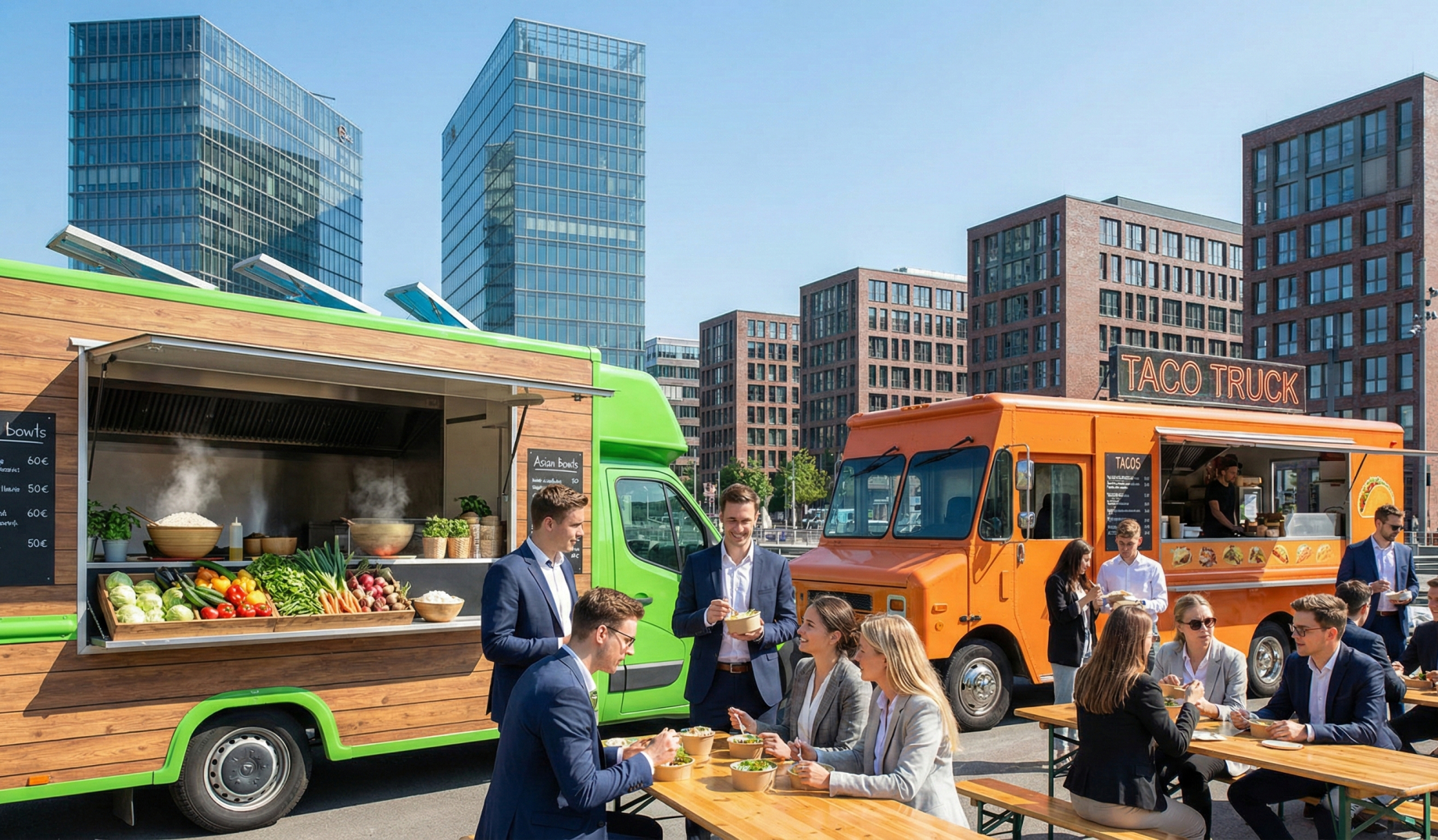
While St. Pauli stands for the tradition of going out and Eppendorf for classic elegance, the HafenCity represents modern, forward-looking Hamburg. In the midst of spectacular contemporary architecture, surrounded by water basins, the Elbphilharmonie and glass office complexes, a completely new kind of street food culture has established itself. The "Food Lovers Market", which takes place regularly on the Überseeboulevard, is the modern answer to the culinary needs of a globalised working world. On market days in the middle of the week, the square turns into a gigantic open-air canteen for the thousands of employees who work in the surrounding company headquarters.
The picture is fascinating: between the strict, geometric lines of HafenCity architecture, colourful, lovingly restored vintage vehicles and modern, high-tech food trailers are parked. Lunch breaks are celebrated here. Instead of a sad sandwich in front of a computer monitor, you meet here on the boulevard to sample your way through the world's kitchens. Competition among the operators is fierce, which leads to enormously high quality and constant innovation. Here you find the perfect Turkish manti dumplings with garlicky yoghurt and paprika butter, alongside food trucks that specialise exclusively in the art of the perfect sweet potato fries with homemade truffle mayonnaise. Asian cuisine is also strongly represented here, often in the form of quick, healthy dishes such as Vietnamese pho soups or Japanese donburi rice bowls that provide energy for the second half of the day. The contrast between the smooth façades of the HafenCity and the rustic, handmade street food gives this market a dynamic all of its own, an urban one.
Maritime Heritage and Raw Authenticity: The Myth of the Fischmarkt and the Streets of Altona
Any discussion of food on Hamburg's streets would be incomplete without paying tribute to the legendary Altona Fischmarkt. It is the rawest, most original and perhaps most honest street food experience this city has to offer. When, in the summer months, the sun slowly rises at dawn over the Elbe and the huge harbour cranes, tens of thousands of people are already crowding along the water. The market criers shout each other down with hoarse voices, while the dull bass of live bands is already thumping from the historic fish auction hall.
From a purely culinary perspective, the Fischmarkt is not an address for delicate tweezer-food dining. Here it is all about the fundamentals. The fresh fish roll straight from the fishing boat is the ultimate Hamburg street food. Whether tender, salty matjes, sourly marinated Bismarck herring or the noble, slightly sweet North Sea shrimp, paired with a dollop of remoulade in a crusty roll, the taste of sea, salt and wind is ever-present here. For the night owls who make a pilgrimage from the Reeperbahn straight to the Elbe, the numerous stands offer hearty foundations in the form of smoky bratwursts and thick neck steaks in a roll. But maritime street food in Altona and the surrounding area is changing too. Away from the pure tourist magnet of the Fischmarkt, towards innovative concepts. Local restaurants and small snack bars such as the unassuming but legendary Veddeler Fischgaststätte (which is geographically on the other side, but breathes the same spirit) show how traditional fried fish has to taste today. At the same time, concepts that interpret the theme of "seafood" in a modern way are establishing themselves on squares such as the Altonaer Balkon or at events such as the Street Food Session on Große Elbstraße, for example in the form of fried calamari with yuzu mayonnaise or North German fish and chips with locally brewed craft beer.
Travelling Gourmet Circuses: Big Festivals and the Global World of Flavour
Hamburg's food culture is dominated not only by the permanent weekly markets, but to a considerable extent by the massive street food festivals that, like travelling circuses of good taste, visit the city for a few days. The sprawling Heiligengeistfeld, known to most people as the home of the Hamburger Dom (which, incidentally, with its stalls for Schmalzkuchen and Dinnete represents a traditional street food universe of its own), or areas such as the Cruise Center Altona, regularly turn into epic festival landscapes for gourmets.
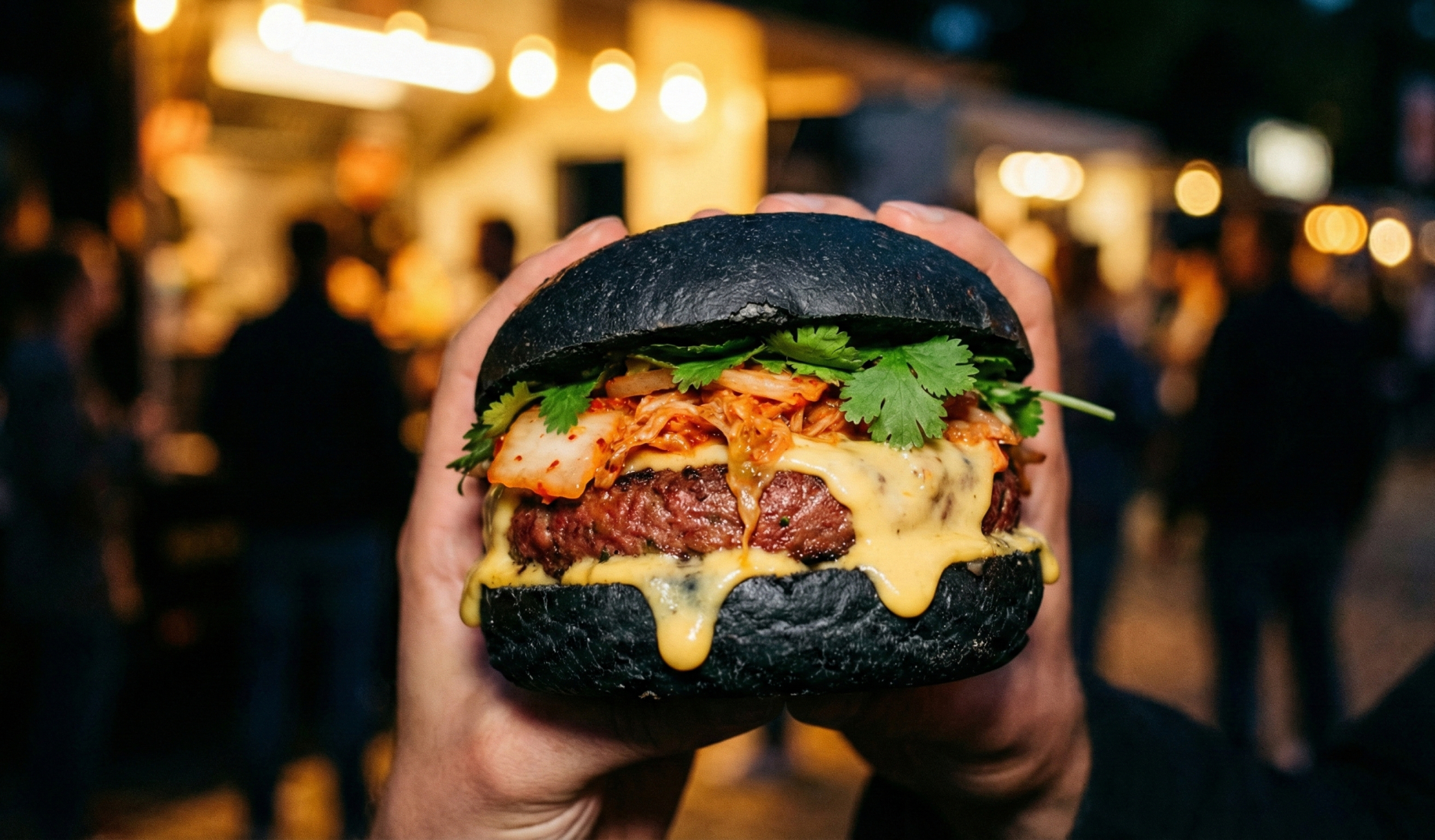
When the International Street Food Festival or formats such as eat&style open their doors, the most creative chefs and truck operators travel in from all over Europe. At these festivals you can observe the absolute avant-garde of street cooking. This is where the latest global food trends manifest themselves first. You stroll from a stand offering Nigerian jollof rice straight on to Colombian arepas overflowing with cheese, and finish the menu with Taiwanese bubble waffles wrapped around nitrogen-frozen ice cream. These big events are social occasions. You do not spend just half an hour here for a snack, but often the whole day. You share countless small portions with friends, listen to the beats of the resident DJs, enjoy local craft beer from small Hamburg breweries and let yourself be overwhelmed by the sheer mass of impressions. Specialised festivals such as the African Food Festival or small, intimate markets in the creative Karoviertel also help ensure that Hamburg's street food scene never stagnates but constantly reinvents itself.
The Evolution of Taste: How and What Hamburg Eats Today
Anyone who watches the street food markets in Hamburg closely will quickly see that visitors' eating habits and expectations have changed massively. The days when it was enough to throw frozen goods into the deep fryer are definitely over. Consumers are informed and demand transparency and quality. One unmistakable trend that runs like a green thread through all the markets is the dominance of plant-based cooking. Vegan street food has stepped out of the niche of pure abstinence and has developed into the most creative branch of the industry. It is long since about meat-free alternatives, but about independent, highly aromatic creations. Operators experiment with fermented mushrooms that imitate the texture of pulled pork perfectly, or create cashew-based sauces that put conventional cheese in the shade in terms of flavour.
At the same time, a return to radical authenticity can be felt. The uncontrolled mixing of different national cuisines (the so-called "crossover chaos") is giving way to a new respect for tradition. When Korean street food is offered at a Hamburg market today, the fried "fried chicken" tastes exactly as sticky, sweet and fiery hot as in the alleys of Seoul. Knowledge of spices, traditional methods of preparation and original recipes is presented with pride by the food truck operators.
The way people in Hamburg consume street food has also become more professional. The experienced foodie knows that cashless payment by smartphone or card is now standard at almost every truck, even if a few euros in cash never hurt at more traditional markets. And since Hamburgers in general take a pragmatic attitude to the notorious local "Schmuddelwetter" (grotty weather), nobody here lets a rain shower keep them from eating. The markets are retrofitting clever covers, and visitors know that a water-repellent jacket is part of the basic kit. Ultimately, street food culture in Hamburg is a mirror of urban society: it is honest, sometimes rough, but at its core incredibly warm-hearted, innovative and marked by a deep love of good craft. Anyone who eats their way through the streets of this city not only fills their stomach, but gets to know Hamburg from its liveliest and tastiest side.
Idyllic Enjoyment by the Water: The Weekly Market at the Goldbekufer
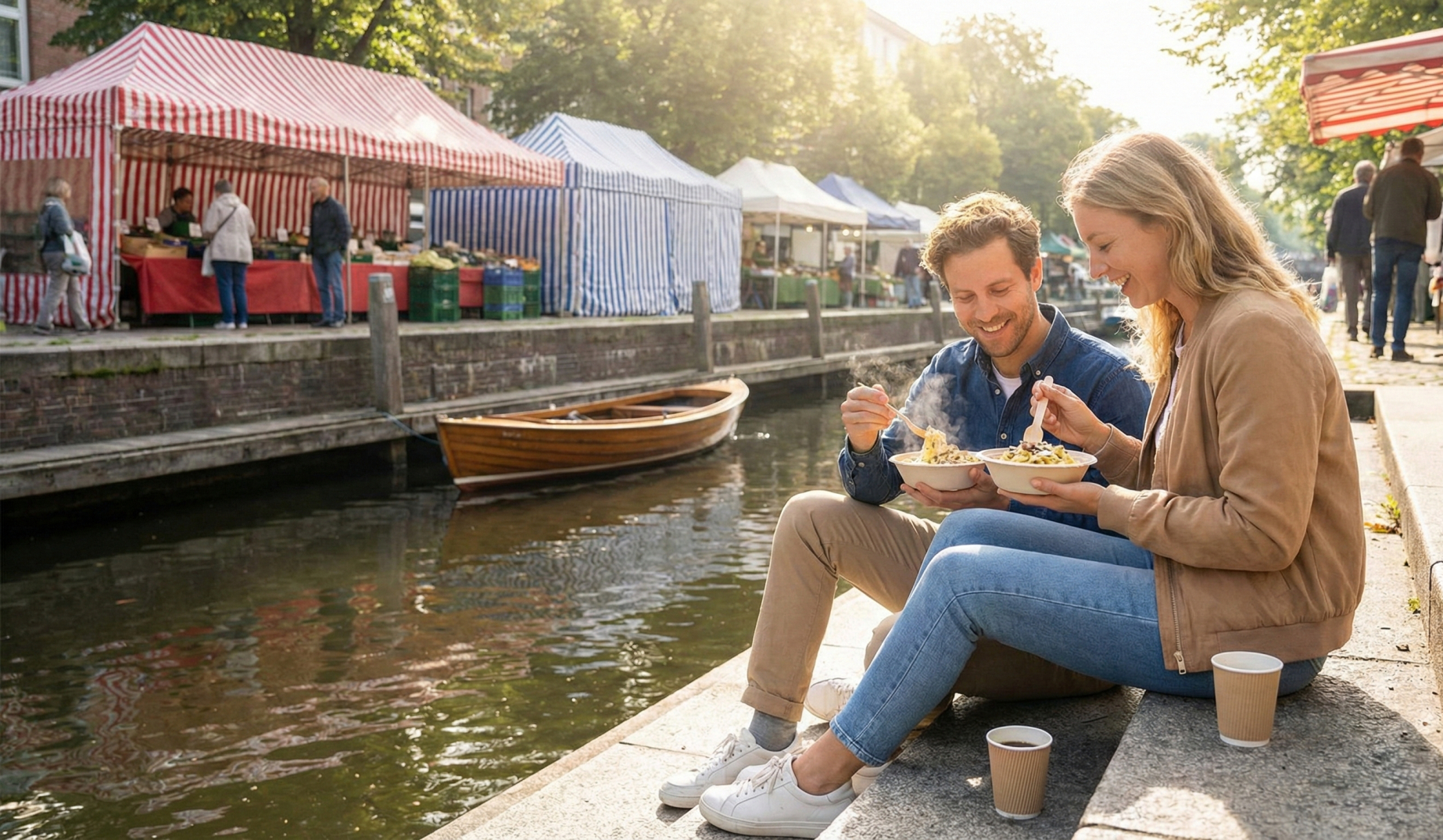
When Saturday morning breaks over Winterhude, one of the most picturesque street food settings in the whole Hanseatic city unfolds at the Goldbekufer. Where cars are parked during the week, a lively, colourful labyrinth of market stalls and mobile kitchens springs up right on the canal's quay wall, giving off a flair all of its own, almost Mediterranean. While stand-up paddlers and small Alster boats glide slowly past on the water, foodies crowd together on the asphalt. This market is the epitome of the Hamburg way of life: affluent but relaxed, quality-conscious and thoroughly pleasure-oriented. You do not come here for a hasty snack, but celebrate a late breakfast or an early lunch as an extended social ritual.
The culinary offering at the Goldbekufer stands out for its craft perfection and its focus on regional organic quality. Between the stalls with lavish bouquets of flowers and old apple varieties from the Alte Land are street food gems that make the heart of every foodie beat faster. The scent of wafer-thin French crêpes baked on hot irons, either classic with caramelised salted butter or savoury as a galette with goat's cheese and figs, mixes with the aroma of freshly brewed, fair-trade filter coffee from converted Piaggio Apes. An absolute magnet for market visitors are the stands with fresh, homemade pasta, tossed right on the spot in huge wheels of Parmesan and served with freshly shaved truffle. You grab your steaming bowl, find a spot on the warm stone steps right by the water, squint into the sun and know: better street food in a lovelier setting is hard to find on a Saturday lunchtime in Hamburg. If you want to let the afternoon wind down sitting, you will also find some of the cosiest cafés in Hamburg in Winterhude and the neighbouring districts.
Alternative Aromas and Urban Subculture: The Schanze and the Karoviertel
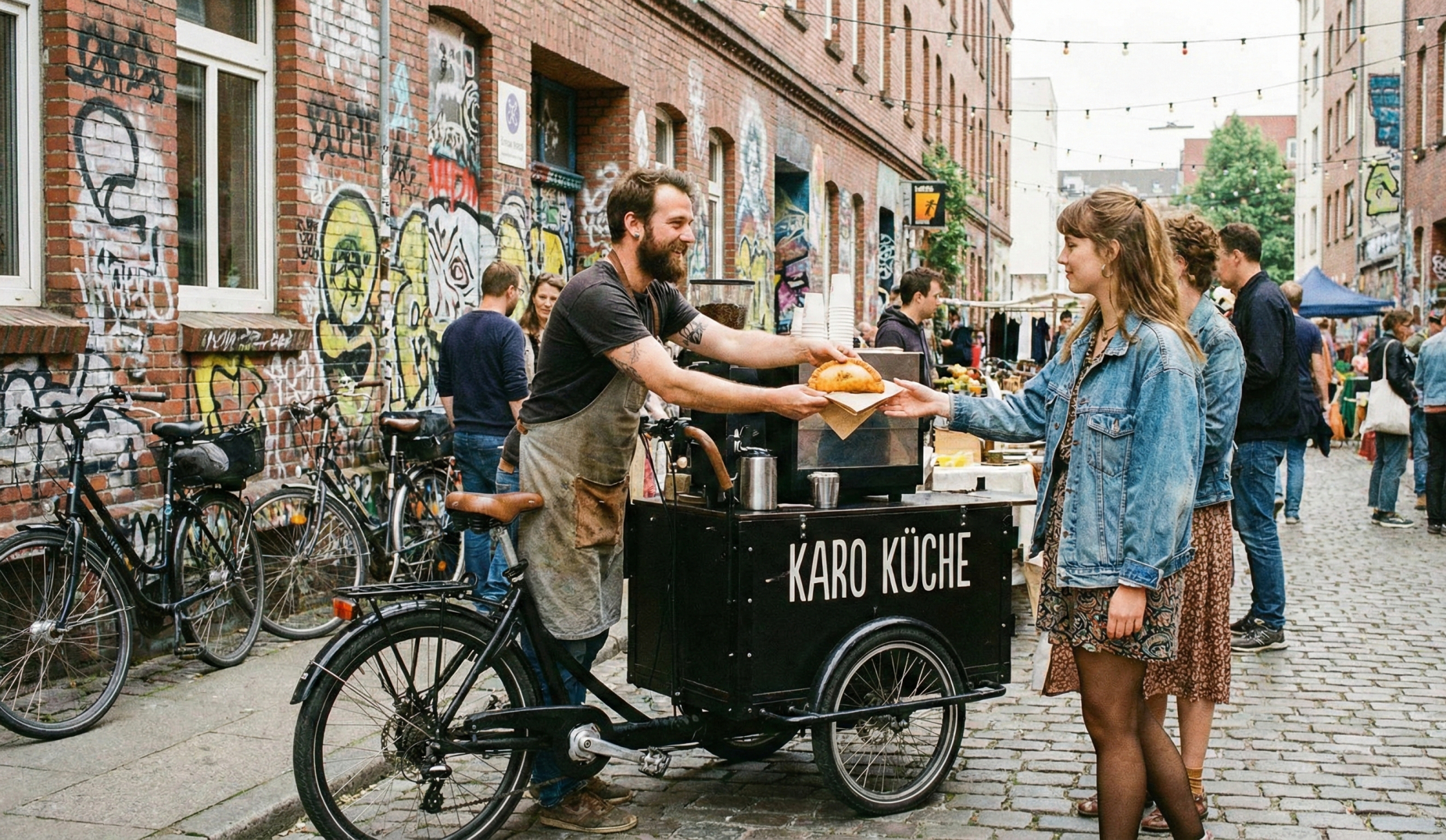
If you leave the refined paths of Winterhude and dive into the Karoviertel and the neighbouring Sternschanze, the pulse of street food culture changes abruptly. Here, where the façades are densely covered in graffiti and political street art and second-hand shops shape the streetscape, you find the rebellious, experimental soul of Hamburg's food scene. Especially on Saturdays, when the "Flohschanze" flea market takes place around the Alte Rinderschlachthalle, the area turns into a paradise for culinary explorers. The street food vendors here are not polished, glossy trucks, but often converted cargo bikes, improvised stalls made of Euro pallets or small, unassuming window sales that deliberately evade the mainstream.
This district is the undisputed germ cell of Hamburg's vegan and sustainable street food movement. Long before plant-based eating became a global trend, people here were already experimenting with seitan, tempeh and regional superfood. Between the stalls with vintage clothing and old records, there is a scent of fried falafel prepared to Syrian family recipes and wrapped in thick flatbreads with homemade, bright pink beetroot hummus. Right next door, hearty South American empanadas with innovative pumpkin-chilli fillings sizzle in hot oil. The Schanze is the place where you chat with a barista on a cargo bike about the roasting of the beans over a cold-brew coffee and then enjoy a Colombian arepa, while in the background street musicians provide the soundtrack to this urban, wonderfully imperfect culinary experience.
Industrial Market Hall Romance: Hobenköök in the Oberhafenquartier
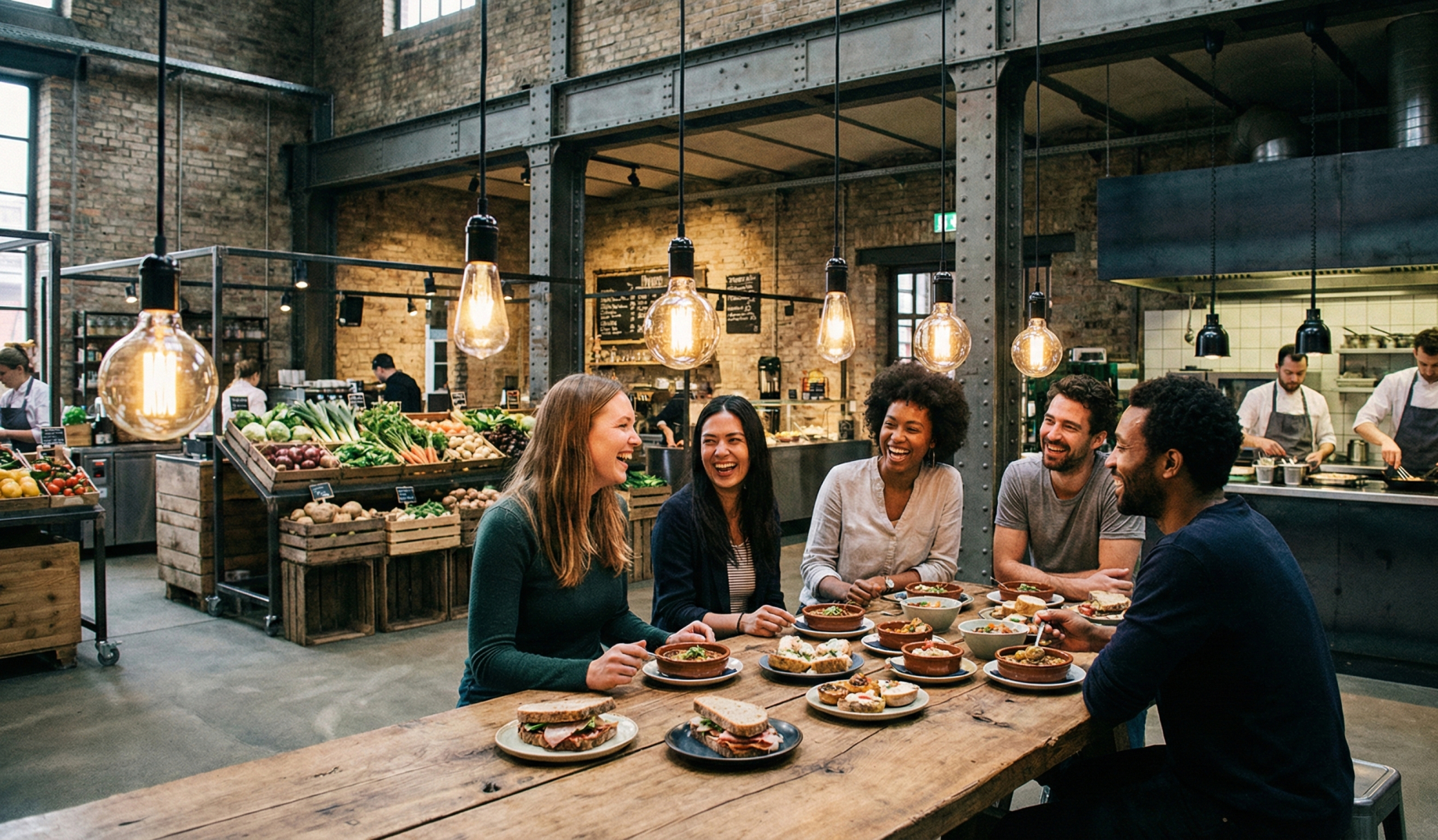
A completely different, architecturally breathtaking approach to market and street food culture is offered by the Oberhafenquartier. Where general cargo and heavy freight were once handled in dark warehouses, a rugged, creative centre has now emerged right by the railway tracks. The absolute heart of this development is the "Hobenköök", Low German for "harbour kitchen". Although this is not a classic open-air market with trucks, this visionary concept perfectly captures the essence of street food, namely closeness to the product, uncomplicated enjoyment and radical regionality, in a spectacular indoor setting.
Anyone who walks through the old, rusty iron gates of the market hall finds themselves in an impressive symbiosis of covered weekly market and huge open kitchen. The Hobenköök completely breaks down the boundaries between shopping and eating. Around 200 regional producers from the area around Hamburg offer their goods here, from crooked, intensely flavoured carrots to handmade cheese from Schleswig-Holstein. And it is exactly these ingredients that go straight, with no detours, into the pots and pans of the chefs in the middle of the hall. You stroll past the vegetable displays, take a seat at long, rustic wooden tables and order "Happen", small, street-food-style portions that celebrate the best of the region. That might be a crispy fried-fish sandwich with a catch from the Baltic Sea, a hearty stew of old vegetable varieties or an innovatively topped sourdough bread with homemade wild boar salami. The atmosphere under the exposed steel girders is marked by a rough, industrial cosiness that makes eating a thoroughly authentic, Hanseatic experience.
After-Work Flair Under the Michel: The Weekly Market at the Großneumarkt
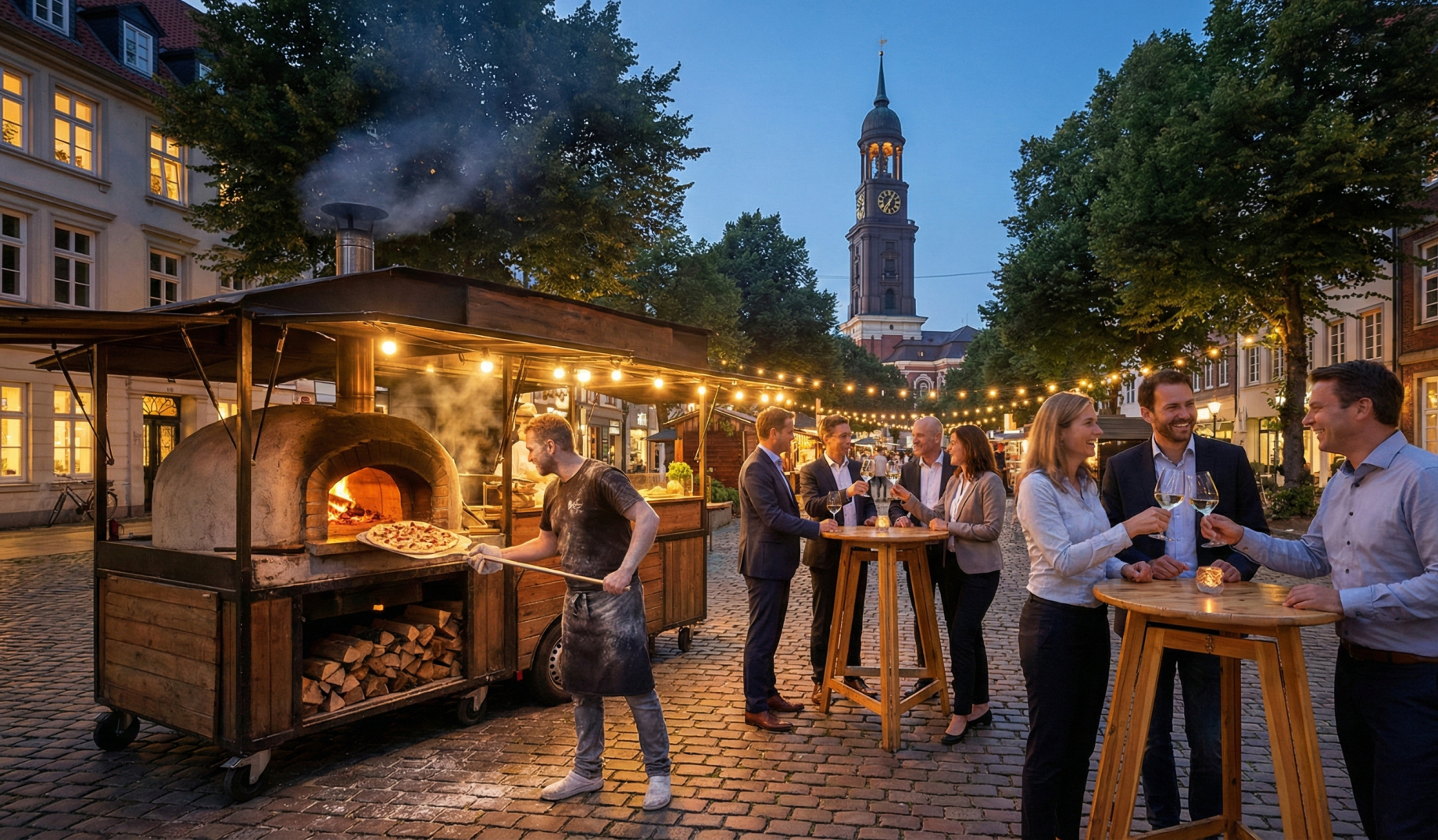
In the middle of Hamburg's Neustadt, just a stone's throw from the city's landmark, the main church of St. Michaelis ("Michel"), lies a square with a very special charm: the Großneumarkt. Framed by historic half-timbered houses, old pubs and large deciduous trees, this square gives off a cosy, almost village-like atmosphere in the heart of the metropolis. When the weekly market pitches its tents here on Thursdays and Saturdays, the square turns into a convivial meeting place that develops a street food dynamic all of its own, especially in the afternoon and early evening hours.
The market at the Großneumarkt is the relaxed answer to the loud St. Pauli Nachtmarkt. This is where the residents come, the agency employees from the Neustadt and gourmets who want to round off the day after work with a good glass of wine and an uncomplicated meal. The food stalls adapt to this refined after-work flair. Instead of deafening music and wild burger creations, you find stands here that pull steaming, wafer-thin Alsatian flammkuchen fresh from the mobile wood-fired oven. Right next to it, a local butcher grills coarse organic bratwursts that land, snapping, in a fresh roll. A particular highlight are the mobile wine stands of small winemakers, where you have a glass of Pinot Gris or a robust red wine poured to take to one of the many standing tables. It is an honest, neighbourly street food experience where you can linger for hours, watch the setting sun in the treetops and enjoy the ringing of the Michel's bells in the background.
The Ultimate Summer Spectacle: The Altonale and the Big Street Festivals
When the Hamburg summer reaches its peak, the city's street food scene explodes and leaves its usual places. This is the time of the big, legendary street festivals, of which the "Altonale" is probably the most impressive and far-reaching. For several weeks in June or July, the whole district of Altona is in a cultural state of emergency. For the big final weekend, whole streets are closed to car traffic, and the streets around Altona station, the Ottenser Hauptstraße and the Platz der Republik turn into the biggest, loudest and most colourful open-air kitchen in Northern Germany.
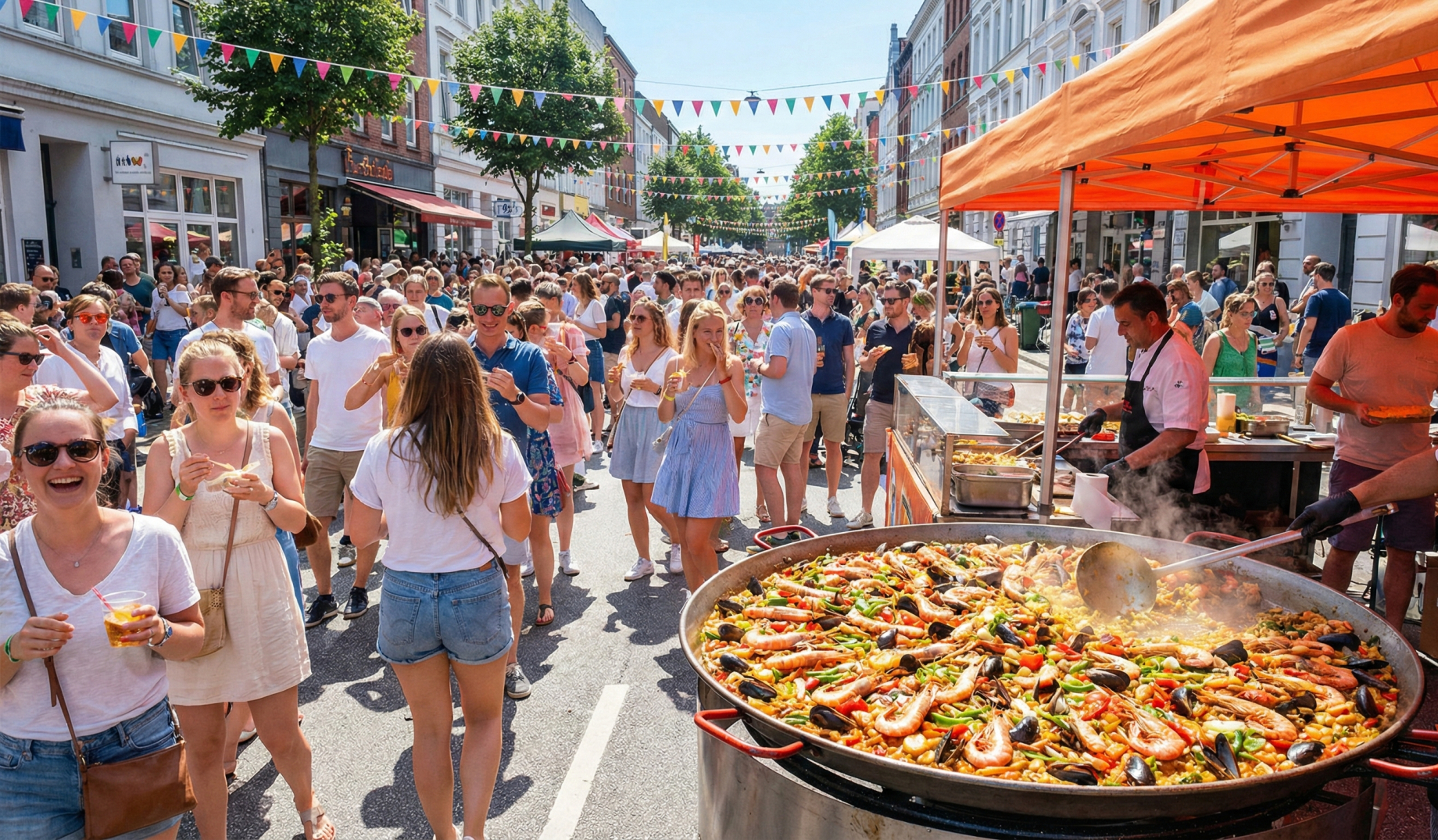
Street food at the Altonale (and similar festivals such as the Eppendorfer Landstraßenfest or the Osterstraßenfest in Eimsbüttel) is a boundless, global intoxication of the senses. The sheer mass of stalls, mobile kitchens and food trucks is overwhelming. Here the neighbourhood cooks alongside professional restaurateurs. Within a few metres you sample your way across the culinary world map: from huge, steaming paella pans in which fresh seafood simmers in saffron-yellow rice, via Senegalese peanut stews to Afghan mantu, steamed dumplings with lentil-yoghurt sauce. The air shimmers with heat, and smells of charcoal, roasted cumin and sweet candyfloss. You push shoulder to shoulder through the cheerful crowds, a skewer of grilled meat in one hand, a cool Astra beer in the other, while the sound of the city booms from the countless live stages. These street festivals are the most ecstatic form of street food in Hamburg, a collective, boundless celebration of diversity, community and fantastic food right on the hot asphalt.
Conclusion: Hamburg's Street Kitchens – A Journey That Never Ends
Anyone who explores the street food markets in Hamburg attentively will quickly see that the Hanseatic city can long since no longer be reduced to its maritime traditions. The culinary landscape between the Elbe and the Alster has turned into one of the most exciting, dynamic and diverse food scenes in Europe. The classic bratwurst and the obligatory fish roll have by no means had their day, but they now share the stage quite naturally with Korean tacos, Peruvian ceviche and experimental vegan burger creations. Street food in Hamburg today is a reflection of a modern, cosmopolitan metropolis that celebrates its international influences while setting the highest standards for quality, craft and regionality.
Every market we have looked at in this guide has its own rhythm and an unmistakable soul. The pulsating St. Pauli Nachtmarkt beckons with urban energy and party atmosphere, while the historic Isemarkt under the elevated railway viaduct celebrates refined delicatessen. The modern HafenCity offers innovative street food against a futuristic backdrop, and the rustic Hobenköök proves how deeply the love of regional products is rooted in Hamburg. It is precisely this contrast, from the raw authenticity of the Sunday Fischmarkt to the hip, plant-based avant-garde in the Karoviertel, that makes the street food experience in this city so incomparable.
The way Hamburgers eat has changed fundamentally. Street food is no longer mere food intake to satisfy a quick hunger. It has become a social event. You meet on the city's squares, share countless small dishes with friends, get talking to the passionate food truck operators and discover flavours you may never have tried before. Street food culture has brought classic gastronomy out of enclosed rooms and onto the streets and made eating a communal, interactive experience again, one that appeals to all the senses and connects people of the most varied backgrounds.
Whether you are a tourist looking for the authentic taste of the north or a local wanting to discover new culinary horizons, Hamburg's street kitchens are waiting to be explored. Pack your curiosity, let yourself be led by the smells and do not be afraid of the famously notorious Hamburg Schmuddelwetter. Because one thing is certain: the next flavour revelation is already waiting around the next corner, steaming, sizzling and ready to cast its spell on you. Enjoy your meal on your culinary voyage of discovery through Hamburg!
Frequently Asked Questions About Street Food Markets in Hamburg
Which street food market in Hamburg is suitable for a first visit?
For a start, the St. Pauli Nachtmarkt on the Spielbudenplatz is the most obvious choice: it combines a classic weekly market and an open-air restaurant, offers a wide range from pulled pork to falafel to vegan Thai curries, and is right in the middle of the nightlife district. If you prefer something quieter, start instead at the Großneumarkt or the Goldbekufer.
Where can I find the best vegan street food in Hamburg?
The Sternschanze and the Karoviertel are regarded as the germ cell of the city's vegan street food movement. Around the Flohschanze you will find falafel to Syrian family recipes, beetroot hummus and empanadas with pumpkin-chilli filling. Plant-based cooking is also strongly represented at the St. Pauli Nachtmarkt and at the "Vegane Straßenfest" in summer.
Which market suits a lunch break?
The Food Lovers Market on the Überseeboulevard in the HafenCity is made for exactly that and turns into an open-air canteen for the surrounding offices on market days in the middle of the week. The Isemarkt under the elevated railway viaduct is the delicatessen version, with panini, oysters and seasonal stews.
Can I pay by card at the street food markets?
Cashless payment by card or smartphone is standard at almost every food truck. At more traditional markets and small stalls, though, a few euros in cash never hurt.
Is a market visit worthwhile in the rain too?
Yes. The markets are retrofitting covers, and visitors do not let Hamburg's Schmuddelwetter stop them anyway; a water-repellent jacket is part of the basic kit. If you want to stay completely dry, head for the covered market hall of the Hobenköök in the Oberhafenquartier.

Sarah Müller
Reise- und Lifestyle-Journalistin