Leverkusen
Japanese Garden Leverkusen: A Green Oasis in Wiesdorf
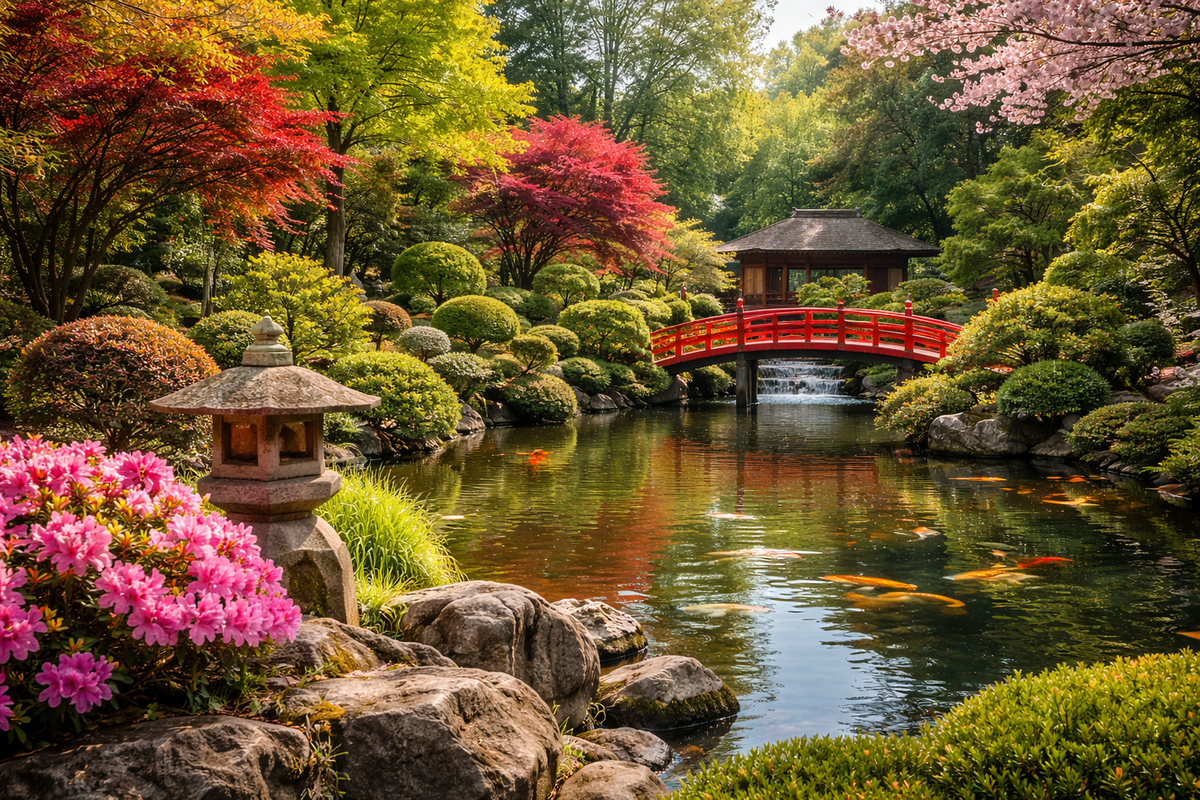
Leverkusen and Far Eastern garden art: at first glance that sounds like an unusual pairing. And yet, on the grounds of the Chempark, squeezed between industrial plants and the city motorway, lies one of the most enchanting places in the whole of the Rhineland: the Japanese Garden. Covering around 15,000 square metres, this site transports its visitors into a world of curved bridges, still ponds and centuries-old garden philosophy. Anyone who enters this place forgets within minutes that chemicals are being produced just a few hundred metres away.
The garden is part of the extensive Carl-Duisberg-Park and lies on the border between the Leverkusen districts of Wiesdorf and Flittard; strictly speaking, the Cologne city boundary even runs straight through the grounds. But such borders play no role here. What counts is the calm that envelops you immediately as you step through one of the three entrance gates.
How an Industrial Captain Brought the Far East to Leverkusen
The creation of the Japanese Garden is inseparably linked with one personality: Carl Duisberg. Born in Wuppertal, he rose to become general director of the dye works Friedrich Bayer & Co. and decisively shaped the company in the first decades of the 20th century. Duisberg was not only a visionary industrialist but also a passionate plant lover and keen bonsai grower.
As early as 1912 he had a first small garden in the Japanese style laid out next to his villa on the factory site. The garden inspector at the time, Richard Hartenauer, carried out the plans and integrated stone lanterns, small ponds and a tea house into a carefully designed landscape. But that was not yet enough for Duisberg.
When he also visited Japan in 1926 on an extended world tour, he was so impressed by the garden culture there that he had the Leverkusen garden considerably enlarged. He brought numerous sculptures, lanterns and art objects home from his travels and had them incorporated into the grounds. What had begun as a private hobby grew into a remarkable piece of garden art.
It is interesting that the garden also plays a role in the context of industrial history. Duisberg not only had the Japanese Garden laid out but, with the whole Carl-Duisberg-Park, created a generous green space that accompanied the factory site along its entire narrow side, about a kilometre in length. This also included a Flora Temple, which Duisberg had conceived as a burial place for himself and his wife, as well as the Casino Garden with the Caritas Fountain by the sculptor Hugo Lederer. The park was an expression of a corporate culture that wanted to combine industrial progress with aesthetics and quality of life.
Relocation and Rebirth: From Villa Garden to Public Park
From the 1950s onwards, Bayer gradually opened the garden to the public. But in 1960 a decisive change was on the horizon: the new Bayer high-rise was to be built on the original site. The garden had to make way, but it was not abandoned; it was completely recreated about 250 metres further south, at its present location.
The landscape architects used the opportunity not only to move the grounds but also to expand them conceptually. They planted numerous new trees, redesigned the layout of the paths and deliberately integrated European garden elements into the Far Eastern aesthetic. The result is not a garden in pure Japanese form but a sensitive interplay of Eastern and Western design principles, and that is precisely what makes it so special.
In 2006, in the vote for "Germany's most beautiful park", the grounds were chosen by an expert jury as one of the five best gardens in the country. Since 2017 the Japanese Garden has also been part of the European Garden Heritage Network, a Europe-wide network of outstanding historic gardens.
What There Is to Discover: the Garden's Highlights
The Japanese Garden achieves its effect above all through the interplay of water, plants, stone and architecture. Around 3,000 square metres of the total area consist of water features: small ponds, babbling streams, fountains and gently flowing waterfalls create an acoustic backdrop that lets you forget the everyday noise of the surroundings. Japanese koi carp and turtles swim in the ponds, a fascinating sight, especially for children.
The plant world changes its face with the seasons and ensures the garden looks different on every visit. In spring, ornamental cherries, magnolias, rhododendrons and azaleas enchant with their blossoms. In summer, deep shades of green dominate, while Japanese maples, grasses and papyrus perennials provide structure and texture. Autumn bathes the garden in a glowing sea of red, orange and gold. Even in winter, when the bare branches of the trees and the evergreen pines define the scene, the place has a meditative quality all of its own.
Scattered among the plants are sculptures and art objects from different parts of East Asia. Bronze sculptures of Buddhas, heron figures, decorated vases and traditional stone lanterns line the paths and set deliberate accents at crossings and resting places.
The Tea House: the Heart of the Grounds
If you follow the winding network of paths to the centre of the garden, you come across the most striking building: a tea house with a distinctive double roof in the Chinese style. Tile-covered double roofs were regarded in ancient China as a sign of high social rank; the best-known example is the roofs of the Forbidden City in Beijing.
Two bronze temple lions flank the entrance. These guardian figures are traditionally found in front of Chinese palaces and Japanese temples. Inside the tea house you can see gold-painted wooden panels showing pairs of dragons and phoenixes, symbols of good rule and happiness. Another depiction shows the seven Japanese gods of good fortune, the Shichifuku-jin, who play a central role in Japanese folk belief.
If you look outside through the tea house's windows decorated with wooden ornaments, you really do have the feeling for a moment of being in a completely different world. The tea house is not regularly used for tea ceremonies, but it serves as the atmospheric centre of the grounds and is a popular photo subject.
The Mikado Bridge and Other Architectural Elements
Besides the tea house, there are other architectural elements that give the garden its unmistakable character. The so-called Mikado Bridge is modelled on an historic bridge in the Japanese temple town of Nikkō and leads in a gentle arc over one of the ponds. Curved archways and an arbour bridge connect different areas of the garden and repeatedly draw the eye to new, carefully staged perspectives.
The network of paths is deliberately laid out: a few straight sections direct the eye to especially picturesque sightlines, while the many winding paths invite slow strolling and attentive contemplation. The garden cannot be surveyed in its entirety from any single point, a typical design principle of Japanese gardens that is meant to awaken curiosity and encourage discovery.
A Garden That Attracts Couples
Over the years the Japanese Garden has also established itself as a popular backdrop for wedding photos. On sunny weekends you regularly see newlyweds having their picture taken in front of blossoming cherry trees, on the bridges or in front of the tea house. The combination of lush vegetation, water and Far Eastern architecture offers a variety of motifs that hardly any other location in the Cologne-Leverkusen area brings together so compactly in one space.
Practical Information for Your Visit
Address: Kaiser-Wilhelm-Allee, 51373 Leverkusen. One of the three entrances is directly on Kaiser-Wilhelm-Allee.
Admission: Free; the garden is freely accessible.
Opening hours: The grounds are open all year round. From April to October the gates are open Monday to Friday from 9am to 8pm, and at weekends and on public holidays from 9.30am. In the winter months from November to March, shorter hours apply: on weekdays until 4.30pm, at weekends and on public holidays from 9.30am to 5pm. Times may occasionally change, so a quick look at the City of Leverkusen website before your visit does no harm.
Getting there by public transport: From Leverkusen-Mitte station you can comfortably reach the garden by bus. Various lines stop near the Chempark entrance.
Getting there by car: At weekends and on public holidays the car park P34 "Japanischer Garten" is available. During the week, parking there is only permitted from 2.30pm, as the car park is reserved for Chempark employees during the day.
Important notes: Dogs are not permitted in the core area of the garden. Unfortunately, the narrow inner paths are not suitable for wheelchair users and pushchairs; however, a step-free circular path runs around the grounds and offers good views into the garden.
Why a Visit Is Worthwhile in Every Season
The Japanese Garden in Leverkusen is one of those rare places that touches its visitors in a different way in all weathers and in every season. In spring the colours explode, in summer the old trees provide welcome shade, in autumn the grounds turn into a paintbox, and in winter the pared-down landscape develops a quiet elegance.
Do allow one to two hours for your visit. If you really want to enjoy the garden, embrace the slow pace that the design dictates: stop, look, watch the koi swimming, listen to the rushing of the waterfalls. This is exactly what this place was created for, as a counterweight to hectic everyday life, as an island of calm in the middle of the city. And it still manages that astonishingly well after more than a hundred years.
Tip: If you want to extend your outing, combine the garden visit with a detour to the nearby Schloss Morsbroich and its museum of contemporary art. Together, the two places make for a varied day of nature, culture and history, and show that Leverkusen has considerably more to offer than you might suspect at first glance.

Max Schmidt
Lokaler Experte