München
The Best Photo Spots in Munich
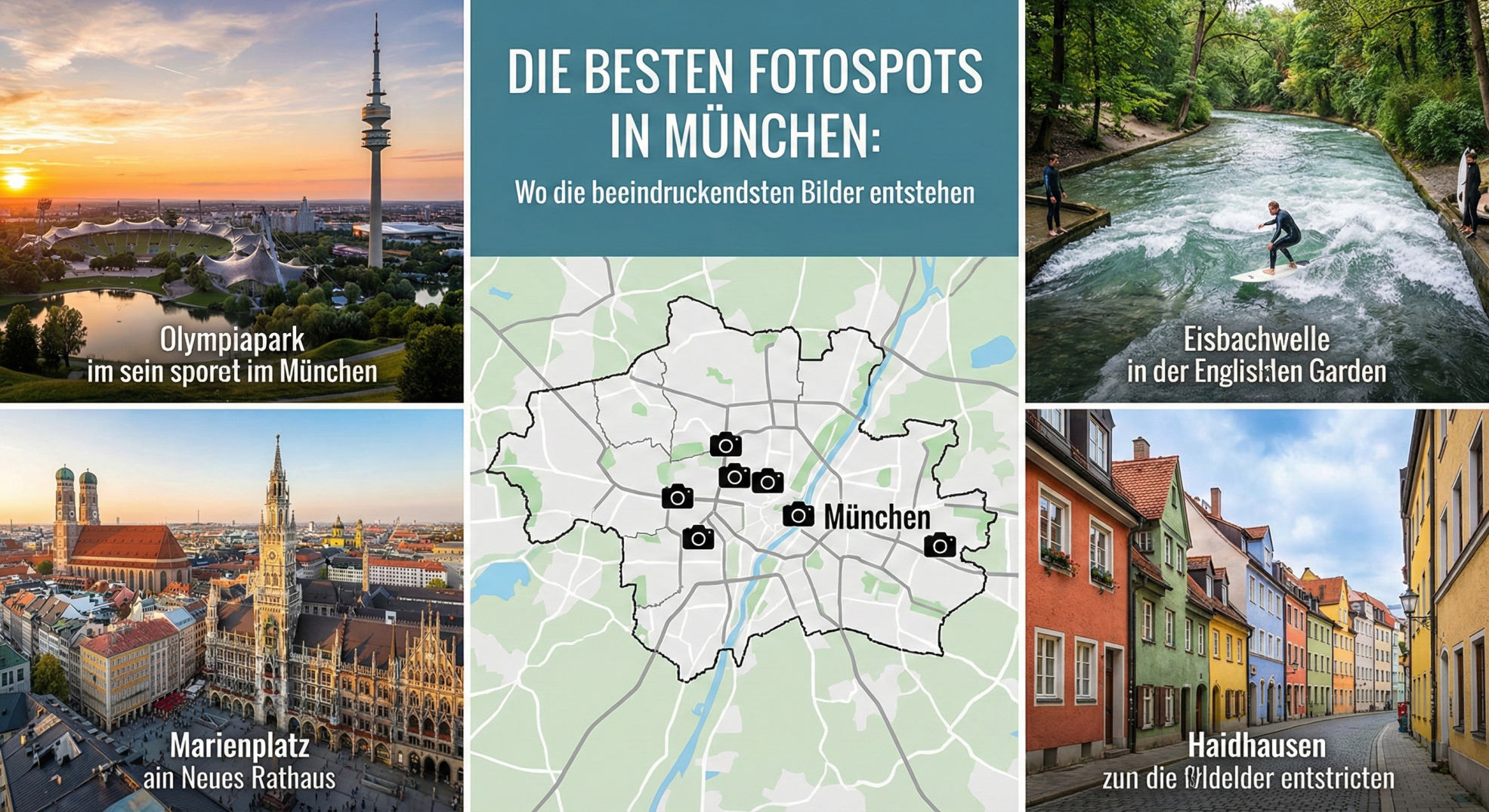
Munich, the radiant Isar metropolis, is far more than a collection of beer gardens, lederhosen and Bavarian cosiness. For photographers, visual storytellers and content creators, the city exerts an incredible, almost magnetic pull, fed by the constant tension between deeply rooted tradition and forward-looking modernity. Anyone searching for "photo spots Munich", "most beautiful photo locations Munich" or "Instagram spots Munich" will quickly find that the Bavarian state capital offers an inexhaustible source of visual inspiration. It is a city where monumental neoclassical architecture blends seamlessly into futuristic high-tech façades, and where urban density is repeatedly broken up by gigantic, picturesque green spaces. In the digital age, the demand for the perfect picture, the ultimate perspective and the unique moment of light has grown exponentially, making Munich one of the most photographed urban spaces in all of Europe.
The sheer variety of photographic subjects in Munich is simply breathtaking and challenges photographers in every discipline. Whether you are a professional architectural photographer with a high-resolution full-frame camera and heavy tilt-shift lenses, a street photographer looking for the decisive, fleeting moment of urban life, or a passionate smartphone user who wants to enrich your feed with extraordinary shots, Munich provides the perfect setting. The challenge nowadays is no longer to find a subject at all, but rather to present the city's well-known landmarks and hidden gems in a new, unseen light. This is exactly where the wheat is separated from the chaff: the average snapshot merely documents presence at a place, while a masterful photo captures the soul, the atmosphere and the architectural essence of the "photo location Munich".
An outstanding photo, however, is never just the result of a good location; it is the masterful orchestration of light, timing and technical understanding. The so-called "golden hour", the first hour after sunrise and the last hour before sunset, bathes Munich's historic sandstone façades and modern glass palaces in a warm, soft and downright magical light that softens contrasts and emphasises textures. Even more fascinating for many is the "blue hour", when the sky glows in deep cobalt blue and the city's artificial street lighting comes to life, which is of essential importance especially for the topic of "photographing Munich at night". Anyone who really wants to make the most of the city's best photo spots often has to set their alarm mercilessly early or hold out until late at night in order to catch the places free of the inevitable tourist crowds and in perfect light.
This in-depth, thoroughly researched guide takes you on a visual expedition to the city's most spectacular places. We have not only analysed search intentions and the internet's top rankings in order to present the most sought-after "Munich sights photography" locations, but we also dive deep into photographic practice. We tell you not only the "where" but also the "how" and "when". From the dizzying bird's-eye view above the rooftops of the old town to the colour-saturated depths of the underground network, from symmetrical baroque splendour to raw surfing action in the middle of the city. Get your memory cards ready, charge your batteries and follow us to the places where Munich's most impressive pictures are taken.
The Alter Peter – the Iconic Bird's-Eye View over the Marienplatz
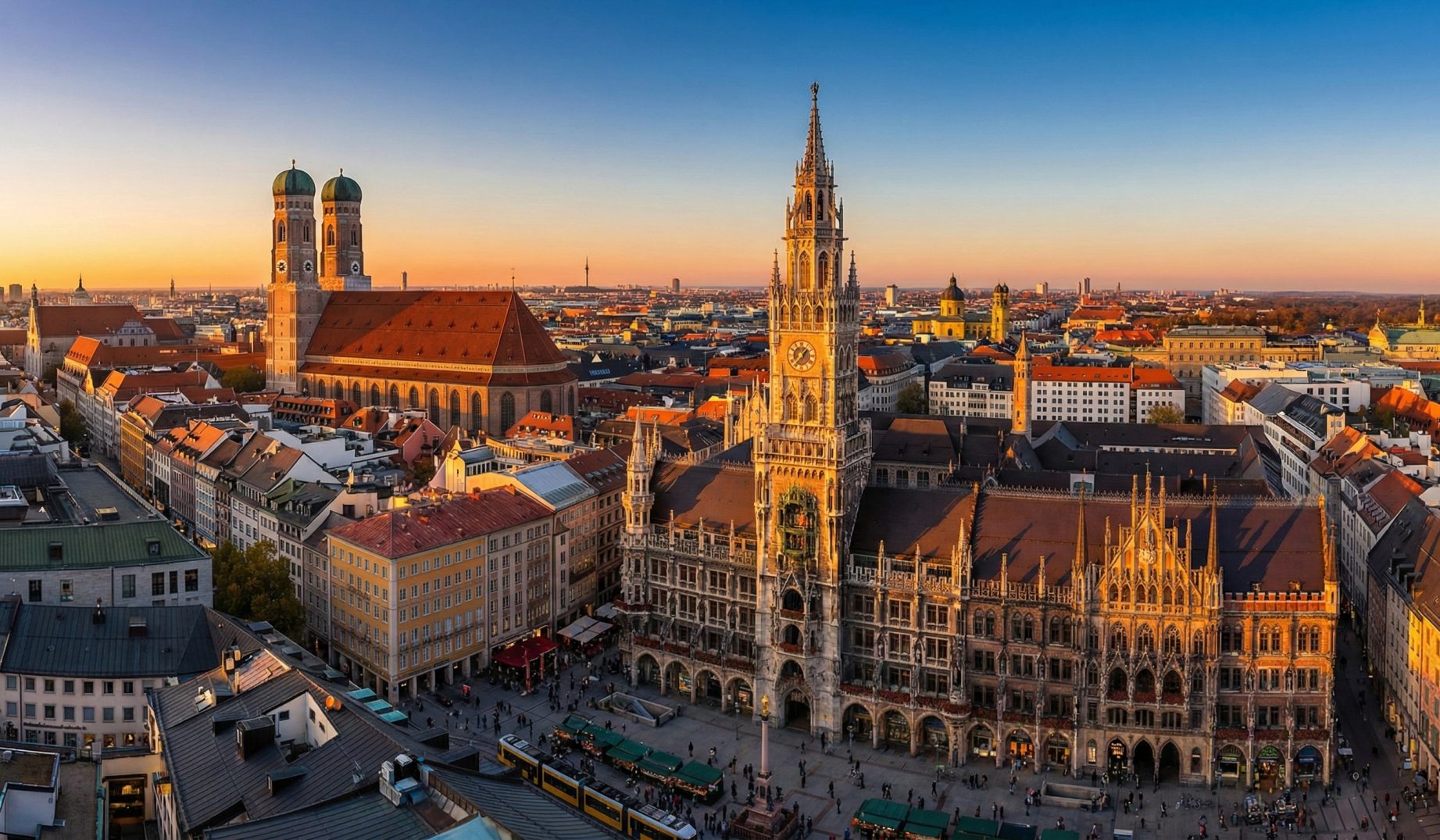
If you ask photographers for the absolute must-have subject in Munich, the name "Alter Peter" almost always comes up first. The parish church of Sankt Peter, affectionately called "Alter Peter" by the people of Munich, is not only the oldest documented parish church in the city but also offers, from its 91-metre-high tower, probably the most spectacular unobstructed panoramic view over the whole historic centre. To reach this coveted "photo location Munich", you first have to master the challenge of exactly 306 narrow, creaking wooden steps. There is no lift, and the climb through the narrow tower shaft with two-way traffic can certainly be sweaty. But the moment when you step through the small door onto the narrow, circular viewing platform and the wind blows around your nose rewards you for every effort. Before you spreads a sea of houses with red tiled roofs that deeply impresses with its density and historic cohesion.
The absolute visual high point and the classic postcard view is the direct look down onto the bustling Marienplatz and the majestic neo-Gothic Neues Rathaus. From this slightly elevated, frontal bird's-eye perspective, the incredible architectural details, the countless gargoyles, statues and the delicate structure of the town hall tower can be captured perfectly. A little further to the right, the world-famous, unmistakable onion domes of the Frauenkirche rise into the sky, and they integrate wonderfully as a central element into the composition. On clear days, especially after a spell of Föhn weather, a breathtaking Alpine panorama reveals itself on the southern horizon, rising like a huge, snow-covered wall behind the silhouette of the city. Anyone who wants to exhaust the topic of "viewpoints Munich" photographically here should definitely choose the late afternoon hours, when the low sun bathes the façades of the Marienplatz in golden light and casts long, dramatic shadows.
In terms of photographic technique, the tower of the Alter Peter brings some specific challenges. The platform is extremely narrow and almost always packed with tourists, which makes using a tripod almost impossible and often strictly forbidden. In addition, the whole platform is secured with a fine-mesh wire fence for safety reasons. The secret of a perfect picture here lies in choosing the right lens: a prime lens or a zoom lens with a relatively narrow front diameter can often be pressed directly against the mesh of the fence. If you then shoot with a wide aperture (small f-number, e.g. f/2.8 or f/4), the wire disappears completely into the blurred foreground thanks to the shallow depth of field and becomes virtually invisible in the final picture. A wide-angle lens (around 16-35mm) is ideal for capturing the whole Marienplatz, while a light telephoto lens (70-200mm) is wonderfully suited to isolating the distant Alpine panorama or individual architectural details of the town hall.
The Olympiapark – Futuristic Architecture and Green Expanses
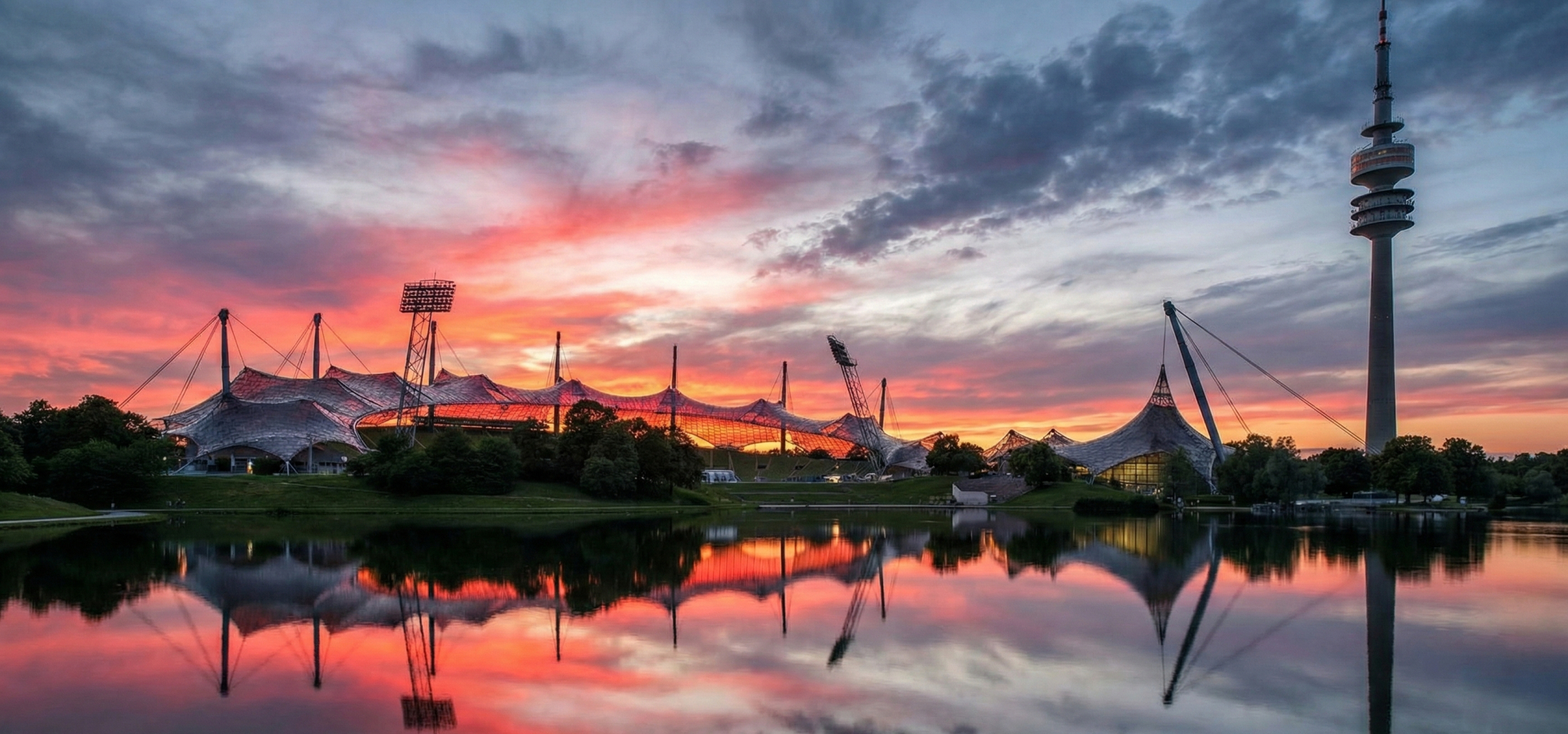
The Olympiapark, built for the 1972 Summer Olympics, is an urban-planning and architectural masterpiece that has lost none of its futuristic fascination to this day. For photographers who specialise in the keyword "architectural photography Munich", this area is an absolute mecca. The heart of the park is the world-famous, revolutionary tent roof construction by Frei Otto and Günter Behnisch. These gigantic, translucent acrylic glass nets, which stretch like floating, organic spider webs over the Olympic Stadium, the Olympic Hall and the swimming hall, break radically with the conventions of massive buildings. They once embodied the idea of the "cheerful games" and of an open, democratic Germany. From a photographic point of view, the curved lines, the complex steel nets and the massive pylons offer an endless playground for abstract compositions, playing with geometric shapes and capturing dramatic leading lines.
The best perspectives in the park are usually earned on foot. An absolute hotspot for landscape and architectural photographers is the Olympiaberg, an artificial hill that was ironically piled up from the rubble of the Second World War. From its summit you have an outstanding view of the whole tent roof ensemble, which fits wonderfully organically into the artificially created lake landscape. Especially at sunrise or sunset, when the low sun bathes the silvery roof in warm pink and orange tones, pictures of epic breadth are created here. Another much-frequented spot is right on the shore of the Olympiasee. On windless days the mirror-smooth water surface acts as a perfect reflector in which the tent roof and the 291-metre-high Olympic Tower are majestically mirrored, a classic but always impressive composition that brings depth and symmetry into the picture.
Technically speaking, the Olympiapark is a place that rewards the use of a wide variety of photographic techniques. To capture the massive expanse of the architecture, an ultra-wide-angle lens is often indispensable. If you want to perfect the reflective surface of the Olympiasee, you should definitely reach for a polarising filter to control disturbing reflections on the water, and use an ND filter (neutral density filter). With a tripod and exposure times of 30 seconds or longer, the water surface is ironed into a silky, milky expanse, and moving clouds in the sky create an incredible dynamism that forms a strong contrast to the rigid architecture of the tent roof. If you visit the park in the evening, the topic of "photographing Munich at night" can also be realised superbly, when the stadium roof is subtly illuminated from inside and the Olympic Tower pierces the dark night sky like a glowing needle.
The Munich U-Bahn Stations – Geometry and Riot of Colour Underground
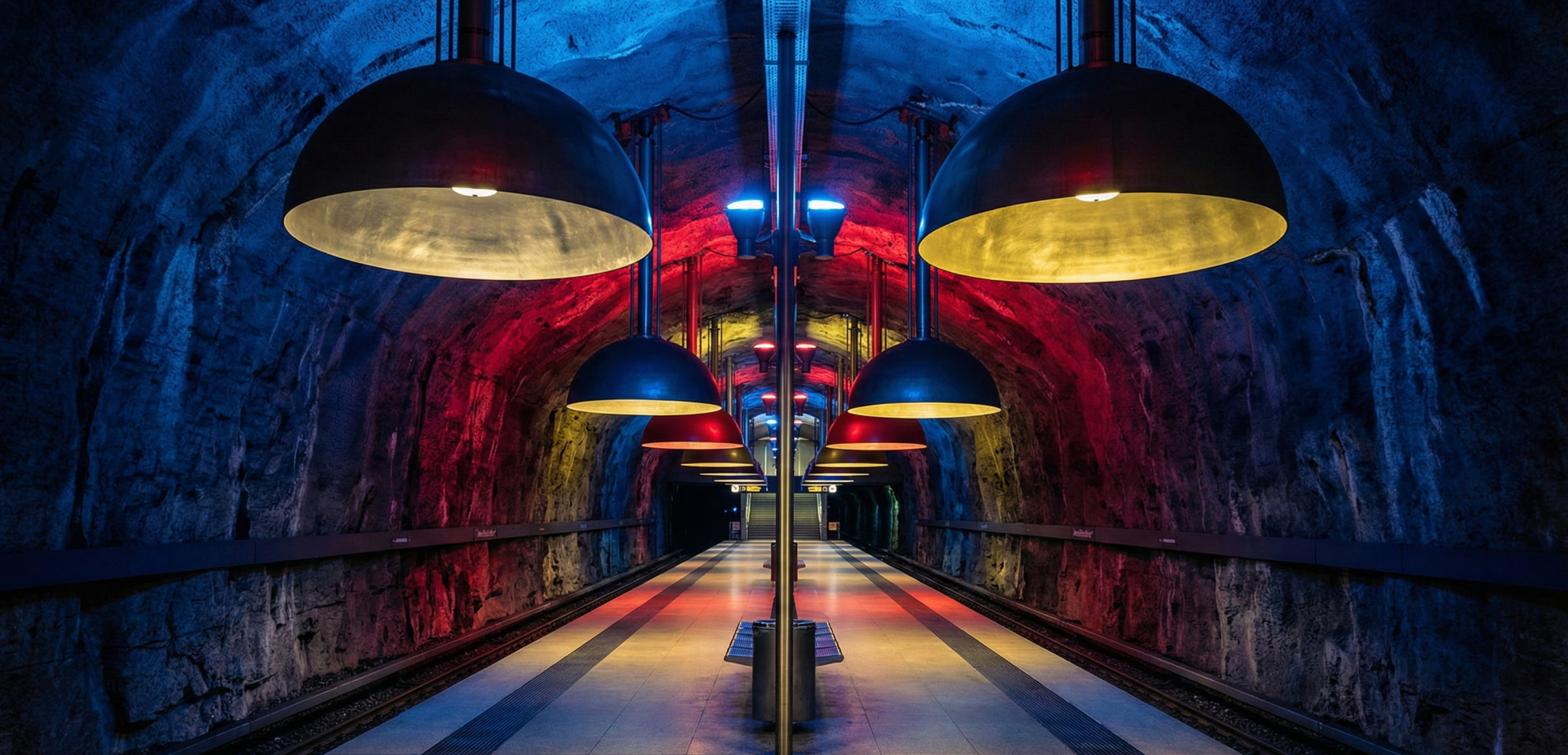
Anyone who thinks only of historic buildings and sunny parks when they think of Munich overlooks one of the most exciting, most urban and most photogenic parts of the city: the underground. The Munich U-Bahn is far more than a purely functional means of transport; it is a hidden, kilometres-long museum of modern architecture, lighting design and pop art. Searches for "photo spots Munich U-Bahn" have risen rapidly in recent years, and quite rightly so. Many stations, especially those designed since the late 1980s and the 1990s, break radically with the dreary, tiled monotony of earlier decades. They are colour-saturated, strictly geometric or futuristic-looking spatial artworks that captivate photographers with their symmetry, their leading lines and their often dramatic, almost cinematic lighting concept. These places provide the perfect backdrop for urban street photography, minimalist architectural shots and surrealist staging.
The absolute icon among Munich's U-Bahn stations is undisputedly the "Westfriedhof" station. The renowned lighting designer Ingo Maurer created a masterpiece here that bathes the raw, unclad walls, reminiscent of a rock cave, in a mystical light. The scene is dominated by eleven gigantic, oversized aluminium hemispheres hanging from the ceiling, bathing the platform in warm, rich tones of blue, red and yellow. This station looks like the set of a science-fiction film and is a dream for every photographer. Another highlight is "Candidplatz", an absolute riot of colour in which the walls, ceiling and columns are painted in a flowing, seamless gradient through the entire spectrum of the rainbow. Stations such as "Marienplatz" with its bright orange tunnel tubes, "Georg-Brauchle-Ring" with its colourful metal panels by Franz Ackermann or the puristic station "Münchner Freiheit", dominated by glass and steel, also belong on the must-see list of every urban explorer.
Photography in Munich's U-Bahn stations, however, is subject to strict rules and considerable technical hurdles. First the administrative side: for commercial shots or the use of massive tripods, the Münchner Verkehrsgesellschaft (MVG) requires a filming or photography permit without exception. For private, quick handheld shots you are usually tolerated. The light in the stations is often deceptively dark, which calls for fast optics (aperture f/1.4 or f/1.8) and a modern camera with excellent noise behaviour at high ISO values. The supreme discipline here is perfect timing and symmetry. To get deserted, graphically perfect pictures, you have to lie in wait either very early on a Sunday morning or very late at night. Waiting for the exact moment when no person disturbs the symmetrical picture and perhaps the red tail light of a departing train just draws a dynamic streak of light into the image requires endless patience, but is rewarded with extraordinary "Instagram spots Munich".
Schloss Nymphenburg – Symmetry and Baroque Splendour
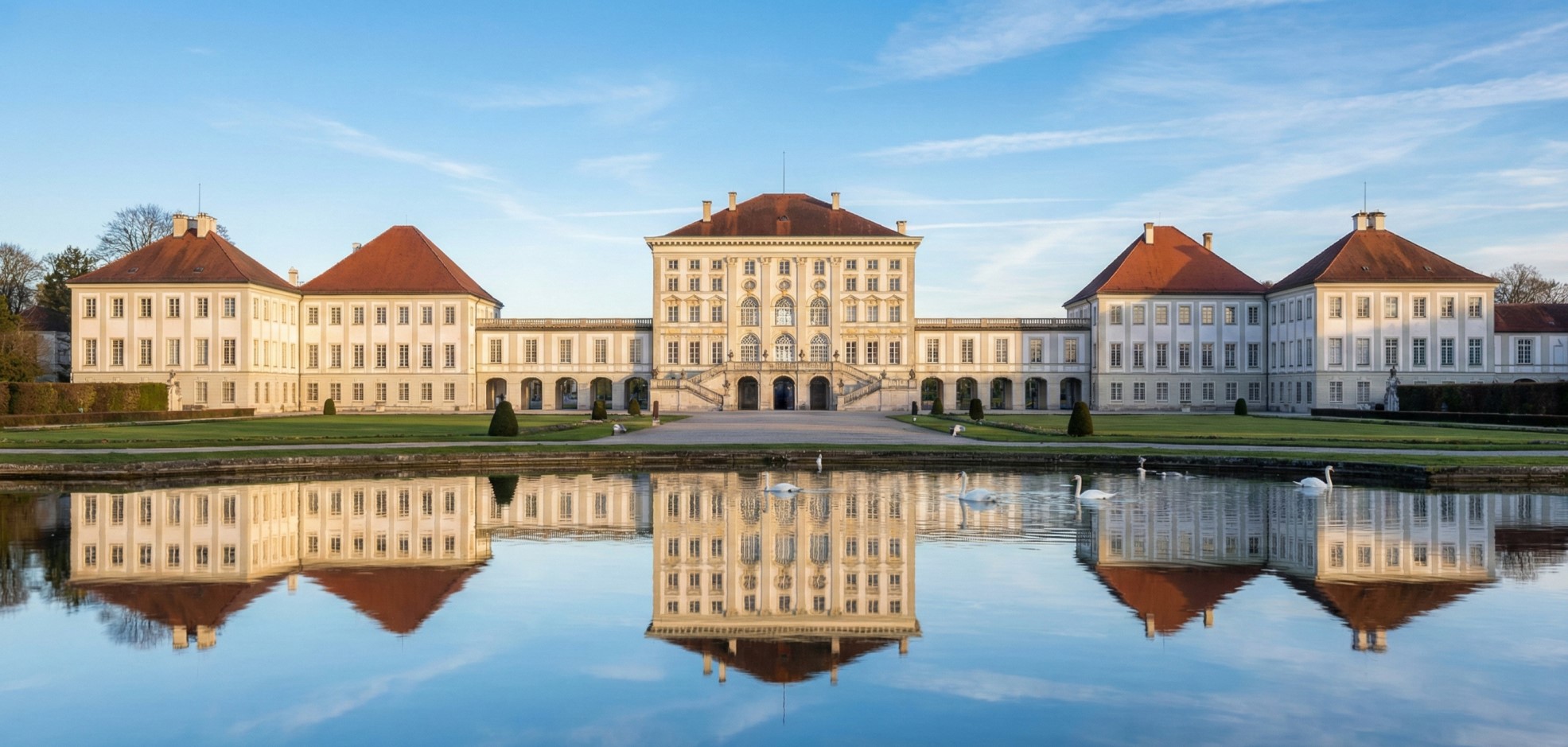
If you feel the need for opulent elegance, majestic symmetry and classical beauty, there is no better place in Munich than Schloss Nymphenburg. The former summer residence of the Bavarian electors and kings of the House of Wittelsbach is one of the largest and most impressive baroque palace complexes in Europe and a guarantee of pictures of truly regal quality. The complex is so extensive that it offers an incredible variety of different subjects and keeps the keyword "Schloss Nymphenburg photography" or also "photo location Munich wedding" very high in search engine rankings. Even the approach along the dead-straight access avenues that run directly towards the impressive main building prepares the visitor for the strict, geometric order of baroque architecture. The palace impresses with its incredible width, its white façade with reddish roofs and the magnificent staircases that immediately transport you to another era.
The classic and most coveted subject is the frontal view of the palace, in which the large canal in the foreground acts as a gigantic natural mirror. On windless days the whole façade, hundreds of metres wide, is reflected crystal clear in the water, interrupted at most by gently gliding mute swans that lend the picture additional, fairy-tale romance. But the true photographic wealth lies hidden in the huge palace park that stretches out behind the main building and passes seamlessly from geometric baroque gardens into an enchanted English landscape garden. Here picturesque park pavilions such as the Amalienburg, the Badenburg and the Pagodenburg are hidden, embedded in dense greenery, small lakes and winding watercourses, opening up completely new, intimate perspectives. The winding woodland paths, the antique statues and the bubbling cascades offer countless opportunities for atmospheric landscape and nature photography in the middle of the city.
To photograph the splendour of Nymphenburg technically perfectly, the choice of time of day is the absolutely critical factor. Anyone who wants to capture the expanse and symmetry undisturbed inevitably has to be on site at sunrise. The early, still cool light often bathes the white façade in delicate pastel tones, and the morning mist that occasionally hangs over the canal and the wide lawns gives the pictures an indescribable, mystical depth. A polarising filter is an absolutely indispensable tool in the camera bag here. It makes it possible to render the blue of the sky intense and rich, to make the white clouds stand out dramatically and, most importantly, it gives the photographer full control over the reflections on the surface of the canal, so that you can either maximise the reflection of the palace or hide it completely. Nymphenburg requires a calm eye for composition and line, to do photographic justice to the strict baroque architecture.
The Englischer Garten and the Eisbachwelle – Pure Action and Nature
The Englischer Garten is not only one of the largest inner-city parks in the world but also a place of extreme photographic contrasts. On the one hand it offers idyllic, almost contemplative landscape subjects that look like paintings of the Romantic era; on the other hand it presents the concentrated energy and dynamism of an urban action sports scene that has no equal worldwide. Anyone searching for "most beautiful photo locations Munich" will inevitably come across pictures from this huge green area. The contrast between peaceful nature with its wide meadows, ancient giant trees and meandering streams and the pulsating city life that meets here for recreation makes the Englischer Garten a fascinating territory for reportage, landscape and action photographers alike.
The undisputed highlight for action and sports photographers is the legendary Eisbachwelle, located right at the edge of the park next to the Haus der Kunst. Here, in the middle of the Bavarian metropolis and hundreds of kilometres from the nearest ocean, surfers in wetsuits ride a constant, wild, artificially generated river wave, in all weathers, in high summer as in an icy snow flurry. The roar of the water, the spray, the tense posture of the surfers and the spellbound audience at the edge of the bridge create an incredible, energy-charged atmosphere. Photographically, it is all about capturing the perfect frozen moment. To render the surfers' rapid movements and the exploding water droplets razor sharp, extremely short shutter speeds (often 1/1000 of a second or even shorter) are imperative. At the same time, deliberate motion blur (panning technique) at longer exposure times can impressively visualise the enormous speed and dynamism of the ride on the wave. It is a place that demands technical skill and quick reactions.
A radical photographic counterpoint to the wild Eisbachwelle is the Monopteros, a neoclassical round temple that sits enthroned on an artificially piled-up hill in the middle of the southern part of the Englischer Garten. This temple is the epitome of landscape romanticism and offers a wonderful all-round view over the treetops of the park as far as the striking silhouette of the old town with the Frauenkirche. Especially in the early morning hours in autumn, when the meadows are still covered in frost and dense wisps of mist drift over the Schwabinger Bach, while the first morning sun bathes the Monopteros in golden light, pictures of melancholy, quiet beauty can be created here. This location forces you to slow down, to set up your tripod deliberately and to compose precisely, while only a few hundred metres away the surfers battle against the roaring force of the Eisbach.
The Siegestor and the Ludwigstraße – Monumental Perspectives at Night
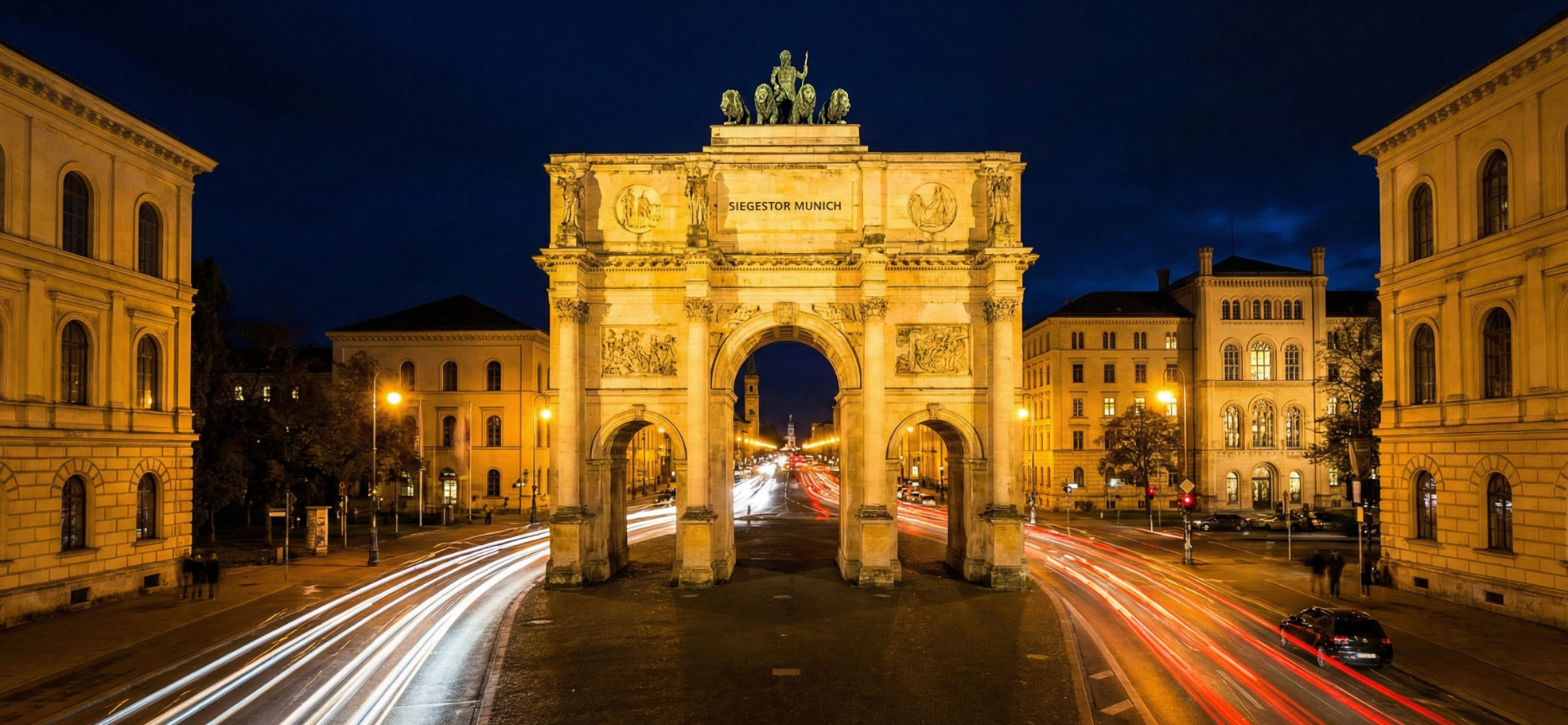
Munich has many grand streets, but none is as austere, as monumental and as photographically appealing as the Ludwigstraße, which is crowned at its northern end by the majestic Siegestor. This triple-arched triumphal gate, topped by the giant Bavaria statue on a quadriga drawn by lions, marks the transition between the intellectual, neoclassical Maxvorstadt and the sophisticated, fun-loving Schwabing. The gate, built on the model of the Arch of Constantine in Rome, was originally dedicated to the Bavarian army but is today a memorial for peace. The sheer size of the monument, combined with the incredible architectural perspective of the seemingly endless Ludwigstraße, lined with symmetrical, stately palace façades in the round-arch style, provides a breathtaking backdrop for urban-planning photography of the absolute top class.
This location only unfolds its full, overwhelming photographic effect after sunset, however. Anyone who types "photographing Munich at night" into their search engine is looking for exactly this kind of urban epic. When daylight fades, the Siegestor is lit by massive floodlights, so that the contours of the quadriga stand out dramatically against the dark night sky. The wide, busy Ludwigstraße then presents itself as the perfect stage for the technique of long exposure. The red tail lights and white headlights of the cars rushing past turn, with exposure times of 10, 20 or 30 seconds, into endless, glowing streams of colour: the so-called light trails. These flowing lines of light cut through the static, stone architecture of the surroundings and create an extreme visual dynamism that preserves the pulse of the big city in a single picture.
The technical approach to this spot requires the greatest precision and absolute stability. A heavy, solid tripod is a must to completely rule out camera shake during the long exposure times. Since you often have to position yourself on traffic islands or central reservations for perfect, central symmetry, the utmost caution is required in flowing traffic. The best results are often achieved not in complete darkness but in the late blue hour, when the sky still has a residual brightness and a deep blue colouring that forms a wonderful colour contrast to the warm, orange street lamps and the cold, white car lights. Using a cable release or the camera's self-timer prevents even the slightest vibration when the shutter is released. The Siegestor at night is a masterclass in urban lighting design and delivers results that stand out in any portfolio.
Conclusion
For photographers, Munich presents itself as a city that doesn't always reveal its visual secrets immediately and obviously but often only comes into its own at second glance and in the right lighting conditions. From the airy heights of the Alter Peter, which make the medieval centre of the city look like a miniature wonderland, to the geometric, underground colour spaces of the Munich U-Bahn network, the city spans an enormous architectural and cultural arc. It is a metropolis that allows the photographer to switch within a few hours from strict baroque symmetry at Schloss Nymphenburg to chaotic, raw action sports photography at the Eisbachwelle. This incredible variety in a relatively small space is what makes Munich's appeal for image-makers from all over the world so unique.
Successfully capturing the best "photo spots Munich", however, requires far more than just ticking off a list of sights. As we have seen, intensive preparation, an understanding of the technical requirements of each location and above all knowing the right timing are absolutely essential in order not just to take pictures but to compose them. Search intentions such as "Instagram spots Munich" or "most beautiful photo locations Munich" illustrate the immense desire for the perfect picture, but the true art lies in giving mainstream subjects your own personal signature. Whether by choosing an unusual focal length, waiting for the perfect evening light at the Siegestor or having the courage to take an abstract detail shot in the Olympiapark, photographic creativity knows no limits here.
At the same time, it is an important concern of ours to appeal for respect and photographic ethics. Great photography should never come at the expense of the places or the people you photograph. That means following the house rules when using tripods in the U-Bahn, respecting nature in the Englischer Garten and in Nymphenburg, preserving the surfers' privacy when photographing at the Eisbachwelle and never putting yourself or others in danger during long exposures in road traffic. The best pictures are created in harmony with the surroundings, through attentive observation and humble appreciation of the architectural and natural beauty that the city makes available to us completely free of charge.
We encourage you to use this guide as a well-founded starting point, but by no means as a rigid set of rules. Pack your camera, check the weather forecast for the next "golden hour" and set off to see Munich through your own unique lens. Do leave the paths described here now and then, turn into small side streets and be open to visual chance. Let these spectacular places fuel your creativity and create pictures that are not merely a documentation of the city but an expression of your personal artistic vision.

Sarah Müller
Reise- und Lifestyle-Journalistin