München
The Best Watchmakers and Jewellers for Mechanical Watches in Munich
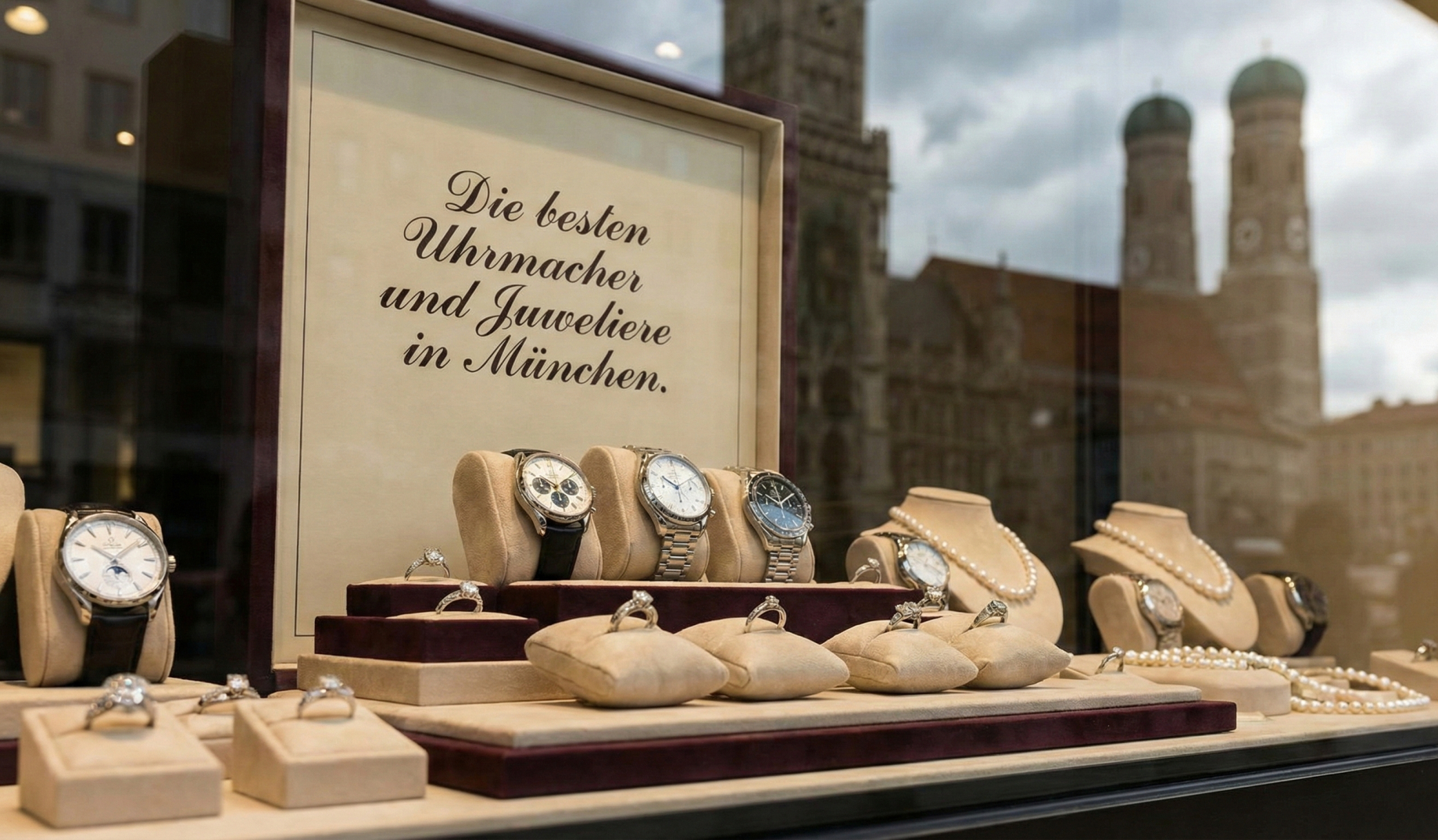
The Bavarian state capital Munich is much more than an economic centre; it is a European metropolis of fine living and deep respect for proven craftsmanship. Anyone strolling along Maximilianstraße or exploring the hidden lanes of the old town immediately senses the appreciation for lasting luxury goods. In this environment, shaped by mercantile tradition and a pronounced sense of quality, a scene has established itself that has few equals worldwide. Especially for lovers and collectors of mechanical timepieces, the city on the Isar is a linchpin that combines historical expertise with state-of-the-art watch service.
The fascination with mechanical watches is, paradoxically, greater than ever in the digital age. While smart wearables become obsolete after a few years, a mechanical watch has an imperishable soul. It is the magic of micromechanics that captivates enthusiasts. Especially with automatic watches with sapphire case backs or artfully finished skeleton watches, in which the complex interplay of gears, springs and the pulsating balance wheel is laid bare, the genius of watchmaking becomes tangible. This visible choreography of tiny, interlocking components turns every glance at the wrist into a small event.
But it is precisely this filigree masterpiece inside the case that demands care which can only be carried out by experienced specialists with a steady hand. A mechanical movement runs without interruption and, despite modern synthetic lubricants, is subject to natural wear. Finding the best watchmaker or jeweller in Munich for a precious Rolex, Patek Philippe, Omega or a rare heirloom is therefore first and foremost a question of trust. A small mistake, a wrong move or a lack of knowledge about historic references can seriously affect the value and function of such a timepiece.
In this guide we shed light on the world of Munich watchmaking in all its facets. We take you to the renowned traditional jewellers in the heart of the city and at the same time show you the hidden studios of the independent master watchmakers dedicated to rescuing historic treasures. You will learn in detail what matters when choosing the right workshop, how a full overhaul proceeds, what it costs and why care by a true master preserves the value of your watch for generations to come.
The Fascination of Mechanical Watches and Munich's Role as a Capital of Watchmaking
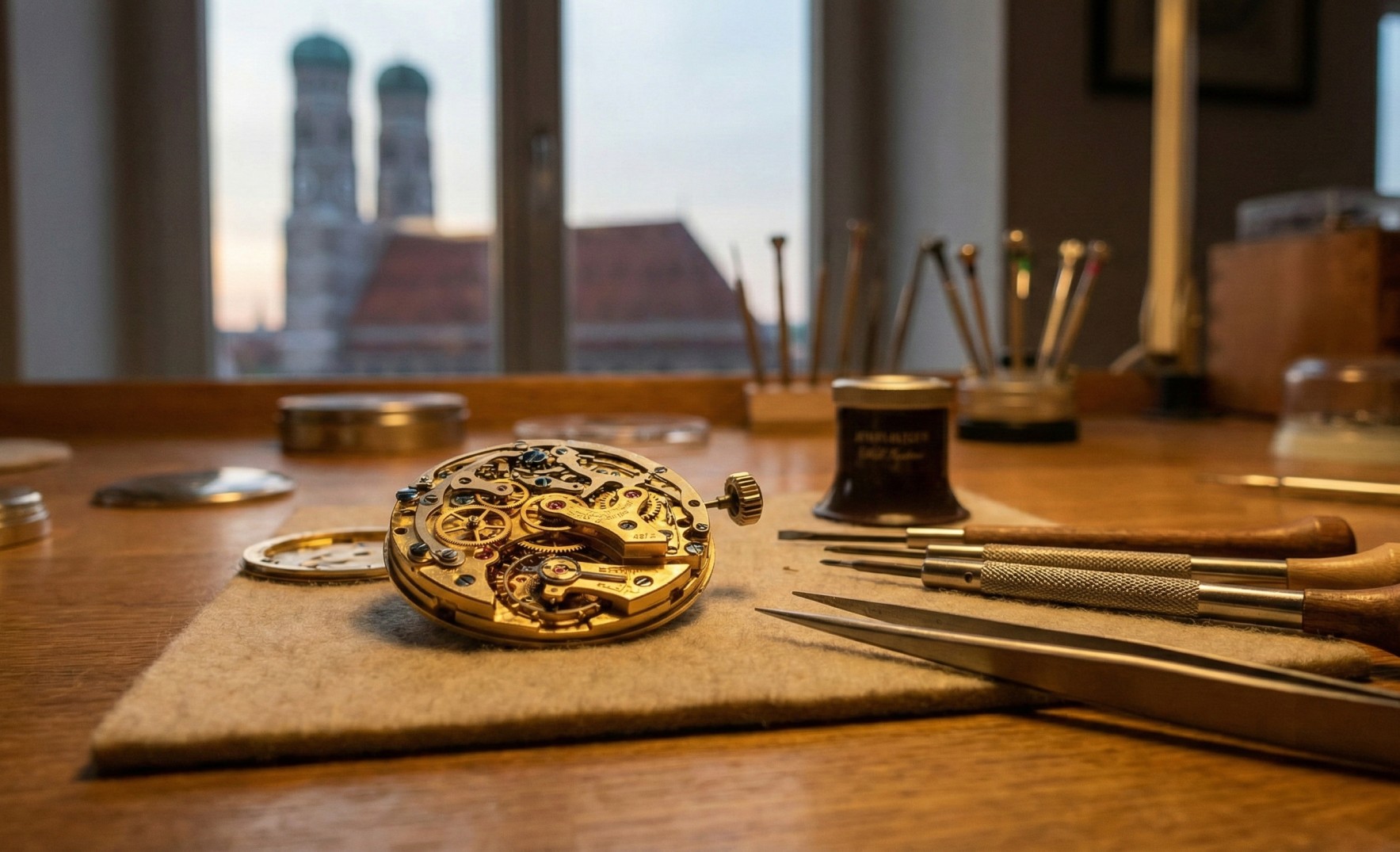
The love of the mechanical watch is a passion that connects people across all generations and cultures. In contrast to an electronic quartz watch or a smartwatch, whose life cycle is often limited to a few years and which is driven by anonymous microchips, a mechanical watch has an undeniable soul. The regular, soothing heartbeat of the balance wheel, the quiet and almost meditative ticking of the escapement and the interplay of gears driven by the energy stored in a mainspring barrel exert a downright magical attraction. Anyone who has once looked through the sapphire case back of a highly complex chronograph or perpetual calendar immediately understands why these little technical marvels are so revered. In this exclusive cosmos, Munich has positioned itself as a stronghold. The city's affluent demographic, paired with a deep understanding of tradition, craftsmanship and understated luxury, creates a perfect biotope for top-class jewellers and watchmakers. Strolling through Munich's city centre, from Marienplatz along Residenzstraße to the world-famous Maximilianstraße, one luxury boutique follows the next. But it is not only the glittering sales that make Munich so special, but above all the deep-rooted knowledge of how to preserve these values. Many of the big jewellery houses maintain their largest and best-equipped service centres in Munich outside the Swiss manufacturers. In addition, there is a lively scene of independent master watchmakers devoted to preserving historic and modern mechanical watches. These masters of their trade are the silent heroes of the industry, who perform real miracles in their often inconspicuous workshops with loupes before their eyes and extremely fine tools in their hands. They rescue rusty, water-damaged vintage watches, make spare parts that have not been produced for decades and restore old heirlooms to their original lustre. Munich's importance in the watch world is also shown by the regular collectors' meetings, auctions and trade fairs held here. The city attracts watch enthusiasts from all over the world, who are not only looking for the latest model but also seek contact with first-class service providers. Anyone entering a watchmaker's workshop in Munich immediately senses the respect for craftsmanship. It smells of special oils, fine metal abrasion and often also of the leather of the many polishing pads. This atmosphere is unmistakable and proof that in an increasingly digitalised world, analogue, traditional craft continues to have an enormous, even growing importance. Investing in a mechanical watch is often a decision for life, and choosing the right watchmaker in Munich is the guarantee that this life continues unharmed across many generations. Incidentally, anyone who shares a passion for old objects will also repeatedly find pocket watches, longcase clocks and collector's items at the antiques shops in Munich, which can then be brought back to life in one of the workshops presented here.
The Most Important Criteria When Choosing the Best Watchmaker or Jeweller for Your Mechanical Watch
The decision about whom to entrust with your valuable mechanical watch should never be made lightly. Whether it is a simple regulation of the rate, replacing a scratched crystal or a full overhaul, choosing the right service provider in Munich requires careful consideration and research. The most important criterion is without doubt the technical qualification and certification of the watchmaker or jewellery house. In the world of haute horlogerie, the big Swiss and German manufacturers such as Rolex, Omega, Patek Philippe, A. Lange & Söhne or Breitling award strict certificates to workshops that meet their high quality standards. A certified service centre in Munich has not only specially trained watchmakers, often trained in the manufacturers themselves, but also direct access to original spare parts, brand-specific tools and the manufacturers' current technical specifications. For owners of modern luxury watches, such a certified partner is often the first and best choice for maintaining warranties and ensuring value retention. Another decisive criterion is the transparency and quality of the advice. An excellent watchmaker will always take the time to examine the watch in detail together with the customer before drawing up a binding cost estimate. They will explain why certain parts must be replaced, what kind of oils will be used and how long the repair is expected to take. This open communication creates the necessary trust that is essential for a long-term customer relationship. The workshop's equipment is just as important. Modern watch repair demands the highest degree of cleanliness and precision; dust and moisture are the greatest enemies of an opened movement. Top workshops in Munich are often equipped as carefully as operating theatres, have overpressure systems against dust ingress and use state-of-the-art timing machines, water-resistance testers working under various pressure conditions and special ultrasonic and rotary cleaning machines. Besides the technical equipment, the watchmaker's experience also plays a major role, especially with vintage watches. Repairing a 50-year-old mechanical watch differs fundamentally from servicing a current model. With vintage watches it is often about preserving the original patina of the dial and hands, carefully handling old luminous compounds such as tritium or radium and, if in doubt, making a defective component anew on the lathe using traditional machining methods instead of simply replacing it with a modern mass-produced part. An outstanding watchmaker understands these sensitive nuances and will never clean the historic dial or replace the hands without first obtaining the collector's express consent, as this could drastically reduce the watch's collector value. Reputation within the Munich watch scene, customer reviews and recommendations from other collectors are also very reliable indicators of a workshop's quality. A jeweller or watchmaker who has been based in Munich for decades and has built up a loyal regular clientele generally delivers consistently high quality, backed by word of mouth and excellent references. Ultimately the choice is also a question of rapport and personal feeling – you have to sense that in this master's hands your own watch is not just an object to be repaired but a treasured piece of watchmaking art.
The Elaborate Process of a Full Overhaul of a Mechanical Movement
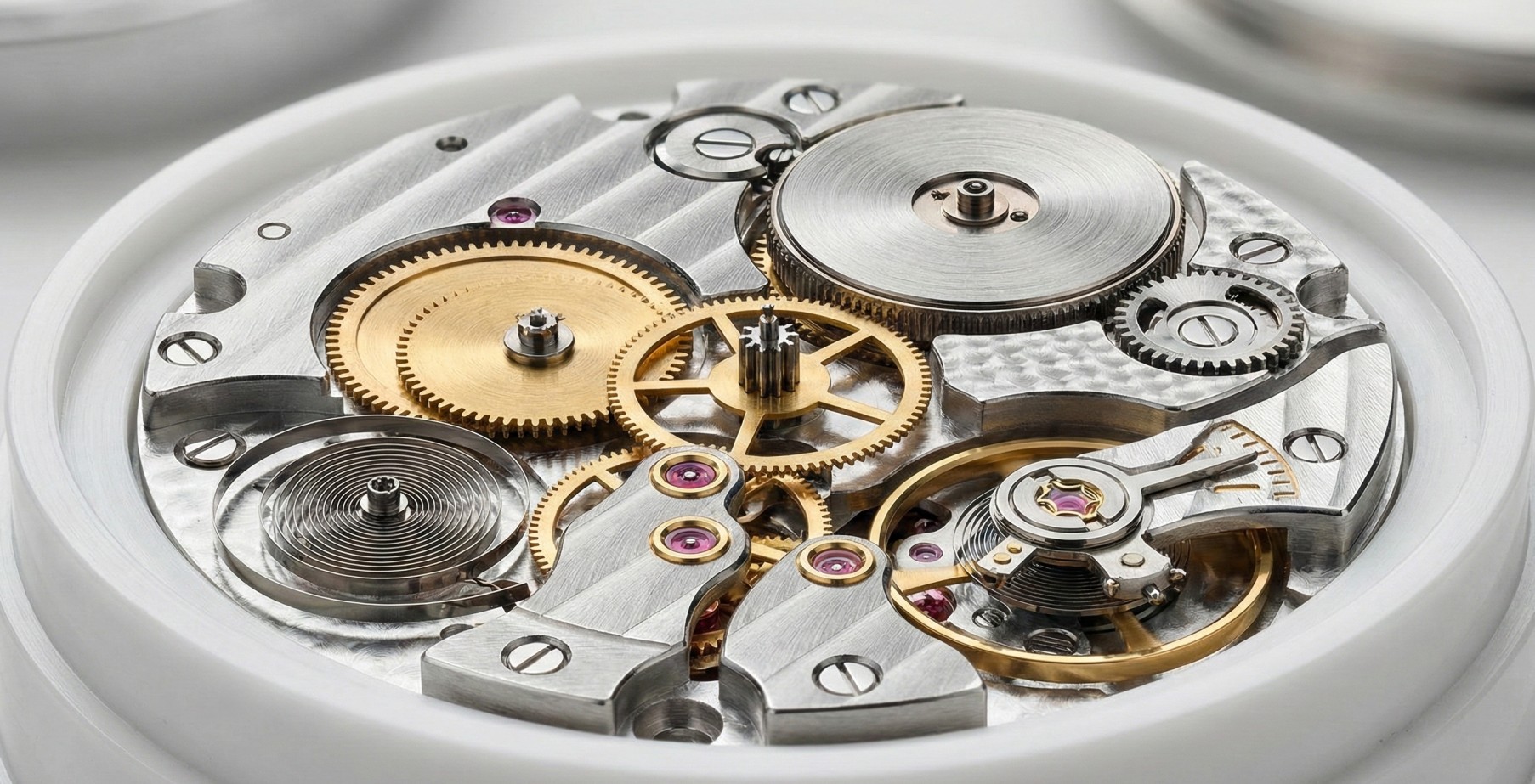
Many owners of mechanical watches wonder why servicing or overhauling their watch at a renowned Munich jeweller or specialist workshop often costs several hundred or even a thousand euros and not infrequently takes many weeks. The answer lies in the complexity and the craftsmanship involved in a full overhaul. A mechanical watch runs continuously, 24 hours a day, 365 days a year. The fine pivots of the gears turn millions of times in their synthetic ruby bearings. Even with the best construction, this permanent friction causes microscopic wear, and the special synthetic oils and greases that lubricate the movement turn gummy, dry out or evaporate after about five to eight years. A full overhaul is therefore like a complete fresh start for the mechanics. The process begins with careful external inspection and the removal of the strap and case. The centrepiece, the movement, is carefully taken out of its case, after which the delicate hands and dial are removed and stored safely in dust-free protective containers. What follows is what only true specialists master flawlessly: the complete disassembly of the movement into all its individual parts. Even a simple three-hand movement consists of well over a hundred tiny components, while a chronograph or a watch with complications can consist of several hundred to over a thousand individual parts. Every screw, however small, every tiny spring and every tiny wheel is checked individually for wear, scratches or damage under the microscope or the watchmaker's loupe. Defective or worn parts, such as worn winding stems, fatigued mainsprings or damaged gears, are sorted out at this point and replaced with original spare parts from the respective manufacturer. In the next step, all remaining components are cleaned in special rotary machines. The parts pass through various chemical baths and ultrasonic cleanings to remove old oil residues, microscopic metal abrasion and dirt completely. After complete drying, the most fascinating and delicate part of the work begins: reassembly. The Munich watchmaker puts the movement back together step by step. Every bearing, every escapement and every tiny friction point must be lubricated with exactly the prescribed type and quantity of oil or grease. The manufacturers specify strict epilame and lubrication plans for every single component, because too much oil can gum up the movement just as too little oil leads to immediate wear. A masterpiece of precision is the fitting and alignment of the balance wheel and hairspring, the watch's actual heartbeat. Once the movement is fully reassembled, it is precisely measured and regulated on the timing machine in various positions (dial up, dial down, crown up, crown down and so on) for rate, amplitude and beat error. In parallel with the movement overhaul, the workshop takes care of the case and the metal bracelet. If the customer wishes, these are professionally ground, satin-finished and polished to a high shine in several steps to remove deep scratches and signs of wear without distorting the case's original edges and geometries. Case gaskets, tube, crown and pushers are, as a matter of principle, always replaced with new components to fully restore water resistance. Finally, dial and hands are refitted, the movement is cased up again and the watch undergoes a strict final inspection for several days on special rotating devices, the so-called watch winders. Only when the watch shows a constant, precise rate even after days and has passed all tests for water resistance and power reserve is it handed back to the customer in Munich with a new service warranty.
What an Overhaul Costs and How Long It Takes
Flat prices cannot be quoted seriously in this craft, but the factors that determine the amount can. Decisive first is the complexity of the movement – a simple automatic movement with a date causes a fraction of the work of a column-wheel chronograph or a perpetual calendar. Second, the scope decides: a pure service with cleaning, relubrication and regulation is well below an overhaul in which wear parts, gaskets and crystal are also renewed. Third, parts availability plays a big role. Original parts for current models are calculable, while a handmade spare part for a watch from the 1950s can mean many working hours at the lathe.
The duration varies accordingly. Smaller jobs such as demagnetising, a battery change on a quartz watch in your collection or a pressure test are often a matter of minutes to days. A full overhaul at a Munich specialist workshop, by contrast, typically takes several weeks, and with certified manufacturer services that ship to Switzerland it can take several months. If you want your watch back by a certain date – for example as a gift or for an occasion – you should mention this when handing it in. Reputable businesses will give you a realistic timeframe, may charge a fee for the assessment that is credited if you place the order, and obtain your consent before any cost overrun. Have the cost estimate and the replaced parts documented in writing; this is worth real money later on resale.
Renowned Traditional Jewellers for Mechanical Luxury Watches in Central Munich
The centre of Munich, especially the streets around Maximilianstraße, Marienplatz, Residenzstraße and Theatinerstraße, is among the most exclusive addresses in the world for lovers of fine mechanical watches. This is where the big, long-established jewellery houses are based, serving not only as retail outlets for the most coveted luxury brands in the world but also having very well-equipped in-house master workshops. One of the big players in Munich is without doubt the house of Wempe, which has several branches in the city. Wempe in Munich enjoys an excellent reputation for its large selection of top brands and in particular for its certified watchmaking studio. As an official service partner of almost all the big Swiss manufacturers, Wempe offers repairs and overhauls at the highest international level. The watchmakers there are permanently trained in the Swiss manufacturers, which ensures that even the most complicated mechanical movements are treated according to the strict manufacturer specifications. Another giant in Munich's jewellery landscape is Bucherer. The Swiss family business has built an outstanding position in Munich and attracts customers with an impressive multi-brand boutique in which haute horlogerie is positively stacked. Bucherer's in-house service department in Munich is known for its efficiency, its expertise and its discretion in handling high-priced collector's pieces. Here too, manufacturer service is in the foreground, and customers can rely on their watches being repaired exclusively with original spare parts. Alongside these globally operating houses, Munich also has strongly regionally rooted traditional jewellers that shape the character of the city. The Leinfelder jewellery manufactory, which devotes itself intensively to watchmaking in addition to excellent jewellery, is an address for individualists who value personal commitment and the highest craft precision. Family businesses such as Juwelier Hilscher in the sought-after district of Schwabing are also worth mentioning, known far beyond the city limits for their warm and highly professional customer service on mechanical watches. These jewellers combine the presentation of the current collections from Rolex, Omega, IWC, Jaeger-LeCoultre or Cartier with a workshop service that need not hide from the workshops in Geneva or Glashütte. The great advantage for the customer at these renowned Munich jewellers lies in the high level of security and the certainty that service work is officially documented. An overhaul carried out by Wempe or Bucherer and backed by papers maintains or considerably increases the resale value of a luxury watch. Consultation in these houses takes place in elegant, discreet lounges, where you discuss the details of the upcoming repair over an espresso or a glass of champagne. Such jewellers are the perfect first port of call for owners of current or mid-aged mechanical watches who value official manufacturer service, unrestricted warranty benefits and the luxurious setting of a classic top jeweller.
Independent Master Watchmakers and Specialist Workshops in Munich
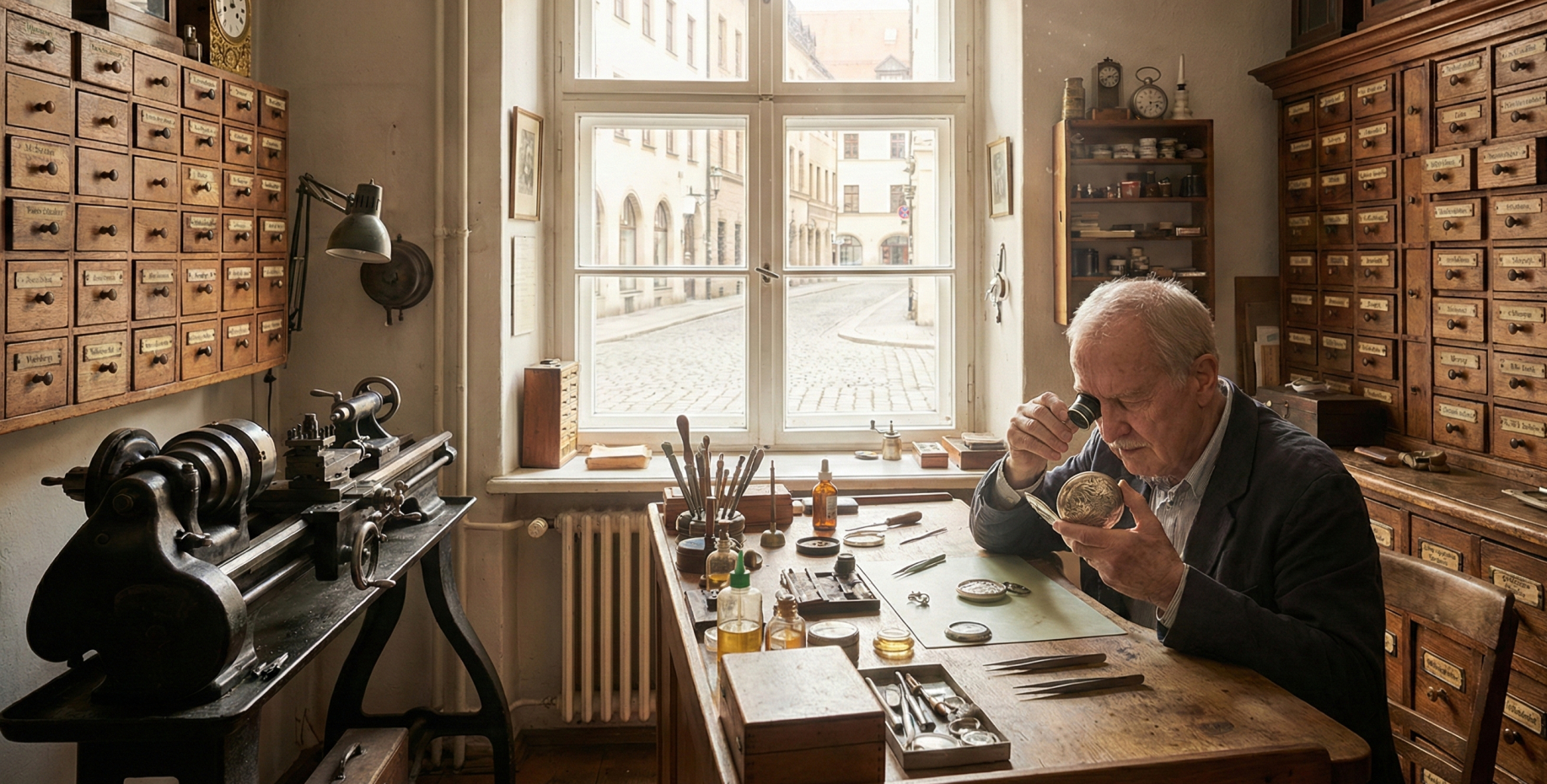
Away from the glamour of the big jewellery houses on Maximilianstraße, Munich has a second, at least equally fascinating world of watchmaking: the small, often owner-run and completely independent watchmaking workshops. These master businesses are the beating heart of traditional craft. They are often found in the quieter side streets of Haidhausen, Sendling, Nymphenburg or the Glockenbachviertel and form an important counterpoint to the official manufacturer concessionaires. Going to an independent master watchmaker in Munich is often the best and sometimes even the only choice when it comes to restoring and repairing genuine vintage watches, historic pocket watches, antique pendulum clocks or old chronographs. Many official manufacturer service centres refuse to repair watches older than thirty or forty years, because standardised spare parts are no longer in stock or the effort does not fit into their tightly timed service processes. This is exactly where the work of the true artists among Munich's watchmakers begins. These highly specialised craftspeople have the knowledge to understand old and forgotten mechanisms. They own historic tools, lathes and milling machines to rebuild a broken little wheel, a worn balance staff or a rare mainspring precisely from a raw piece of brass or steel in hours of meticulous handwork. A different philosophy prevails in these workshops in Munich: it is not primarily about quick, standardised part replacement but about the conservation of historic substance. With a rare 1960s Rolex Submariner or an old Omega Speedmaster chronograph, an experienced independent Munich watchmaker will take meticulous care to leave the dial, hands and original bezel untouched so as not to destroy the watch's collector value. The advice from these independent masters is often incomparably personal. You do not stand at an anonymous sales counter but directly at the master's workbench. You can watch them work over their shoulder, discuss the weak points of your own movement and voice individual wishes regarding regulation or case refinishing. In addition, these independent workshops in Munich often also offer servicing and repair for a wide range of brands, independent of concessions. Anyone who owns a varied collection that includes brands such as Sinn, Nomos, old Heuer chronographs, vintage Breitlings or complicated pocket watches will often find in a competent Munich master watchmaker a lifelong companion for their entire collection. Moreover, although the craft level is very high, service costs at independent watchmakers in Munich are often more transparent and moderate than the flat prices of the big luxury-brand service centres, since the focus here is on the pure time spent and the craftsmanship, without having to co-finance the overheads of global marketing machinery.
The Market for Buying, Selling and Appraising Used Mechanical Watches in Munich
Munich is not only a centre for repair but also one of the most important marketplaces in the German-speaking world for trading high-quality used mechanical watches, vintage treasures and so-called certified pre-owned models. The market for pre-owned luxury watches has grown strongly, driven by the scarcity of new models from popular brands, the long waiting lists at the concessionaires and the growing awareness of watches as a value-retaining investment. In this dynamic and at times confusing market environment, the expertise of Munich's best watchmakers and specialised vintage dealers is invaluable. Anyone who wants to buy a used Patek Philippe Nautilus, a Rolex Daytona or a rare vintage diving watch in Munich should not do so on dubious platforms but turn to the established local experts. Numerous top jewellers and renowned watch dealers in Munich have specialised in buying, selling and reputable brokering of these treasures. The decisive advantage these Munich experts offer is the guarantee of authenticity and mechanical perfection. Before a used luxury watch reaches the display of a reputable Munich dealer, it undergoes a rigorous testing process in the attached watchmaking workshop. The masters open the case and check every engraving, every serial number and every single component of the movement for originality in order to expose so-called "Frankenwatches", watches assembled from various, often non-original parts, beyond doubt. In addition, the movement is often given a full overhaul before sale, so that the buyer receives a multi-year in-house warranty on the pre-owned piece. The renowned Munich addresses also offer great advantages for sellers. Anyone who wants to sell an inherited or no longer worn mechanical watch receives a realistic, market-based price assessment here, founded on up-to-the-minute international auction results and market data, combined with a condition assessment by the watchmaker. Some specialised boutiques in the heart of Munich, such as dealers in Bogenhausen or in the old town, have built an international reputation and have a worldwide network of collectors. They often act not just as dealers but as highly specialised advisers who search the world for specific, extremely rare references on behalf of their clients. The Munich market benefits enormously from this interplay of solid merchant tradition and deep watchmaking understanding. When the dealer is at the same time a business run by a master watchmaker, the typical risks of the secondary market almost completely disappear, and collecting and investing in mechanical watches becomes a safe, transparent and joyful matter in the Bavarian state capital.
Tips on Caring for Mechanical Watches and Preserving Their Value from Munich's Experts
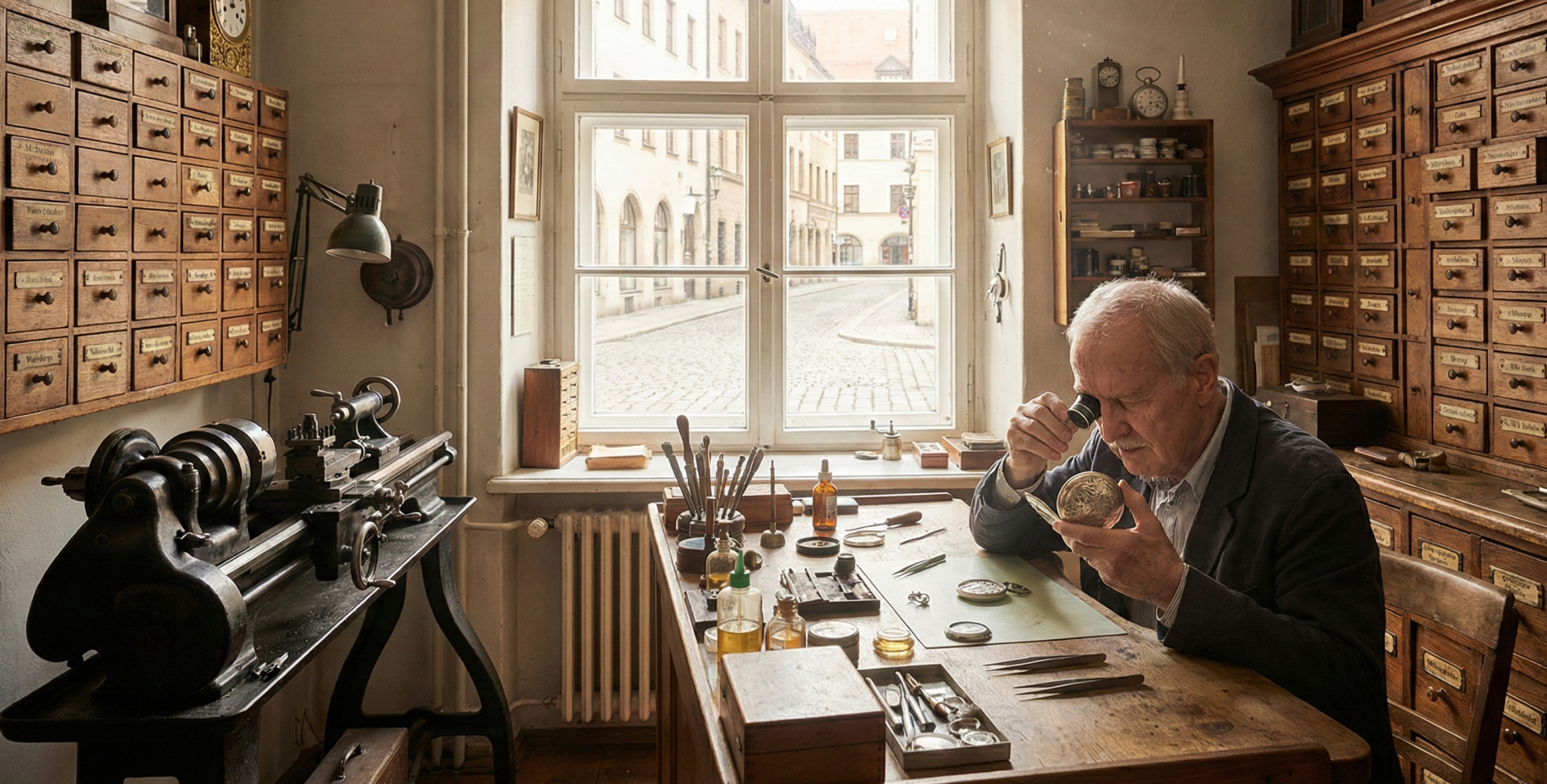
Even the most outstanding work by the best watchmakers and jewellers in Munich cannot prevent a mechanical watch from suffering in the long run if it is not treated with the necessary respect and proper care in everyday life. Munich's master watchmakers never tire of stressing that value retention and longevity of a highly complex mechanical timepiece depend heavily on the wearer's behaviour. A mechanical movement, however robust it may be made by modern shock protection such as Incabloc or Paraflex, is ultimately a highly sensitive structure. The experts' first and most important advice is to avoid hard knocks, massive shocks and extreme vibrations. Activities such as playing golf, tennis, chopping wood or mountain biking are pure poison for the hair-fine pivots of the balance staff and the precise alignment of the hairspring. Even if a modern luxury watch is marketed as a sports watch, this does not mean its filigree heart will survive such stresses unharmed in the long run. Another risk in modern everyday life is magnetism. Today we are permanently surrounded by strong magnetic fields – from smartphones, laptops, speakers, induction hobs and even the magnetic clasps of handbags. If the balance spring of a mechanical watch becomes magnetised, its tiny coils stick together so that the watch runs drastically fast, often by several minutes a day. The best watchmakers in Munich have to demagnetise watches every day – a fortunately quick and inexpensive procedure that can, however, be easily avoided with some care when laying the watch down on electronic devices. Water resistance is also the subject of constant misunderstandings. The gaskets of a watch made of rubber or Teflon age, dry out and become porous – influenced by sweat, cosmetics, chlorinated water, salt water and strong temperature fluctuations. Master watchmakers in Munich urgently advise having the water resistance of a mechanical watch that is worn while showering, swimming or diving checked by a professional at least once a year, ideally shortly before the summer holiday. Such a pressure test takes only a few minutes but can save you from expensive water damage in the movement. If the watch has been worn in salt water, it must afterwards be rinsed under running fresh water to remove aggressive salt crystals, which in the long run attack even high-quality stainless steel and destroy gaskets. Operating the mechanical functions also requires care. For example, the date on mechanical watches should never be quick-set in the period between about 9pm and 3am. During this phase the delicate gears of the date mechanism are already engaged, and manual intervention via the crown can damage the movement. As for cleaning, Munich's jewellers recommend regularly freeing the metal case and metal bracelet of dust, skin flakes and sweat with a very soft brush, a little lukewarm water and mild soap, since this dirt, mixed with movement, acts in the long run like abrasive sandpaper and accelerates wear on the bracelet links. If the watch is not worn for a longer period, it is advisable not to leave it lying for years in a dark safe, as otherwise the oils in the movement can stiffen. Instead, a high-quality watch winder or regular, gentle hand winding every few weeks is recommended to keep the lubricants in the movement in motion. Anyone who heeds these basic but important care tips from Munich's best watchmakers ensures that their mechanical work of art functions reliably for many decades, holds or even increases its value and keeps its lustre.
Conclusion: Preserving Time as a Masterly Craft in Munich
In summary, Munich offers owners of high-quality mechanical watches an infrastructure that operates at world-class level in density and quality. The city shines through a balance of two complementary worlds. On one side are the glamorous, globally connected traditional jewellers in the centre, who score with certified manufacturer service, seamless documentation and a luxurious brand environment. On the other side, the independent, often owner-run watchmaking workshops enrich the city, performing real miracles in the restoration of vintage watches with patience, historic tools and deep knowledge of detail.
The decision about whom to entrust your valuable timepiece to depends largely on your individual needs, the respective watch brand and the age of the model. Whichever workshop you choose, however, one universal truth remains: a mechanical watch is not an ordinary everyday object but a work of art that needs care. Regular servicing, professional water-resistance tests and respectful handling in everyday life are the indispensable cornerstones for protecting the financial and emotional value of this investment in the long term.
Ultimately, preserving a mechanical movement is always also preserving a great tradition. Whether it is an indestructible diver's chronograph or a highly elegant automatic skeleton watch in which you can watch the ceaseless dance of the escapement with every tick – only through the masterly hands of a skilled watchmaker does this mechanical heart stay alive. The passion with which Munich's experts adjust tiny balance staffs, remove gummed-up oils and return scratched cases to their original condition testifies to a deep respect for analogue brilliance.
Munich will remain a centre in the future for all those who do not simply want to read the time but to celebrate it in its most beautiful form. Anyone who makes use of the local watchmakers' expertise and takes the care advice seriously ensures that their timepiece loses none of its precision and magic even after decades. In this way a simple watch becomes an heirloom that outlasts generations and carries the craftsmanship of the city on the Isar into the future. And if you would like to combine your workshop visit with a pleasant day in the city, you will find many more addresses in our recommendations for Munich – for example for rounding things off in one of the best gourmet bars in Munich.
Frequently Asked Questions About Watchmakers and Jewellers in Munich
How often does a mechanical watch need an overhaul?
As a rule of thumb, Munich's specialist workshops cite an interval of about five to eight years, because the synthetic oils break down or evaporate in this period. What matters, though, is the condition, not the calendar: if the rate deviation increases, the power reserve drops noticeably or the crown becomes stiff, you should not wait for the appointment. Watches worn daily and under strain need service sooner than pieces kept in a display case.
Should I go to a brand service or an independent watchmaker?
For current luxury watches with a valid warranty, and for models where seamless documentation determines the resale value, the certified manufacturer service is the safe choice. For vintage watches, older chronographs and pocket watches, Munich's independent master businesses are often superior, because they make missing parts themselves and preserve the original substance instead of replacing it with mass-produced parts.
What does an overhaul cost in Munich?
A flat figure would be unreliable, because the price depends on movement complexity, scope of work and parts availability. A simple three-hand movement sits at the lower end, a chronograph or a watch with complications well above it, and handmade spare parts for vintage models add extra working hours. Always ask for a written cost estimate before work begins.
My watch is suddenly running several minutes fast a day – what should I do?
This is the classic symptom of a magnetised balance spring, usually caused by laptops, speakers, induction fields or magnetic clasps. Demagnetising is among the quickest and cheapest procedures a watchmaker performs and is usually done within a few minutes. If the deviation persists afterwards, there is usually a mechanical problem and a check on the timing machine is due.
What should I look out for when buying a used watch in Munich?
Buy from dealers who run their own workshop or work with one. Ask to see serial numbers, movement number and papers, and ask about the last overhaul and whether the dial, hands and bezel are original. Reputable Munich addresses will open the case on request, explain the condition of the movement and give their own warranty on the pre-owned piece.

Sarah Müller
Reise- und Lifestyle-Journalistin