München
Munich's Best Craft Bakeries for Traditional Bread and Pastries
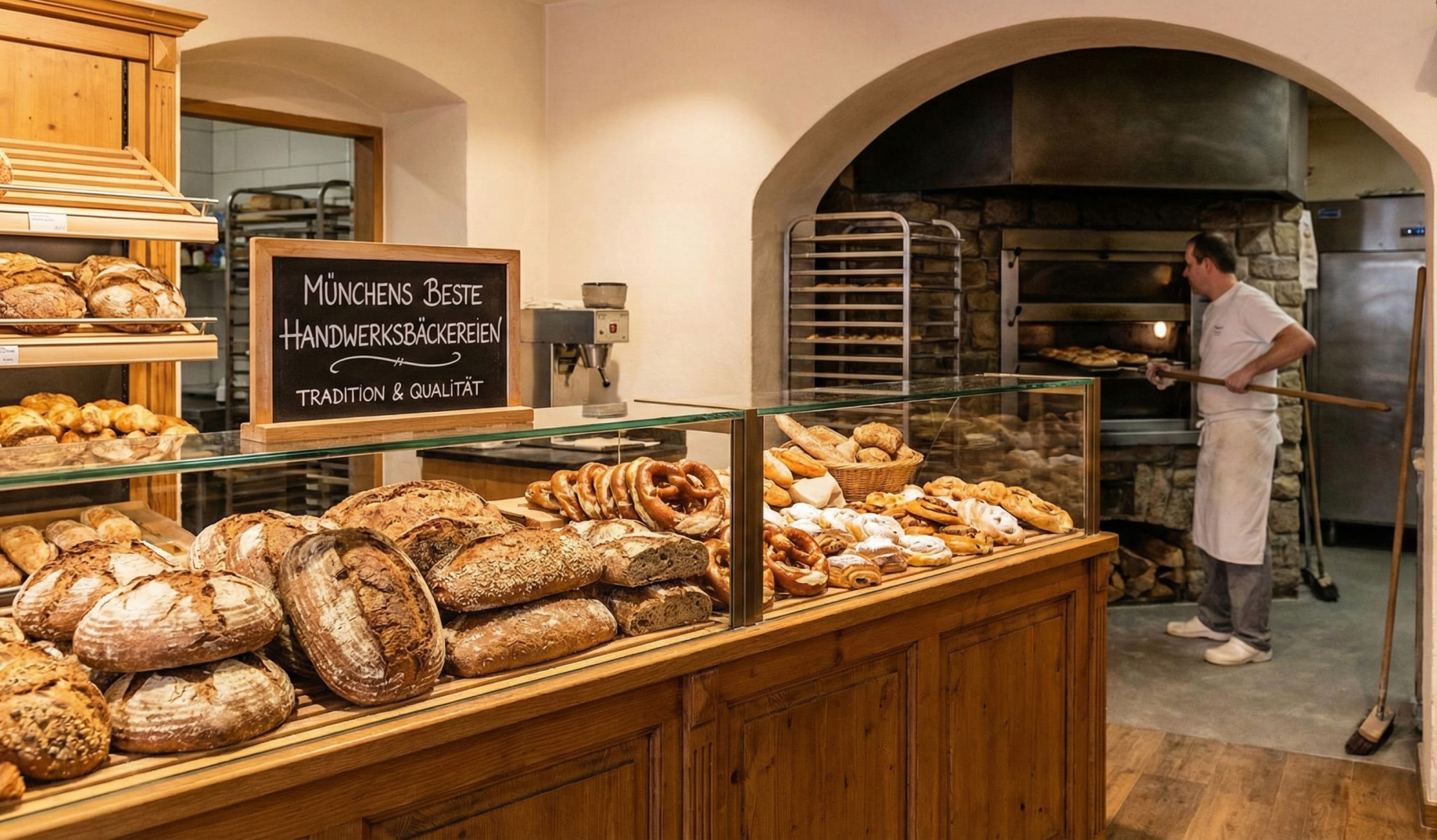
There are few scents that have such an immediate, profound effect on our well-being as the smell of freshly baked bread just out of the oven. This scent promises warmth, security and a primal pleasure anchored deep in our cultural DNA. But in an age when baked goods are increasingly made industrially in huge factories, transported deep-frozen halfway around the world and merely baked off in supermarkets, this genuine experience threatens to be lost. The standardised crumb, the optimised fluffiness and the uniform taste of industrial bread have dulled our palates over the years. But in Munich, a city that upholds its traditions, a wonderful resistance to the standard bread roll is stirring. A renaissance of the true baker's craft is in full swing, carried by a new generation of passionate craftspeople and by long-established family businesses that steadfastly refuse to compromise on quality.
Munich, with its rich Brotzeit culture, its world-famous beer and the indispensable pretzel, is the ideal soil for this development. Munich people are discerning connoisseurs. They know that a good Leberkäse roll only works with a crisp, craft-made roll and that Obatzda demands a strong, tangy farmhouse bread. This deeply rooted appreciation of quality forms the foundation on which the city's best craft bakeries flourish. For these bakers it is not about nostalgia but about a return to the essentials: flour, water, salt and, as the most important ingredient, time. In their bakehouses nature is not tricked with raising agents and technical enzymes; instead they work with it. Long dough fermentation of often 24 to 48 hours, the care of complex natural sourdoughs and the shaping of loaves by hand are not marketing phrases here but lived daily reality.
The search for the best bread in the city is therefore also a journey to the roots of flavour. It is a voyage of discovery that teaches us that bread is not just bread. A true craft bread has character; it has a crust that crackles and splinters when cut, a crumb that is juicy and aromatic, and a taste that develops in the mouth and lingers long. This quality has its price, because handwork and time are expensive factors in a thoroughly economised world. But once you have tasted the difference, once you have understood that a long-fermented bread not only tastes better but is also easier to digest, it is hard to return to industrial produce. Investing in good bread is an investment in quality of life and health.
In this comprehensive guide we turn to the outstanding players in Munich's bread scene. We introduce you to bakeries that not only carry craftsmanship in their name but celebrate it daily in the bakehouse. We look behind the scenes, explain the philosophies of the various master bakers and reveal where you will find the darkest crusts, the juiciest rye breads and the most authentic pretzels in the metropolis on the Isar. Join us on a tour through the districts, from Schwabing to Haidhausen, on the trail of unadulterated flavour. Get ready to recalibrate your definition of good bread, because what these craftspeople pull from the oven is far more than just a staple food – it is a piece of culture. You will find more culinary tours of the city on our page with recommendations for Munich.
Julius Brantner Brothandwerk: The Avant-Garde of Sourdough
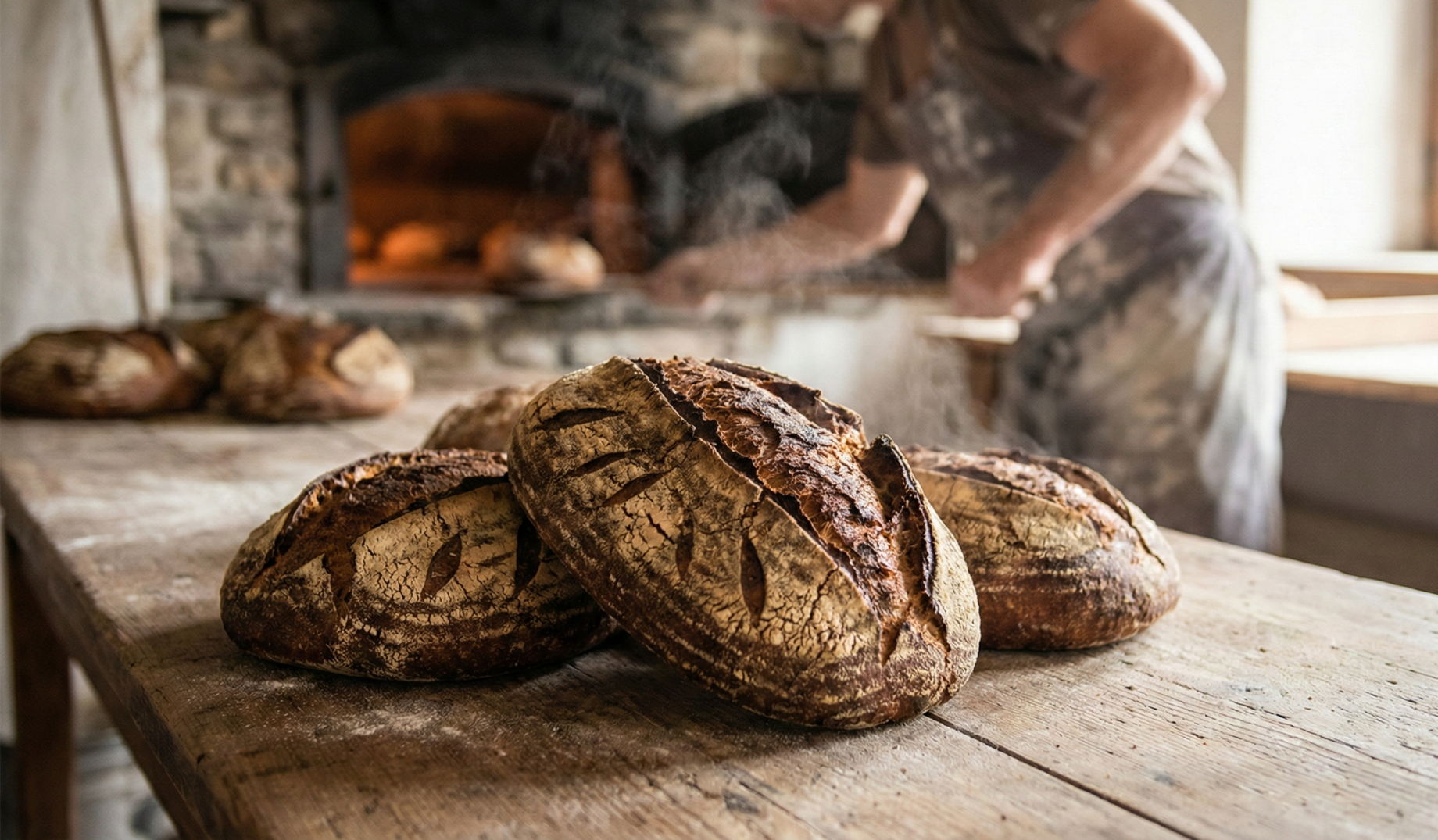
Julius Brantner is undoubtedly the best-known face of the new generation of Munich bakers and, with his minimalist bakehouse near the Siegestor, has triggered a real hype around “real bread”. Brantner, who comes from a long-established baking family, has deliberately turned away from the conventional paths of the modern baking trade in order to return to the roots, but to interpret them in a radically modern way. His concept is purist: there are only a few kinds of bread, no sprawling cake counter, no filled snacks. The focus is one hundred percent on the loaf of bread. His philosophy is based on absolute reduction to the basic ingredients and the maximum extension of maturing time. In his glass-walled production, visible to every customer, he demonstrates that craftsmanship has nothing to hide. Transparency is part of the concept; the customer should see how much physical work and devotion goes into every single product.
The stars of Brantner's range are his large-format sourdough breads, which acquire their unmistakable character through an extremely long dough fermentation of up to 48 hours. This long fermentation is the key to everything: it not only creates the complex flavour development, ranging from mildly tangy to deeply malty, but also breaks down hard-to-digest components of the grain (FODMAPs), which makes the bread particularly easy to digest. His breads are distinguished by a very dark, almost caramelised crust – a deliberate stylistic device, since most flavour compounds sit in the crust, produced by the Maillard reaction during baking. Inside, the connoisseur finds a wild, open crumb structure and a moist, elastic crumb that stays fresh for days. The signature bread, the “Münchner Hauslaib”, is a prime example of this new school of baking, which combines traditional techniques with modern knowledge of microbiology.
A visit to Julius Brantner often involves a queue, especially at weekends, which underlines Munich people's enormous longing for quality. But the wait is worth it. The experience of receiving a still-warm loaf whose scent accompanies you all the way home is incomparable. Brantner has managed to make bread a premium product again, one that deserves its own appreciation and doesn't merely serve as a carrier for toppings. His craft bakery has set standards in Munich and inspired many others to take the path back to the natural product as well. The somewhat higher price of his breads quickly puts itself into perspective when you consider the quality, the keeping properties and the enormous craft effort behind every loaf.
Hofpfisterei: Guardian of Pure Rye Tradition
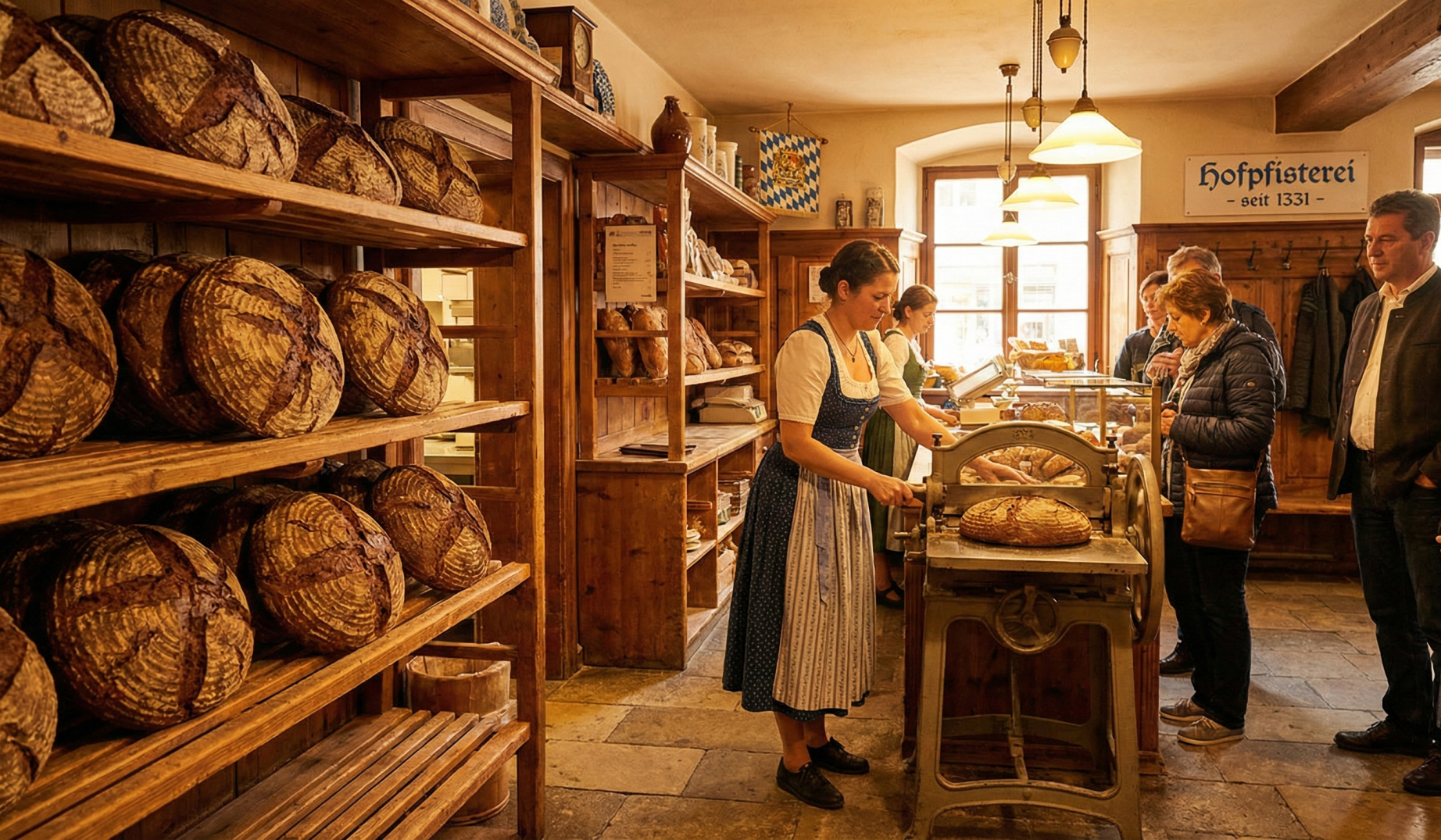
When you talk about traditional bread in Munich, you can't get past the Hofpfisterei. It is an institution whose roots go back to the 14th century, when it was still the ducal court bakery. Today the Hofpfisterei is synonymous with uncompromising organic baking and the preservation of Bavarian rye bread culture. Long before “organic” became a mainstream trend, the Hofpfisterei switched completely to organic ingredients as early as the 1980s – a visionary step that was smiled at back then but is recognised today as a pioneering achievement. The unmistakable blue lettering and the characteristic, spicy scent streaming from its numerous branches all over the city are firmly part of Munich's cityscape. The Hofpfisterei proves that craft principles can also be applied on a larger scale if the basic convictions are right.
The centrepiece of the Hofpfisterei is the pure natural sourdough, which is managed in an elaborate three-stage process. This process is essential to make pure rye flour bakeable at all and to give it its typical, strongly tangy taste. The Hofpfisterei's breads are no lightweights; they are compact, juicy and heavy loaves that give strength. Classics such as the “Pfister Öko-Sonne” or the “Bauernbrot” are epitomes of southern German bread flavour. A special feature is the baking method in thermal-oil ovens. This technique provides very even, mild radiant heat that makes it possible to bake the large loaves long and gently, forming a thick, aromatic crust that protects the juicy interior like a natural safe and keeps the bread fresh for many days.
Despite its size, the Hofpfisterei has retained many craft steps. The “Rundwirker” and “Langwirker” in the central bakehouse are still people, not machines, who give the dough pieces their shape and tension. The consistent rejection of chemical baking aids, preservatives or artificial acidifiers is law here. The Hofpfisterei stands like a rock against the industrialisation of taste and offers Munich people a reliable source of bread that tastes like in grandmother's day – honest, earthy and unadulterated. It is a living monument of Bavarian bread culture that shows that tradition and ecological responsibility can be forward-looking.
Bäckerei Neulinger: Organic Pioneers with Heart in Haidhausen and Sendling
Bäckerei Neulinger is far more than just a place to buy bread; it is a fixed part of neighbourhood culture in the districts of Haidhausen and Sendling. Ludwig Neulinger has created places here that combine the traditional baker's craft with a cosy coffeehouse culture. The house philosophy is simple yet demanding: “Where craftsmanship is at home”. This means a consistent turning away from any ready-made mixes and frozen dough pieces. Everything that goes over the counter here is made from scratch in the bakery's own bakehouse in the Schlachthofviertel, and exclusively from organic ingredients. Transparency and closeness to the customer matter to Neulinger, which is why at the Sendling branch you can watch the bakers at work directly through large windows.
The bread range at Neulinger is varied and reflects the breadth of true craftsmanship. Alongside strong rye sourdough breads there are also excellent spelt breads, airy baguettes in the French style and innovative creations with ancient grains. Especially worth highlighting are the “scooped” breads. In this traditional technique, a very soft, water-rich dough is “scooped” (lifted) from the vat with wet hands and shot straight into the oven. The result is a bread with an incomparably juicy, glossy crumb and a wild crust that stays fresh for an extremely long time thanks to the high water content. The use of regional organic grain also strengthens local economic cycles and guarantees short transport routes, which fits the bakery's idea of sustainability.
But it is not only the bread; the fine pastries at Neulinger are also worth a sin and follow the same strict quality criteria. The doughnuts contain real butter instead of cheap palm fat, the fillings are cooked from real fruit and not from buckets with artificial flavourings. The Danish pastries are flaky and buttery, the cakes taste homemade. Bäckerei Neulinger proves that ecological responsibility and the highest enjoyment are no contradiction. The lively atmosphere in the attached cafés, where young and old meet to enjoy a piece of craft-made cake with a cappuccino, makes Neulinger an important social anchor in the neighbourhood and a beacon for living food craftsmanship.
Cumpanum: Radical Transparency and Purity
Cumpanum, founded by master baker André Heuck, pursues one of the most consistent approaches in the modern craft bakery, which can be summed up briefly as “bread without the fuss”. In an industry where ingredient lists are often long and incomprehensible, Cumpanum takes the opposite route of radical purity. The bakery renounces one hundred percent technical enzymes, baking agents, preservatives or other additives that are standard in industry to speed up processes and standardise results. At Cumpanum there is only grain, water, salt and natural sourdough or yeast. This self-restriction demands the highest craft skill, because without the little helpers from the laboratory the baker must understand the behaviour of the dough perfectly and be able to react flexibly to fluctuations in the raw materials.
A special feature of Cumpanum is the variety of grains used. Besides wheat and rye, ancient grains such as emmer, einkorn and spelt are increasingly used, often offering more intense, nuttier flavour profiles and perceived by many people as more digestible. Long dough fermentation is the be-all and end-all here too. The doughs are allowed to mature for many hours to develop their aromas and to swell the starch. The result is breads with enormous flavour density that are very filling and have a naturally long shelf life. You taste the difference from “pumped-up” industrial breads immediately; Cumpanum's breads are more compact, more honest and earthier in taste.
Cumpanum's concept is also an educational one. In the shops, which can be found at several locations in Munich and the surrounding area, the principle of transparency is lived. The bakehouses are often designed openly, and the staff are trained to explain to customers exactly why a bread may look slightly different today than yesterday – because natural products are being processed and no standardised industrial process is running. This approach resonates with customers who increasingly question what is in their food. Cumpanum successfully shows that a return to absolutely pure ingredients is not only possible but can also be economically successful if the quality of the end product convinces.
The Renaissance of the Pretzel: Where Munich's Emblem Is Still Handmade
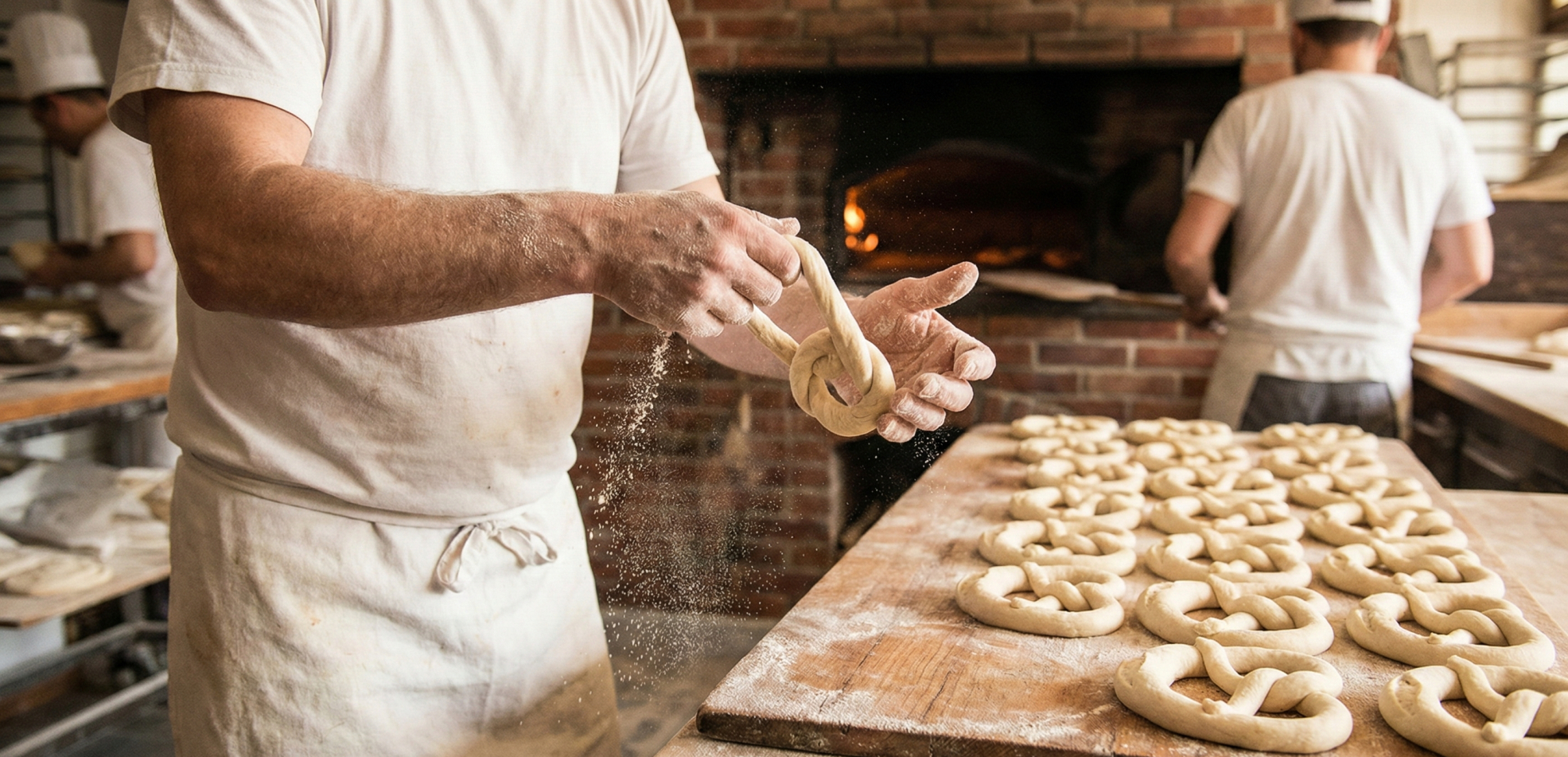
No pastry is so inseparably linked with Munich as the pretzel. It is cultural heritage, staple food and symbol of the Bavarian way of life in one. But this very emblem has suffered badly from industrialisation. The mass-produced frozen dough pieces, inflated in bake-off stations into uniform, often bland and fluffy creations, have hardly anything in common any more with a real, craft-made Munich pretzel. A real pretzel must have character: the arms must be thin and crisp, the “belly” on the other hand thick, soft and juicy. The “Ausbund”, the tear on the belly, must have burst open wildly and naturally, and the colour must be a deep, glossy chestnut brown, produced by the correct lye and the right heat.
The search for Munich's best pretzel inevitably leads to the craft bakers who still take the trouble to make this complex pastry themselves. The difference begins with the ingredients: while industry often uses cheap vegetable fats, traditionalists swear by lard or at least good butter in the dough, which is decisive for the typical, hearty flavour and the delicate shortness. The pretzel dough also needs time to mature before it is – ideally by hand – twisted. Pretzel twisting is an art in itself that requires speed and precision to produce the characteristic shape with the strands of different thickness. Only through this handwork do the desired texture differences between the crunchy arm and the soft belly arise.
Bakeries such as the already mentioned Neulinger or Brantner, but also other local greats such as the craft bakery Riedmair, hold high the flag of the real pretzel. A handmade pretzel from these masters is a sensory experience: it crackles when you bite into it, smells malty and of lye, and has a deep, complex flavour of its own that needs no toppings but of course reaches absolute peak form with good butter. These pretzels are often somewhat smaller and more irregularly shaped than their industrial cousins, but precisely this imperfection is the hallmark of handwork. They are proof that even a seemingly simple everyday pastry can become a culinary highlight through craft care.
Conclusion
The journey through the world of Munich's craft bakeries is more than just a culinary excursion; it is a lesson in appreciation. It teaches us that true quality cannot arise in a rush. The bread that these dedicated bakers pull from their ovens is the result of a complex interplay of high-quality raw materials, microbiological processes and above all human experience and patience. In every loaf lies the conviction that food is a means of life and not goods that can be optimised at will. The somewhat higher price you pay for this bread is not only compensation for the fair pay of the laborious handwork but also an investment in your own health and in preserving a centuries-old cultural technique that shapes our city.
When we get used again to how real bread can taste – the crackling crust, the moist, aromatic crumb and the complex acidity of a natural sourdough – we retrain our senses. We become more critical of the uniform offerings of the bake-off shops and supermarkets. We recognise that industrial standardisation has taken from us much of the sensory variety that grain can offer. The return to craft bread is therefore also an act of culinary self-determination and enjoyment that enriches everyday life. A simple evening meal of bread with a slice of excellent bread and some good butter can be more satisfying than many a complex dish – and if you want to expand it into dinner, you will find the right accompaniment in our guide on which wine goes with which dish.
It is crucial that we as consumers support these craft businesses. They are an essential part of a lively and diverse urban culture. Without them Munich would not only be impoverished in taste but also lose places of social exchange and local identity. Every purchase from a craft baker is a small vote for quality, regionality and against anonymous mass production. The bakeries presented are beacons of this movement, but it is also worth keeping your eyes open in your own district for the small baker who still bakes for themselves.
So let yourself be seduced by the scent of real bread. Take the time to stand in the queue outside Julius Brantner's shop, enjoy the rustic atmosphere at the Hofpfisterei, have a coffee at Neulinger or discover the pure aromas at Cumpanum. Break open the crust, smell it, taste consciously. You will find that Munich's best craft bakeries don't simply sell baked goods, they give us a piece of quality of life, slice by slice.
Frequently Asked Questions about Munich's Craft Bakeries
What distinguishes a craft bakery from a bake-off shop?
A craft bakery makes its own doughs and gives them time to mature – often 24 to 48 hours. In bake-off stations, by contrast, industrially prefabricated, deep-frozen dough pieces are merely baked to finish. The difference shows in the crust, the crumb structure and above all in the taste, which in craft bread develops in the mouth and lingers long.
Why is craft-made bread more expensive?
The price mainly reflects two factors: handwork and time. Long dough fermentation ties up bakehouse capacity for days, loaves are shaped by hand, and high-quality, often organically produced raw materials cost more than standard flour. In addition, cheap baking aids that would otherwise speed up the process are dispensed with.
How do I recognise a real Munich pretzel?
The arms are thin and crisp, the belly by contrast thick, soft and juicy. The Ausbund, that is the tear on the belly, has burst open wildly and naturally, and the colour shows a deep, glossy chestnut brown. Hand-twisted pretzels are often somewhat smaller and more irregular than industrial ones – precisely that is their mark of quality.
How do I keep a sourdough bread fresh for as long as possible?
Breads with long dough fermentation and a high water content naturally keep for several days because the thick crust protects the juicy crumb. Store the loaf cut side down in a cool place that is not airtight. Plastic bags are unsuitable because they make the crust go soft.
Which grains will I find in Munich's craft bakeries?
Besides wheat and rye, spelt and ancient grains such as emmer and einkorn play a growing role. They bring more intense, nuttier flavours and are perceived by many people as more digestible. Bakeries such as Cumpanum have dedicated themselves especially to this variety.

Sarah Müller
Reise- und Lifestyle-Journalistin