Oldenburg
Oldenburg 2025: Sustainable Development and Digital Transformation
Wie Oldenburg Nachhaltigkeit und digitale Transformation vereint

Oldenburg 2025: Sustainable Development, Digital Transformation and Quality of Life in the City
Oldenburg, the capital of the district of the same name in north-west Lower Saxony, has stood for years for a high quality of life, a lively cultural scene and a strong services and science sector. In 2025 the city again faces important decisions: digital transformation, climate protection and social participation are moving even further into the centre of municipal strategy. The nationwide Bitkom Smart City Index 2025 shows that German cities are closely matched in the race for the smartest urban future: Munich tops the ranking for the third time, but Hamburg is closing in and Stuttgart is pushing ahead of Cologne into third place. This dynamism shows how rapidly digitalisation is developing in German cities and what opportunities it also brings for medium-sized cities such as Oldenburg. At the same time, Germany's sustainability strategy is based on the 17 goals of the United Nations, including affordable and clean energy, climate action and the creation of sustainable cities and communities. This framework forms the basis for Oldenburg's most important projects.
Oldenburg in Transition: The Starting Point in 2025
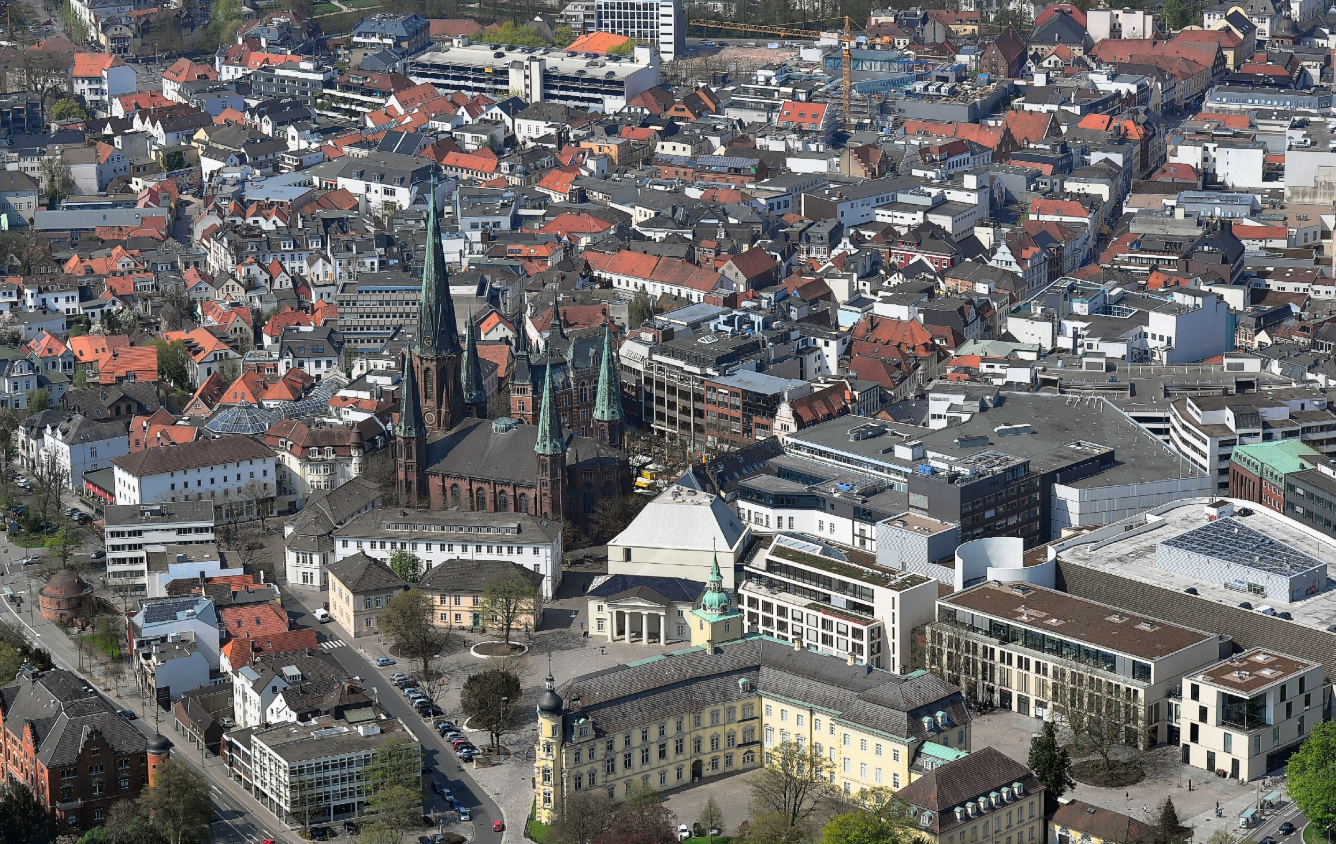
Oldenburg has around 170,000 inhabitants and is a university and administrative city with a historic old town, a long-established cultural scene and a green hinterland. Like many other medium-sized cities, Oldenburg is struggling with the effects of climate change and urbanisation: rising traffic volumes, high energy consumption and the challenge of making public services digital and citizen-friendly. The city has pursued an active climate policy for years: the Masterplan 100 % Klimaschutz was adopted as early as 2016, with which Oldenburg wants to become climate-neutral by 2050. In recent years the city's cycle paths have been extended, car-sharing schemes created and energy efficiency programmes for public buildings launched. The Covid-19 pandemic has shown, however, that digital offerings such as online citizen services or virtual cultural events need to be expanded further to be prepared for crises.
Digitalisation as an Opportunity: Projects and Visions
1. Digital Administration and Citizen Portal
A central aim of the city administration is to offer all important administrative services online by 2030. This includes an accessible citizen portal through which residents can deal with driving licence, registration or building authority matters digitally. Appointments can already be booked online and some applications submitted digitally, but the complete digitalisation of administrative processes will require resources and a change of culture. The federal government supports municipalities with the Smart City Dialog and the Smart Cities model projects initiative, which provide inspiration and solutions for sustainable cities. Oldenburg takes part in this dialogue to learn from other cities and to secure funding.
2 Fibre Optics and 5G for a Connected City
A future-proof smart city needs nationwide broadband rollout and modern mobile networks. Oldenburg is working with regional energy suppliers and telecommunications providers to extend the fibre-optic network to all districts by 2028. In the coming years, 5G radio cells are also to be set up in commercial areas, on the university campus and at important transport hubs. This infrastructure is the basis for innovative applications such as telemedicine, autonomous driving and real-time traffic management.
3. Intelligent Traffic Management and Sustainable Mobility
The transport transition is in full swing in Oldenburg. The city's mobility concept provides for the expansion of cycle streets, 30 km/h zones and green pedestrian areas. A digital parking guidance system is intended to reduce traffic in the city centre by showing multi-storey car park occupancy in real time. At the same time the city is investing in electric buses and planning a light rail line that will connect the main station with important residential areas. Car-sharing providers are cooperating with the council to make electric vehicles available in residential areas; charging stations are being built in multi-storey car parks and at supermarkets. These projects are not only climate-friendly but also raise the quality of life in the city centre.
4. Smart City and Climate Adaptation
The consequences of climate change, from heatwaves to heavy rain, call for intelligent solutions. Oldenburg is testing sensors that measure water levels in ditches and canals and automatically trigger warnings in heavy rain. Green spaces are monitored digitally so that watering is based on need. The city is relying on urban gardens and green roofs to cool the city and promote biodiversity. A planned digital climate dashboard is to visualise measurements of temperature, air quality and energy consumption in real time. Residents can thus see how their behaviour has an effect and where they can save energy themselves.
5. Extending Cultural Participation and Tourism Digitally
Oldenburg is known for its museum landscape (Horst-Janssen-Museum, Stadtmuseum, Oldenburgisches Staatstheater) and popular events such as the Kramermarkt and the Lambertimarkt. A special highlight is coming up in 2025: the AGRAVIS-Cup Oldenburg, a traditional horse-riding tournament in the Große EWE-Arena, takes place at the end of October. Besides the sporting competition, the event offers a shopping village, a children's programme and food and drink. The city plans to offer digital tours and virtual livestreams so that people who are not there in person can take part too. Augmented-reality apps could guide visitors through the old town and display historical facts, artworks or stories about buildings.
Sustainable Energy and Climate Neutrality
Oldenburg is a pioneering region for renewable energy: the surrounding area is home to numerous wind farms, photovoltaic systems and biogas plants. The city works closely with the Carl von Ossietzky University and the German Aerospace Centre (DLR) to develop technologies for the energy transition. Researchers are studying innovative concepts such as load management in the power grid, hydrogen production from surplus wind power and micro power plants in residential areas.
The Masterplan 100 % Klimaschutz provides that by 2035 Oldenburg will meet its electricity needs 100 % from renewable sources. To this end the municipal energy cooperative, in which residents can buy shares, is being strengthened. Solar initiatives promote photovoltaics on school roofs and industrial halls. A climate-friendly expansion of district heating uses waste heat from the port and from biomass power plants. Oldenburg also relies on climate-resilient urban planning: water features, trees and green corridors are being promoted to avoid heat islands and improve the quality of public spaces.
Research and Education as the Engine of Transformation
The Carl von Ossietzky University of Oldenburg is one of the most important universities for energy and sustainability in Germany. Its research focuses on renewable energy, sustainability science and digital technologies. Programmes such as the master's degrees in Sustainable Renewable Energy Technologies (SuRE) and Energy Informatics train specialists who drive the energy transition forward. OFFIS – Institute for Information Technology develops software systems for the energy sector, transport and the health industry.
In cooperation with the city, real-world labs have been set up in which students and researchers test new mobility or energy projects together with residents. This public participation is crucial for the acceptance of innovations and for shaping the smart city strategy in a socially fair way.
Social Participation and Digital Education
A smart city is more than technology: it requires digital skills and equal opportunities. Oldenburg is therefore investing in digital education, from primary school to adult education. Schools are receiving modern IT equipment and training for teachers. The adult education centre offers courses on topics such as online security, programming and media literacy. Older people can take smartphone courses to use digital services.
The city is also working on open data platforms that make municipal data accessible to start-ups and committed residents. This makes it possible to develop applications that, for example, show free bike stations, visualise energy consumption or bundle events. The federal government's Smart City Dialog encourages precisely such participatory solutions.
Challenges and Approaches to Solutions
Oldenburg has ambitious goals, but the road to a climate-neutral and digital city is a rocky one:
Funding: Major investments in infrastructure, energy and digitalisation have to be funded from municipal budgets, state and federal grants and private investment. Public-private partnerships can help to share the risks.
Data protection and security: The use of sensors and real-time data requires high security standards. Transparent data protection policies and dialogue with residents are important for building trust.
Social justice: Digitalisation must not lead to social division. Affordable public transport fares, access to inexpensive internet and targeted educational offerings are intended to enable all population groups to take part.
Skills shortage: Many projects lack specialised engineers and IT professionals. Cooperation with universities and attractive working conditions are intended to attract talent.
Outlook for 2030 and Beyond
Oldenburg has the potential to become a pioneer as a sustainable smart city. By 2030 the city wants to offer a broad range of digital services, make transport climate-neutral, meet its energy needs predominantly from local renewable sources and actively involve residents. Funding programmes such as the federal government's Smart Cities model projects provide financial resources so that municipalities can develop innovative projects. The nationwide comparison shows that cities such as Hanover have climbed 34 places to seventh thanks to strategic measures. For Oldenburg this is an incentive to use its own strengths, such as the high quality of life, the university and the committed citizenry.
In the coming years Oldenburg will continue to work on climate adaptation strategies, digital platforms and intelligent mobility solutions. The city is relying on transparency and participation, because change can only succeed together with its residents. 2025 marks an important milestone on this path, as the city demonstrates that medium-sized municipalities can play a central role in shaping Germany's sustainable and digital future.
FAQ: Frequently Asked Questions about Oldenburg's Future
Why is Oldenburg an interesting smart city?
Oldenburg is a growing university and administrative city with a lively culture, green open spaces and a strong research sector. This allows the city to test and implement innovations quickly.
What role does the AGRAVIS-Cup 2025 play for the city?
The AGRAVIS-Cup is one of the largest horse-riding tournaments in the north-west and attracts thousands of visitors every year. In 2025 Oldenburg is planning a hybrid event concept with digital broadcasts and interactive offerings to reach more people.
How does the federal government support Oldenburg's digitalisation?
Through programmes such as the Smart City Dialog and the Smart Cities model projects, the federal government provides funding and offers a platform for exchange.
What measures are being implemented for climate protection?
The city is investing in renewable energy, energy efficiency, sustainable mobility and green infrastructure. The Masterplan 100 % Klimaschutz serves as the strategic framework.
When is Oldenburg due to become climate-neutral?
The long-term goal is climate neutrality by 2050 at the latest, with electricity needs to be met entirely from renewable sources as early as the 2030s.
Oldenburg's journey into a sustainable, digital future shows by example how medium-sized cities can combine the global goals of sustainability and digitalisation with local commitment. With a clear strategic course, bold investment and the involvement of its residents, the city can realise its potential in full.
Johannes Müller