Speyer
Wine Bars in Speyer

Wine taverns can be found pretty much everywhere, particularly in areas where a lot of viticulture takes place. Most of Germany's wine taverns are located in the south-western part of the country. The climatic conditions are the reason for this.
Rhineland-Palatinate, Hesse and Baden-Württemberg together are home to 11 of the 13 German wine regions. As wine plays such a special role in this region, there are a great many wine taverns here. Their wines are enjoyed not only across the rest of Germany but around the world too.
Because wine taverns have such a natural character, they're a wonderful place to relax and enjoy yourself. The atmosphere they exude is simply unmistakable. The great thing about them is that as soon as you're travelling through a wine-growing region, you'll find a wine tavern in almost every town — no matter how tiny the village.
The Wine Tavern
But what actually goes on in a wine tavern? Well, as the first half of the word suggests, wine of all kinds plays a major role. And what one does in a ‘Stube’ (parlour) we can all imagine — ‘step into the parlour’ is a familiar phrase to us all. A wine tavern is the perfect place for good company, food and drink.
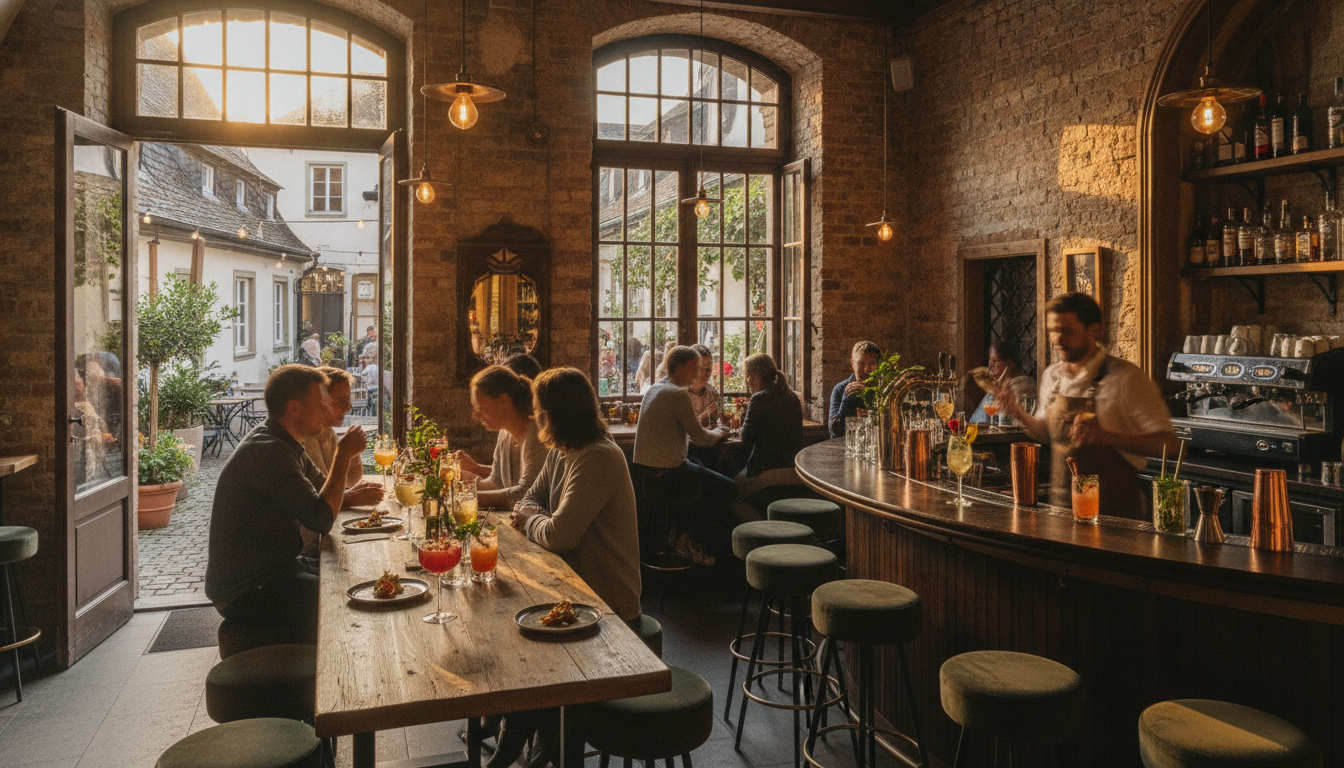
Wine taverns are usually housed in centuries-old timber-framed buildings, many of which are listed. In rustic vaulted cellars, regional home-style cooking meets cosy get-togethers amid a natural atmosphere.
You can experience this unmistakable atmosphere in Speyer at the house brewery of Domhof GmbH & Co. KG.
Nevertheless, it's worth remembering that, logically, not all of the country's wine taverns can be located within a wine region. Where this is the case, a selection of wines from the wine-growing areas is bought in and served. Here, different approaches can be taken:
Either the wines are sourced exclusively from the nearest wine region, or — the second option — the fine drops are selected from more than one of the 13 wine-growing areas.
Precisely because of this geographically determined selection, wines from abroad are also frequently found on the wine list — from overseas destinations such as South Africa, the USA, Australia or Argentina, but also from European countries such as Spain, France or Italy.
What's on offer in Speyer
Given the close ties between the taverns and their respective wineries, serving regional wines is naturally part of the concept! The wines on the list are, of course, carefully selected, as the tavern often has little space available. In these taverns, wine from various local wineries is poured. This draws more attention to the wine, and visitors are likely to take a box or two home with them.
At several wine taverns, guest wines are even given their own page on the wine list.
For legal reasons, menus in wine taverns are kept very simple. Generally, only food that doesn't require much preparation may be served alongside wine. At Zur alten Münz this is exactly the case.
In the small part of Hesse and in the French-influenced south-west of Rhineland-Palatinate, onion cake and tarte flambée — the latter only served during the grape harvest season, accompanied by so-called Federweißer (young wine) — are among the regional classics of the menu.
So-called Spundekäs, a fresh cheese preparation usually eaten with hearty bread, can be found in almost every tavern in the Rheinhessen and Rheingau regions in the north-east of Rhineland-Palatinate.
In Franconia, more precisely along the Main, ‘blauer Zipfel’, ‘angemachter Camembert’ or ‘Kochkäse’ are found on the menu.
The so-called ‘Fettbemmchen’, a baguette with pork dripping, is offered in the ‘Sachsen’ wine-growing region.
Generally, you'll also find mixed and Mediterranean platters, sausage salad with bread, bacon-wrapped dates and feta cheese. Winegrower's platters are very popular in wine taverns and are essentially just sausage and/or cheese platters.
Wines for Speyer
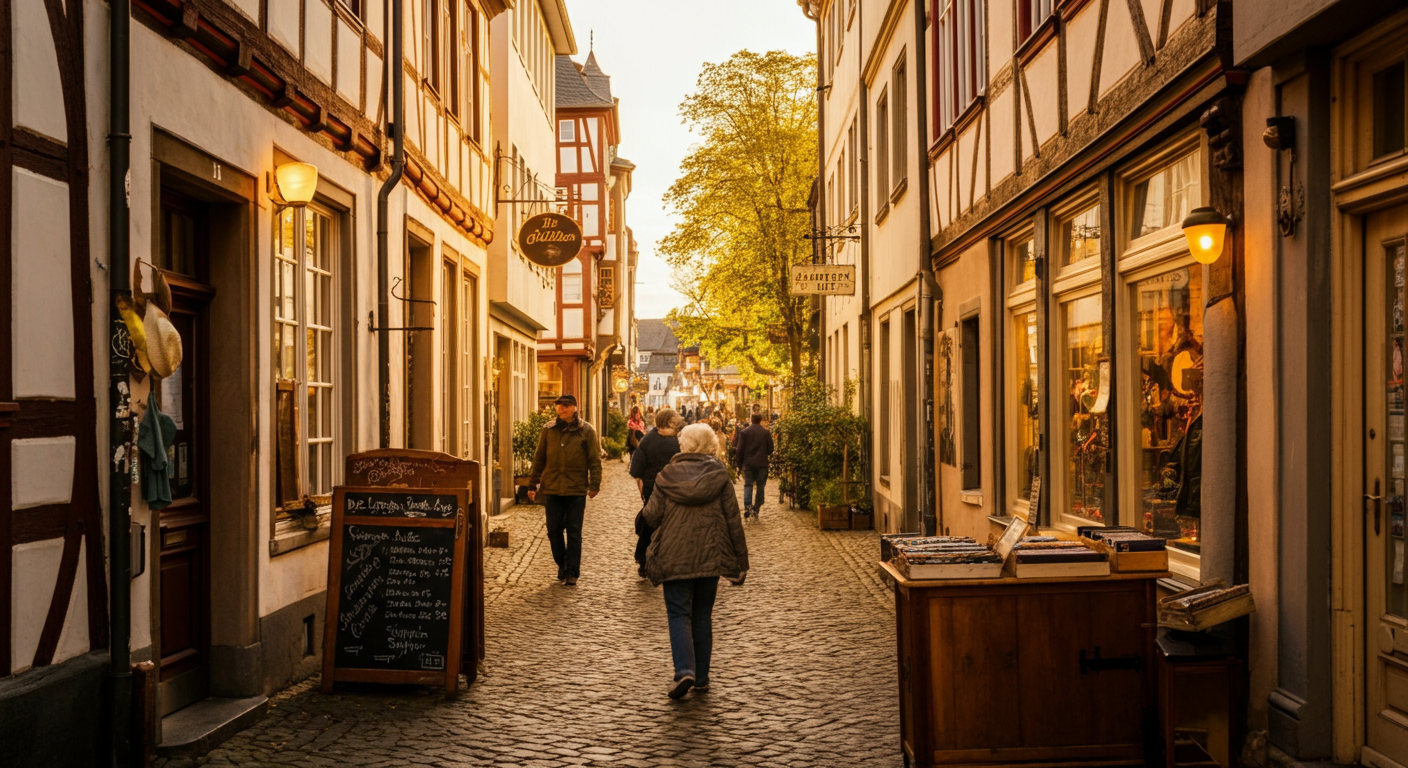
The villages in the wine regions have been shaped by the cultivation of the surrounding vineyards for several centuries. The historic village centres delight visitors with lovingly maintained timber-framed buildings and romantic little lanes that invite you to linger.
Entire village centres are often listed for preservation — as, of course, are individual buildings. But amid all the splendour of the wine villages, you shouldn't forget the surrounding countryside.
Hiking trails, sweeping field paths and vineyard slopes are romantic and challenging in equal measure. Depending on the region, numerous castles, castle ruins and palaces line the routes.
Forests and a sea of vines — that's what you'll see when you look out over the landscape below: in autumn you'll see a mosaic of striking colours, everything from deep red to rich yellow and orange tones, while in summer lush green covers everything.
The Wine-Growing Regions
As already mentioned, most wine-growing regions lie in south-western Germany. Aside from Saale-Unstrut and Sachsen, all wine regions are located in Hesse, Baden-Württemberg or Rhineland-Palatinate. Why is each region so unique? Which wine region produces the best white or red wine? And what makes, for example, Goldriesling so special? Here's an overview:
Rheinhessen is Germany's largest wine-growing region, covering 26,000 hectares. That accounts for a good quarter of Germany's total wine-growing area (100,000 hectares).
Thanks to the varied soils and mild climate, conditions here are ideal for white grape varieties. Rheinhessen is home to the world's largest cultivation area for Silvaner.
The Pfalz wine region is the second-largest, at a good 23,000 hectares. Red and white wines thrive along the German Wine Route thanks to the consistently sunny weather and varied soils. The main grape varieties grown here are Riesling, Müller-Thurgau and Dornfelder.
At just under 16,000 hectares, the Baden wine region is considerably smaller, yet at 400 kilometres long, it's the longest. According to an EU regulation on the division into seven wine-growing zones with distinct climatic characteristics, Baden is Germany's warmest wine-growing region. Burgundy varieties are mainly grown here, with half of the yield made up of Weißburgunder, Grauburgunder/Ruländer and Blauer Spätburgunder.
In the 11,000-hectare Württemberg wine region, you'll mainly find the red grape varieties Trollinger, Schwarzriesling and Lemberger. Rotling, also known as Schillerwein, is characteristic of this region. Red and white grapes must be pressed together to produce this wine. Because of its colour, it's often mistakenly compared to rosé.
Covering around 9,000 hectares, the Mosel wine-growing region is considered the world's largest steep-slope wine-growing area — the gradient of the world's steepest vineyard is around 65 degrees.
Rheingau, Franken, Ahr and More
The Franken wine-growing region covers about 6,000 hectares. It's also home to the world's largest Riesling-growing area. White wine accounts for the lion's share in Franken, at around 80%. Müller-Thurgau and Silvaner are the most commonly grown varieties. Higher-quality Franken wines are bottled in rounded, flat bottles with a short neck — the Bocksbeutel is well known for this region.
The Nahe wine region, covering 4,000 hectares, is an Eldorado for winegrowers. You'll find around 180 different soil types here, a result of past volcanic activity. This diversity is also reflected in the wine. Whether Riesling, Müller-Thurgau, Dornfelder or Spätburgunder — all wines feel right at home here.
In the Rheingau wine-growing region, white wine — Riesling in particular — is the main variety grown. It accounts for about 80% of the wine produced in this roughly 3,000-hectare wine-growing area. This is also home to Germany's largest contiguous growing area for Spätburgunder.
The Saale-Unstrut wine region is the larger of the two wine-growing areas located in the new federal states. It's also the northernmost of Germany's wine-growing regions. At almost exactly 800 hectares, it's more than half the size of Rheingau. Because this region lies in the north and is therefore subject to particular weather conditions, it mainly grows early to mid-ripening varieties such as Müller-Thurgau and Silvaner. Three-quarters of the total yield is white wine.
Despite its comparatively modest size of 560 hectares, the Ahr region produces more red wine than any other region in Germany. The slate soil provides excellent conditions for top-quality wines, which is also why Spätburgunder feels perfectly at home here.
Smaller Wine-Growing Regions
Goldriesling is a rarity, as it's only grown in the 500-hectare Sachsen wine-growing region. Sachsen is Germany's easternmost wine-growing region. Weißburgunder and Grauburgunder are grown here, but Traminer is the most common variety.
Cultivation in the Mittelrhein region is very time-consuming and costly. The sun shines ideally on the terraced slopes, which makes the winegrowers' efforts truly worthwhile. Riesling accounts for almost 70% of the total harvest.
Germany's smallest wine-growing region, at just 460 hectares, is the Hessische Bergstraße. Riesling plays a major role here too, accounting for almost 50% of the yield. The small amount of red wine produced in this wine region is also highly regarded everywhere.
That concludes our information specifically on the 13 German wine regions and Speyer in general. We hope our blog article has helped you gain an overview of the wine taverns and wine-growing areas of the country. Enjoy your exploration.

Miriam Brandt
Miriam hat Medizinjournalismus studiert und übersetzt komplizierte Fachthemen in verständliche Sprache. Sie recherchiert zu Praxen, Kliniken und Therapieangeboten und legt großen Wert darauf, Fakten von Marketingversprechen zu trennen. Privat läuft sie Halbmarathon.