Leverkusen
Visiting Schloss Morsbroich: Baroque Moated Castle & Art Museum
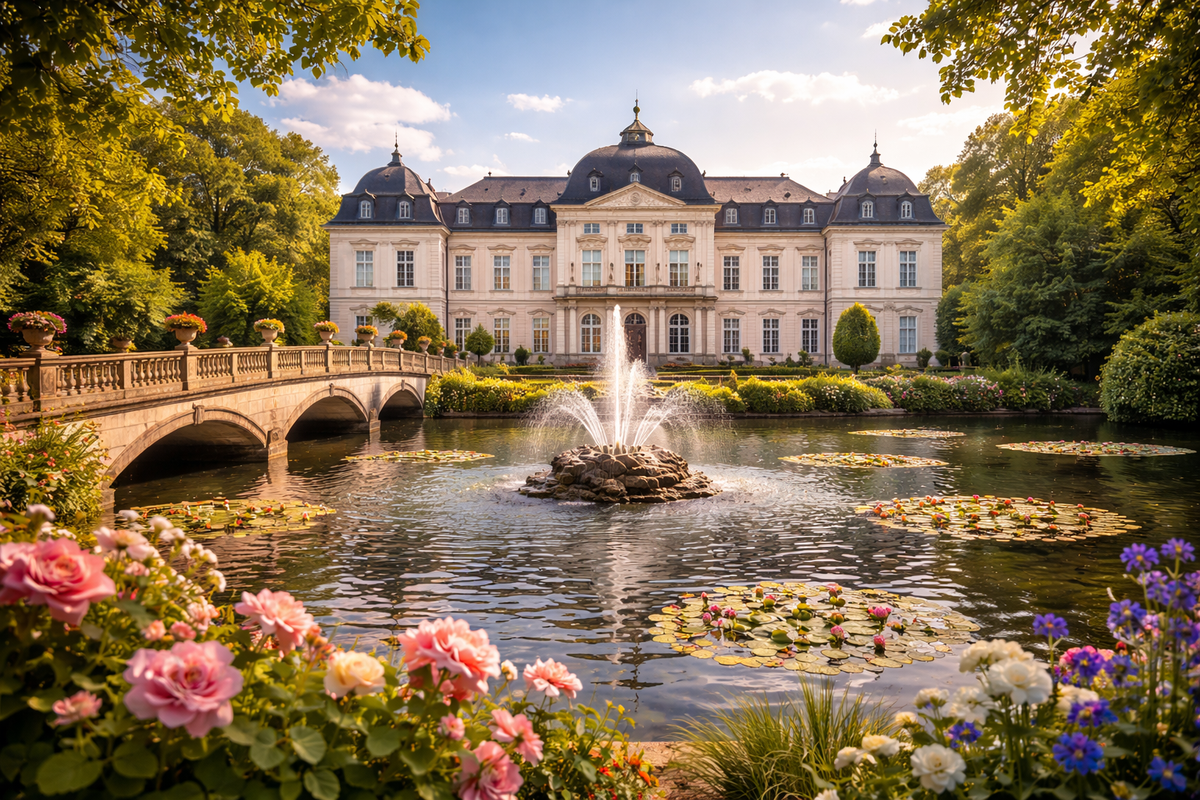
When you think of Leverkusen, you probably think first of Bayer 04 or the chemical company. Yet in the district of Alkenrath there is a cultural gem that surprises even many Rhinelanders: Schloss Morsbroich. Surrounded by an expansive park and set in the river landscape of the Dhünn, the Baroque ensemble feels like an oasis of calm in the middle of the city. What makes the castle so special: its opulent rooms house one of the oldest museums of contemporary art in all of North Rhine-Westphalia.
Whether you are interested in architectural history, want to spend an inspiring afternoon among sculptures and paintings, or are even looking for an extraordinary location for your wedding – a visit to Morsbroich is worthwhile for many reasons. This article gives you everything you need to know for your trip: from the history of the house and the collection to getting there, admission and programme.
From Medieval Knight's Seat to Baroque Castle
The history of Morsbroich reaches far back. The first documentary mentions date from the 14th century, when a knight named Johann Moyr von deme Broichge owned a fortified farmstead on the site. Over the centuries the property changed hands several times and from 1619 served as a base of the Teutonic Order.
The decisive turning point came in 1774: Ignaz Felix Freiherr von Roll had the by then badly dilapidated medieval complex demolished completely and an elegant Rococo-style castle built in its place. The well-known hunting lodge Falkenlust in Brühl is said to have served as the architectural model. At the same time, a landscape garden in the English style was laid out around the new building, which still makes up the special appeal of the grounds today.
The Napoleonic era brought turbulent changes of ownership. After secularisation in 1803, the estate passed into state ownership and eventually, by a roundabout route, ended up with the Cologne banker Abraham Schaaffhausen. From 1857 the industrialist family von Diergardt then took over the castle and had two side wings added in the 1880s. These extensions still shape its appearance today and give the building its characteristic U-shape.
A Pioneer of Modern Art
After the Second World War, the damaged castle initially stood empty. The city of Leverkusen rented the building in 1948, and after some deliberation – at one point even an old people's home and a children's home were under discussion – the decision came down in favour of art: in January 1951, a museum of modern art opened its doors in Schloss Morsbroich. It was thus one of the first institutions in the entire Federal Republic to devote itself deliberately to contemporary and modern art after the cultural devastation of the Nazi era.
This founding spirit was programmatic. At a time when cultural life in the Rhineland was still strongly marked by the aftermath of twelve years of artistic oppression, Morsbroich set a clear signal. The aim: to make modernism, which had been denounced as "degenerate" during National Socialism, visible again, while also turning attention to current art production.
Under the legendary director Udo Kultermann, the museum enjoyed a true heyday in the 1960s. In 1960 Kultermann organised the world's first museum exhibition on monochrome painting, and in 1962 he showed the first comprehensive retrospective of the work of Lucio Fontana. He brought well-known thinkers such as Theodor W. Adorno to Leverkusen and made Morsbroich a place of intellectual exchange.
His successor Rolf Wedewer continued this course and, with the 1969 exhibition "Konzeption – Conception", achieved another milestone: it was the first museum presentation anywhere in the world explicitly devoted to conceptual art – a movement that still decisively influences contemporary art production today. If you are interested in the history of postwar art, Morsbroich is therefore no sideshow, but one of the places where this history was written.
The Collection: From Op Art to Nouveau Réalisme
Anyone entering the Museum Morsbroich today can expect an impressive range of art movements. The collection, which has grown over decades, includes paintings, sculptures, objects and works on paper that cover all the major currents of postwar art.
Particular emphasis is placed on analytical painting, Nouveau Réalisme, Op Art and kinetic art. Works by artists such as Yves Klein, Piero Manzoni, Lucio Fontana, Andy Warhol, Louise Nevelson and Robert Motherwell are among the highlights of the holdings. In 2008, 23 works by Wolf Vostell were added as a permanent loan from the state of North Rhine-Westphalia, further sharpening the museum's profile.
The exhibitions change roughly every quarter and regularly refer to the special character of the building. The Baroque rooms with their many windows, stucco ceilings and numerous doorways are not neutral gallery spaces – they challenge the art on display and create a field of tension between historic splendour and contemporary aesthetics. Around half of all exhibitions since 2006 therefore deliberately refer to the castle as an architectural or social space.
For you as a visitor, that means: you will hardly ever experience the same thing twice here. It is worth checking briefly before your trip which exhibition is currently on – and if you visit several times a year, you will soon notice how differently the same rooms can look.
The Hall of Mirrors: Showpiece and Wedding Venue
The heart of the castle is undoubtedly the Baroque Hall of Mirrors. With its decorated walls, gleaming mirrored surfaces and elaborate Rococo stucco ceiling, it is regarded as the "best parlour" of the city of Leverkusen. Formal events take place here regularly – from concerts and talks to festive receptions.
For many couples, however, the Hall of Mirrors is above all one thing: a dream venue for the civil wedding ceremony. The Leverkusen registry office regularly holds weddings here, and demand is high. If you want to say "I do" amid Baroque elegance, you should reserve early. After the ceremony, the adjoining castle park with its old trees, bridges and sculptures offers an ideal backdrop for wedding photos. For guests from out of town, it is worth taking a look at the best hotels in Leverkusen.
Among the notable art projects in the Hall of Mirrors is a work by the Swiss artist Andrea Wolfensberger: as part of the "Werkstatt Morsbroich 2022–26", she created a sculptural ensemble based on the sound patterns of spoken words. Recordings of Leverkusen residents saying a clear "yes" or "no" form the basis of the work – a poetic reference to the many weddings that take place here.
The Sculpture Park: Art Under the Open Sky
A generous park with old trees extends around the castle and is freely accessible. Between winding paths and the historic moat, you will discover various sculptures and installations that the museum has placed there over the years.
The originally Baroque garden design has changed over the centuries and was partly left to itself. For some years now, a participatory art and planning project called "Parklabyr" has been under way, aiming to rethink the park together with the city's residents. Artists are working with Leverkusen residents to open up the enchanted castle park to an increasingly diverse urban society.
A walk through the park is worthwhile in every season: in spring magnolias and fruit trees bloom, in summer shady spots invite you to linger, and in autumn the leaves of the old trees bathe the grounds in warm colours. In winter, when mist lies over the moat, the ensemble has something almost mystical about it. Because the park is free to enter, it is also suitable for a short detour when there is no time for a museum visit.
Practical Information for Your Visit
Address: Gustav-Heinemann-Straße 80, 51377 Leverkusen
Opening hours: The museum is usually open Tuesday to Sunday. The park is freely accessible at all times. For current opening hours and possible special arrangements, it is worth checking the museum's website.
Admission: Regular admission to the exhibitions is €8, reduced €4. Public guided tours take place on Sundays at 3pm and cost €12 including museum admission (reduced €8). Historical tours that lead through the building and the park and bring former life in the castle to life are also offered regularly.
Getting there by public transport: From Leverkusen-Mitte station, take bus line 212 directly to the "Museum Morsbroich" stop. From there it is only a few steps to the entrance. The express bus lines SB21, SB22 and SB42 also stop nearby.
Getting there by car: From the A3, take the Leverkusen exit and follow the signs towards Morsbroich. Paid parking is available directly in front of the museum grounds, although it can fill up quickly during larger events. When it is busy, it is advisable to switch to bus or bike.
Accessibility: The Hall of Mirrors can be reached step-free via a lift.
Food and shop: The castle has a museum café and a museum shop with art books and editions. If you prefer to drink your coffee in town, you will find more addresses in our overview of the best cafés in Leverkusen.
Events and Programmes for Families
Besides the changing exhibitions, the Museum Morsbroich offers a varied events programme. This includes workshops for adults and children, slow-art tours with deliberate pauses in front of selected works, and creative educational formats for school classes and nurseries.
Especially exciting for children: the "Schlossgespenster" programme, in which young visitors roam through the house with a symbolic bunch of keys and decide for themselves which artworks they want to explore. This free offering takes place regularly and requires no advance registration.
In addition, the city of Leverkusen uses the castle's opulent Hall of Mirrors for cultural events such as concerts and readings. In summer, the park becomes an open-air stage for outdoor events.
Why a Visit Is Worthwhile
Schloss Morsbroich is neither an ordinary museum nor an ordinary castle. It is both at once – and it is precisely in this dual role that its appeal lies. The tension between Baroque architecture and provocative contemporary art, between a well-kept castle park and experimental sculpture projects, makes every visit a multi-layered experience.
Located only around 20 kilometres north of Cologne, Morsbroich is an ideal destination for a half-day trip. Combine your museum visit with a leisurely walk through the park, a coffee in the museum café and – if you like – one of the regularly offered tours, which shed light on both art history and the eventful past of the building itself. That way you experience centuries of Rhineland history and the pulsating contemporary art scene in a single afternoon. If you want to extend the day afterwards, you will find more recommendations for Leverkusen on our city page.
Frequently Asked Questions about Schloss Morsbroich
Where is Schloss Morsbroich and how do I get there?
The castle is in the Leverkusen district of Alkenrath, at Gustav-Heinemann-Straße 80. From Leverkusen-Mitte station, bus line 212 takes you directly to the "Museum Morsbroich" stop, and the express bus lines SB21, SB22 and SB42 also stop nearby. By car, take the A3, Leverkusen exit, and follow the signs; paid parking is available directly at the grounds.
How much is admission to the Museum Morsbroich?
Regular admission to the exhibitions is €8, reduced €4. Public guided tours on Sundays at 3pm cost €12 including museum admission, reduced €8. The castle park, on the other hand, is freely accessible and costs nothing to enter.
Can you get married at Schloss Morsbroich?
Yes. The Leverkusen registry office regularly holds civil weddings in the Baroque Hall of Mirrors. Because demand is high, you should reserve your preferred date early. The adjoining castle park with old trees, bridges and sculptures then offers an atmospheric backdrop for wedding photos.
Is a visit with children recommended?
Definitely. The museum offers workshops and educational formats for children, including the free "Schlossgespenster" programme: with a symbolic bunch of keys, children roam through the house and decide for themselves which works they want to explore. No advance registration is needed. The expansive park also offers space to run around.
How much time should I allow for the visit?
For the exhibition, museum café and a walk around the park, you should allow around half a day. If you join one of the tours, allow extra time. As the exhibitions change roughly every quarter, it is worth checking the current programme beforehand.
Max Schmidt
Lokaler Experte