Ludwigsburg
Ludwigsburg - Wine Bars
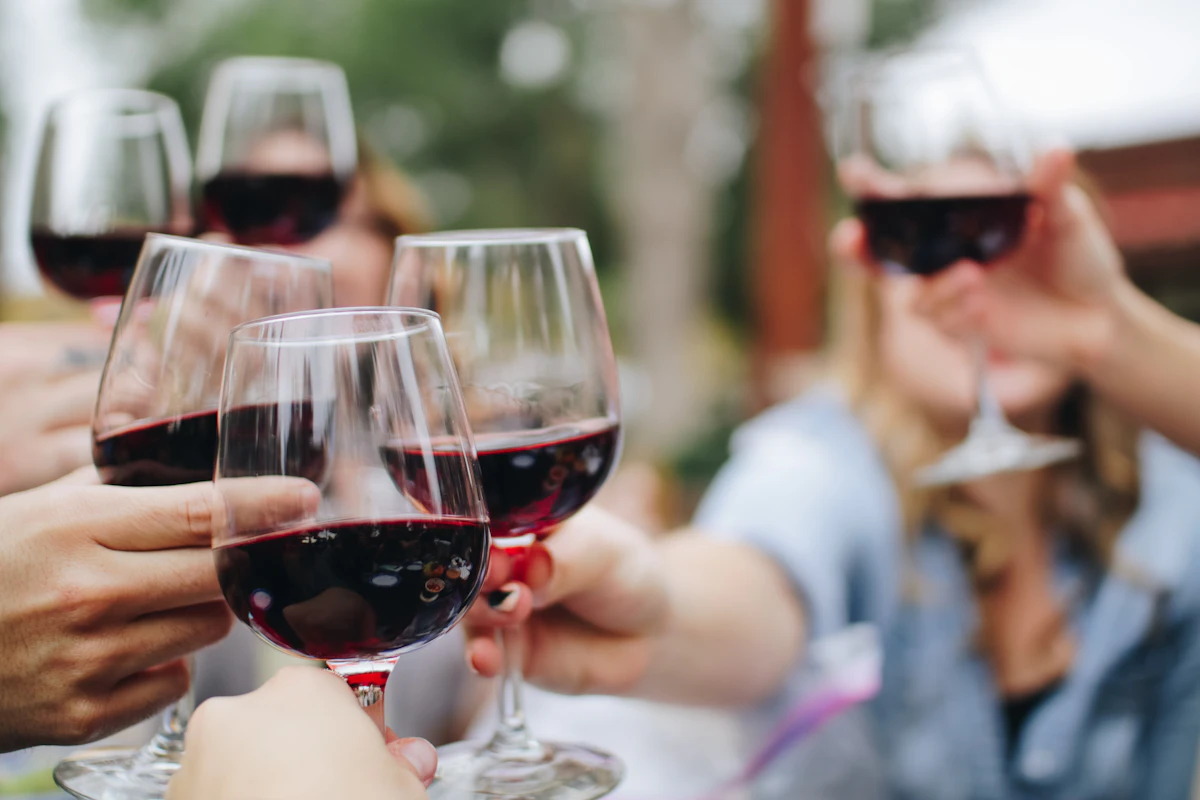
Wherever wine growing takes place, you'll definitely also find wine taverns. The majority of these areas are in the south-western part of the country. The climatic conditions play a huge role here.
In Hesse, Baden-Württemberg and Rhineland-Palatinate together lie 11 of the 13 German wine regions. As wine plays such a special role here, there are many wine taverns in these areas. In the rest of Germany and the world, German wine is very much enjoyed.
As wine taverns have such a rustic character, they're wonderful places to linger and enjoy yourself. The atmosphere they exude is quite unmistakable. In a wine-growing area, you'll find a wine tavern nearby no matter how tiny the villages are.
Baden-Württemberg Wine Taverns
But what does one actually do in a wine tavern? Well, as the first half of the word suggests, wine of all kinds plays an important role. And we can all imagine what goes on in a wine tavern — ‘come on in and make yourself at home’ is a saying we all know. A wine tavern is the perfect place to be sociable, and to eat and drink together.
Wine taverns are often housed in centuries-old half-timbered buildings, which are frequently listed as historic monuments. Regional home-style cooking meets cosy get-togethers in rustic vaulted cellars, all set within a natural atmosphere.
Of course, it should also be mentioned that, logically, not all of the country's wine taverns can be located within a wine-growing region. Where this is the case, carefully selected wines from the wine-growing areas are purchased and offered. Here, different approaches can be followed:
Either all the wines on offer are sourced exclusively from the nearest wine-growing region, or — the second option — the fine wines are selected from more than one of the 13 wine-growing regions.
Particularly with this geographical selection, wines from abroad are also frequently found on the menu — whether from overseas, such as Argentina, Australia, the USA or South Africa, or from European countries such as Italy, Spain or France.
What's on Offer in Ludwigsburg
Thanks to the connection between wine taverns and winegrowing businesses, serving regional wines is naturally a matter of honour! Of course, all the wines on the menu are carefully chosen, as the space in wine taverns is usually limited. Nevertheless, it's common for a tavern's own wine to be served in other taverns too. This way, more holidaymakers become aware of the wine and might take a box or two home with them.
Some taverns give so-called guest wines their very own section on the menu.
In wine taverns, the food on offer tends to be fairly limited — this is for legal reasons. Only food that requires little preparation may be served alongside wine. This is the case, for example, at Weinstube Klingel.
In the small part of Hesse and in the French-influenced south-west of Rhineland-Palatinate, Flammkuchen (tarte flambée) and Zwiebelkuchen (onion cake) — the latter only during the grape harvest season, served with so-called Federweißer, new wine — are among the regional classics on the menu.
A fresh cheese preparation known as Spundekäs, mainly eaten with hearty bread, can be found in almost all taverns in the Rheingau and Rheinhessen regions in the north-east of Rhineland-Palatinate.
‘Kochkäse’, ‘blaue Zipfel’ or ‘angemachte Camembert’ feature on the menu along the Neckar.
The baguette with Griebenschmalz (crackling lard), known as Fettbemmchen, is served in the ‘Sachsen’ wine-growing region.
In general, you'll also often find sheep's cheese, mixed and Mediterranean platters, sausage salad with bread, and dates wrapped in bacon. Likewise, the Winzerplatte, a sausage and cheese platter, is popular in wine taverns everywhere.
Wine Villages and Surroundings
The villages in the wine regions have been shaped by the cultivation of the surrounding vineyards for several centuries. Accordingly, the historic village centres delight visitors with lovingly restored half-timbered buildings and romantic little lanes that invite you to linger.
Entire village centres are often listed as historic monuments – just as individual buildings often are, too. But amid the beauty of the wine villages, you shouldn't forget their surroundings.
There are extensive field paths through the vineyards and hiking trails that can be both challenging and romantic at the same time. There are numerous castles, castle ruins and palaces along the way.
From many of them, you can look out over the landscape at your feet — a carpet of vines, and often forest too: in autumn, you'll see a mosaic of splendid colours, from rich yellow and orange tones to dark red, while in summer you'll see lush green everywhere.
Germany's Wine-Growing Regions
As mentioned above, most of the wine-growing regions lie in the south-west of Germany. Aside from the Saale-Unstrut and Sachsen wine regions, all of them are located in either Rhineland-Palatinate, Hesse or Baden-Württemberg. Why are the individual regions so special? Which wine-growing region produces the best red or white wine? Why, for example, is Goldriesling so special? We have an explanation:
Rheinhessen is the largest wine-growing region in Germany, covering 26,000 hectares. This makes up a good quarter of the entire area (100,000 hectares) in Germany.
Thanks to the mild climate and varied soils, excellent conditions prevail for white wines. The world's largest area under cultivation for Silvaner is located in Rheinhessen.
With a good 23,000 hectares, the Pfalz wine-growing region ranks second in terms of area. Along the German Wine Route, red and white wines thrive thanks to the consistently sunny weather and varied soils. Dornfelder, Müller-Thurgau and Riesling are mainly grown here.
With just under 16,000 hectares, the Baden wine region is considerably smaller, yet at 400 kilometres it's the longest. According to an EU regulation on climatic characteristics, Baden is the warmest of all Germany's wine-growing regions. Grauburgunder/Ruländer, Blauer Spätburgunder and Weißburgunder are mainly grown here — in other words, Burgundy-style wines in general.
Above all, in the 11,000-hectare Württemberg wine region, you'll find the red grape varieties Schwarzriesling, Trollinger and Lemberger. Rotling, also known as Schillerwein, is the speciality of this region. For this, white grapes are pressed together with red grapes. Because of its colour, it's often mistaken for a rosé.
Covering around 9,000 hectares, the Mosel wine-growing region is regarded as the world's largest steep-slope wine-growing area — the gradient of the steepest vineyard in the world is around 65 degrees.
Rheingau, Ahr, Franken and Others
The Franken wine-growing region covers a good 6,000 hectares. It's also home to the world's largest Riesling-growing area. 80% of the vineyard area in the Franken region is planted with white wine varieties. Müller-Thurgau and Silvaner are the most widely grown here. Higher-quality Franken wines are bottled in flat, round-bellied bottles with a short neck — the Bocksbeutel is very distinctive to this region.
The Nahe wine-growing region, with its roughly 4,000 hectares, is an Eldorado for winegrowers. In this region, you'll find around 180 different soil variations, owing to past volcanic activity. This diversity is also reflected in the wine. Whether it's Riesling, Müller-Thurgau, Dornfelder or Spätburgunder — all these wines feel right at home here.
In the Rheingau wine-growing region, the Riesling grape variety is used mainly to produce white wine. Riesling accounts for around 80% of the wine produced in this roughly 3,000-hectare wine-growing region. Germany's largest contiguous area for growing Spätburgunder is located here.
The Saale-Unstrut wine region is the larger of the two wine-growing regions located in the new federal states. At the same time, it's the northernmost of all German wine-growing regions. At just about 800 hectares, it's considerably smaller than Rheingau. Because this region lies in the north and is subject to particular weather conditions, mainly early to mid-ripening grape varieties are grown here, such as Silvaner and Müller-Thurgau. Three-quarters of the total yield consists of wines made from light-coloured grapes.
In the Ahr region, almost exclusively red wine is cultivated — more than in any other region — despite its small area of just 560 hectares. The slate soil provides a promising basis for top-quality wines. Spätburgunder, in particular, feels completely at home here.
Small Wine-Growing Regions
Goldriesling is grown exclusively in the roughly 500-hectare Sachsen region and is therefore a rarity. Sachsen is the easternmost wine-growing region in the country. Grauburgunder and Weißburgunder are grown here, but above all Traminer.
In the Mittelrhein wine-growing region, cultivation is very labour-intensive and costly. But the effort pays off for the winegrowers, as the sun shines perfectly on the steep terraces. The sun is especially good for Riesling, which accounts for a good 60% of the total yield as a white wine.
The smallest of all the wine-growing regions is the Hessische Bergstraße, with just 460 hectares. Riesling also plays a significant role here, accounting for almost 50% of the yield. The red wine from this wine region is also highly regarded everywhere.
That concludes our information specifically on the 13 German wine-growing regions and on Ludwigsburg in general. We hope this article has helped you gain an overview of the wine-growing regions. Enjoy exploring.

Lena Hoffmann
Lena hat nach ihrer Ausbildung in der Hotellerie das Schreiben für sich entdeckt. Seit sechs Jahren testet sie Restaurants, Cafés und Weinbars — immer auf der Suche nach ehrlichem Handwerk statt Hochglanz. Ihr Motto: Die besten Lokale erkennt man an der Stammkundschaft, nicht an der Speisekarte.