Deutschland
Buying Property in Berlin: The Complete Guide 2026
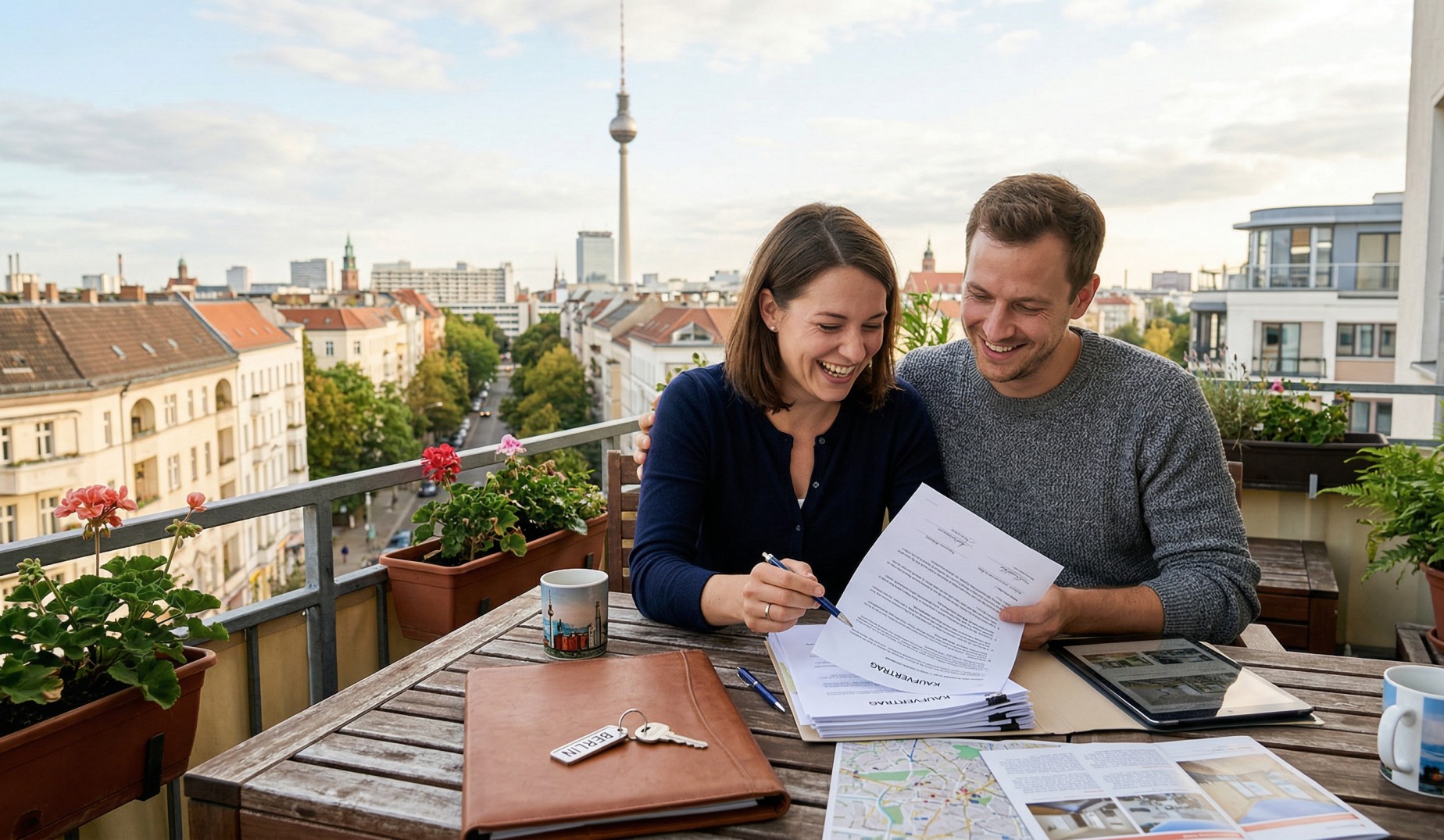
Berlin remains one of Germany's most attractive property markets. Following the price correction triggered by the interest rate rises of 2022 and 2023, the market has stabilised, and the capital once again offers a wide range of opportunities for buying property in 2026. This comprehensive guide will help you make your dream of owning a home in Berlin a reality.
Berlin's property market continues to develop dynamically. While central locations are already very expensive, up-and-coming districts still offer interesting buying opportunities – particularly for buyers who aren't put off by renovation work.
Current property prices in Berlin 2026
Purchase prices in Berlin vary significantly depending on the district, location and condition of the property. Following the decline between 2022 and 2024, prices have shown a slight upward trend again since 2025, though they remain below the peak values of 2021. Average prices per square metre for flats range roughly between €3,500 and €9,000, with prime locations and new builds commanding more.
Prices are highest in Mitte, Prenzlauer Berg and Charlottenburg-Wilmersdorf. Here, buyers often pay well over €7,000 per square metre for renovated period properties and new builds, with five-figure sums in top locations.
More affordable alternatives can be found in the outer districts. Spandau, Marzahn-Hellersdorf, Reinickendorf and parts of Treptow-Köpenick offer more affordable options for first-time buyers.
Price ranges by category (guide prices):
- New-build flats: usually €6,000 to €10,000 per square metre, more in prime locations
- Renovated period flats: around €5,000 to €9,000 per square metre
- Unrenovated existing flats in outer districts: from around €3,000 per square metre
- Detached and terraced houses: vary greatly depending on location and plot, usually between €4,000 and €8,000 per square metre of living space
The best districts for buying property
When choosing a district, you should consider various factors. Alongside budget, infrastructure, development potential and personal preferences all play an important role. Our Berlin neighbourhood guide provides an overview of the various areas.
Established premium locations:
- Charlottenburg-Wilmersdorf: Exclusive period properties, best infrastructure
- Mitte: Central location, strong value stability
- Prenzlauer Berg: Popular trendy neighbourhood with strong demand from families
- Friedrichshain-Kreuzberg: Young crowd, vibrant culture
Up-and-coming districts with potential:
- Neukölln: Regeneration is progressing, the south is still more affordable
- Wedding and Moabit: Affordable prices with good transport links
- Lichtenberg: Family-friendly with development opportunities
- Tempelhof-Schöneberg: Diverse neighbourhoods, moderate prices
- Spandau and Pankow-Nord: Large new-build areas in planning and under construction
Choosing the right district has a major bearing on how your property's value will develop. Find out in detail about planned infrastructure projects – such as the extension of underground and tram lines – and urban development measures.
Financing options and funding opportunities
Solid financing forms the foundation for any successful property purchase. In Berlin, you have access to various financing models and funding schemes.
Most buyers use a conventional mortgage with 20 to 30 per cent equity. After the sharp rise, mortgage rates have settled at around 3.5 to 4 per cent – compare different providers and get quotes for different fixed-interest periods. Regional banks and savings banks (Sparkassen) often know the Berlin market particularly well.
Key funding schemes for Berlin property buyers:
- KfW programme ‘Wohneigentum für Familien’ (300): low-interest loans for families with children buying climate-friendly new builds
- KfW programme ‘Jung kauft Alt’ (308): funding for families buying existing properties in need of renovation and carrying out energy-efficient refurbishment
- KfW loans and grants for energy-efficient refurbishment (BEG)
- Berlin housing subsidies and IBB programmes for middle incomes
- Wohn-Riester for financing your own home
Alongside the purchase price and additional costs, plan in a buffer. Unforeseen expenses or renovation costs can quickly put a strain on your budget.
The buying process: step by step
A structured approach significantly increases your chances of success. Several months usually pass between the first viewing and the handover of keys.
Phase 1: Preparation and search
- Clarify your financing scope and obtain a financing confirmation
- Define your search criteria
- Contact an estate agent or search yourself
- Arrange viewing appointments
Phase 2: Valuation and negotiation
- Property viewing with experts, a surveyor if needed
- Negotiate the purchase price – this has been more successful again since 2023
- Finalise your financing
- Review the draft purchase contract (at least two weeks' notice required for consumer contracts)
Phase 3: Completion
- Arrange a notary appointment
- Sign the purchase contract
- Pay the property transfer tax and wait for the change of ownership to be registered
- Organise the handover of keys
Give yourself enough time for each step. Rushed decisions often lead to costly mistakes or unfavourable contracts.
Bear additional costs in mind when buying property
Additional purchase costs in Berlin amount to around 10 to 12 per cent of the purchase price. These extra costs are often underestimated and should be factored in from the outset – banks generally won't finance them as part of the mortgage.
Property transfer tax in Berlin is 6 per cent of the purchase price. On top of this come notary and land registry costs of around 1.5 to 2 per cent. If an estate agent is involved, a further 3.57 per cent commission applies – since 2020, sellers and buyers have had to split the commission at least equally.
Typical additional costs at a glance:
- Property transfer tax: 6 per cent of the purchase price
- Notary and land registry costs: 1.5 to 2 per cent
- Estate agent commission: usually 3.57 per cent for the buyer
- Surveyor's fees: a few hundred to a few thousand euros
- Financing-related costs: around 0.5 to 1 per cent
For a purchase price of €500,000, this results in additional costs of around €50,000 to €60,000. This sum must be available on top of your equity.
Legal aspects and avoiding pitfalls
When buying property in Berlin, you should be aware of various legal particularities. An experienced solicitor or notary can help protect you from costly mistakes.
Check the land register carefully for any charges or rights of way. The declaration of division (Teilungserklärung) for flats also deserves particular attention. This contains important provisions on property management and special levies; the minutes of the most recent owners' meetings will reveal any upcoming refurbishment work.
For period properties, you should check for any listed-building restrictions. These can make renovations considerably more expensive or restrict them significantly. Energy-efficiency refurbishment obligations under the Building Energy Act (GEG) can also incur additional costs – for example, insulating the top-floor ceiling or replacing an old boiler following a change of ownership.
Key things to check before buying:
- Check the land register extract for any charges
- Planning permissions and changes of use
- Energy performance certificate and refurbishment status, particularly of the heating system
- Service charges, reserves and minutes for flats
- Tenancy agreements for let properties – in Berlin, a ten-year protection period against termination applies after conversion into flats
- Social preservation areas (Milieuschutzgebiete): here, converting a property into individually owned flats requires approval
Future outlook for Berlin property
Berlin remains an attractive place to invest in property in the long term. Ongoing population growth and strong economic development continue to support demand for housing, while new-build construction falls short of targets.
Urban development is increasingly focusing on the outer districts. New residential quarters are emerging in Spandau, Pankow, Lichtenberg and on the site of the former Tegel Airport. These often offer better value for money than central locations.
Climate protection and sustainability are becoming increasingly important. Energy-efficient properties are in higher demand and achieve better sale prices, while unrenovated properties with a poor energy rating face price reductions. Investment in building technology pays off in the long run.
Berlin's property market continues to offer good opportunities for well-informed buyers. With the right preparation and professional advice, you too can find your dream property in the capital. If you're staying in rented accommodation for now, our article on Rental prices in Berlin 2026 offers some useful context.
Frequently Asked Questions about buying property in Berlin
What does a flat cost in Berlin in 2026?
Depending on location and condition, between around €3,500 and €9,000 per square metre; new builds and prime locations cost more, unrenovated flats in outer districts cost less.
How high are the additional purchase costs in Berlin?
Around 10 to 12 per cent of the purchase price: 6 per cent property transfer tax, 1.5 to 2 per cent for notary and land registry, plus usually 3.57 per cent estate agent commission.
What funding is available for buyers in Berlin?
Above all, the KfW programmes ‘Wohneigentum für Familien’ and ‘Jung kauft Alt’, subsidised loans for energy-efficient refurbishment, and programmes run by the Investitionsbank Berlin (IBB).
Is it worth buying a let flat?
Let flats are cheaper, but are difficult to move into yourself due to tenant protection laws and Berlin's blocking period. They can be of interest to investors.
How much equity do I need?
At least enough to cover the additional purchase costs, ideally 20 to 30 per cent of the purchase price. The more equity you have, the better your interest rate terms will be.
For more information on living in Berlin, including rental prices and districts, see our comprehensive guide Living in Berlin – rental prices, districts and finding a flat 2026. You'll find more city guides on our Germany page.
Also read: Living in Berlin – rental prices, districts and finding a flat 2026
Stefan Fischer