Regensburg
Our Wine Bar Tips for Regensburg
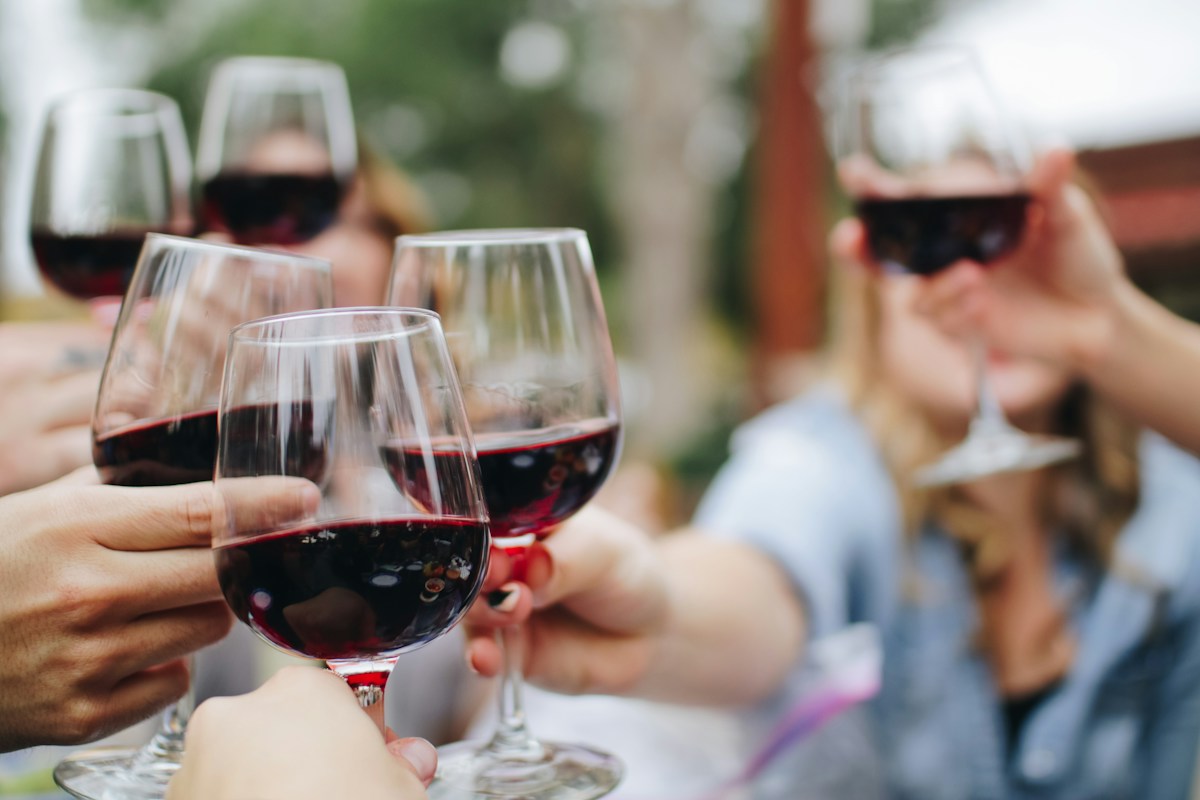
Wine bars are found mainly where there are wine-growing estates. In Germany, these are mostly found in the south-western part of the country. This is down to the prevailing climatic conditions.
Of the 13 wine regions, 11 are located in Baden-Württemberg, Hessen and Rheinland-Pfalz. Wine holds particular significance in this region, which is why there are quite a few wine bars here. Their wines are enjoyed not just across the rest of Germany but around the world.
With their natural charm, wine bars invite you to linger and indulge. They have a special character all of their own. In any wine-growing area, you'll find a wine bar nearby, however tiny the village.
Regensburg's Wine Bars
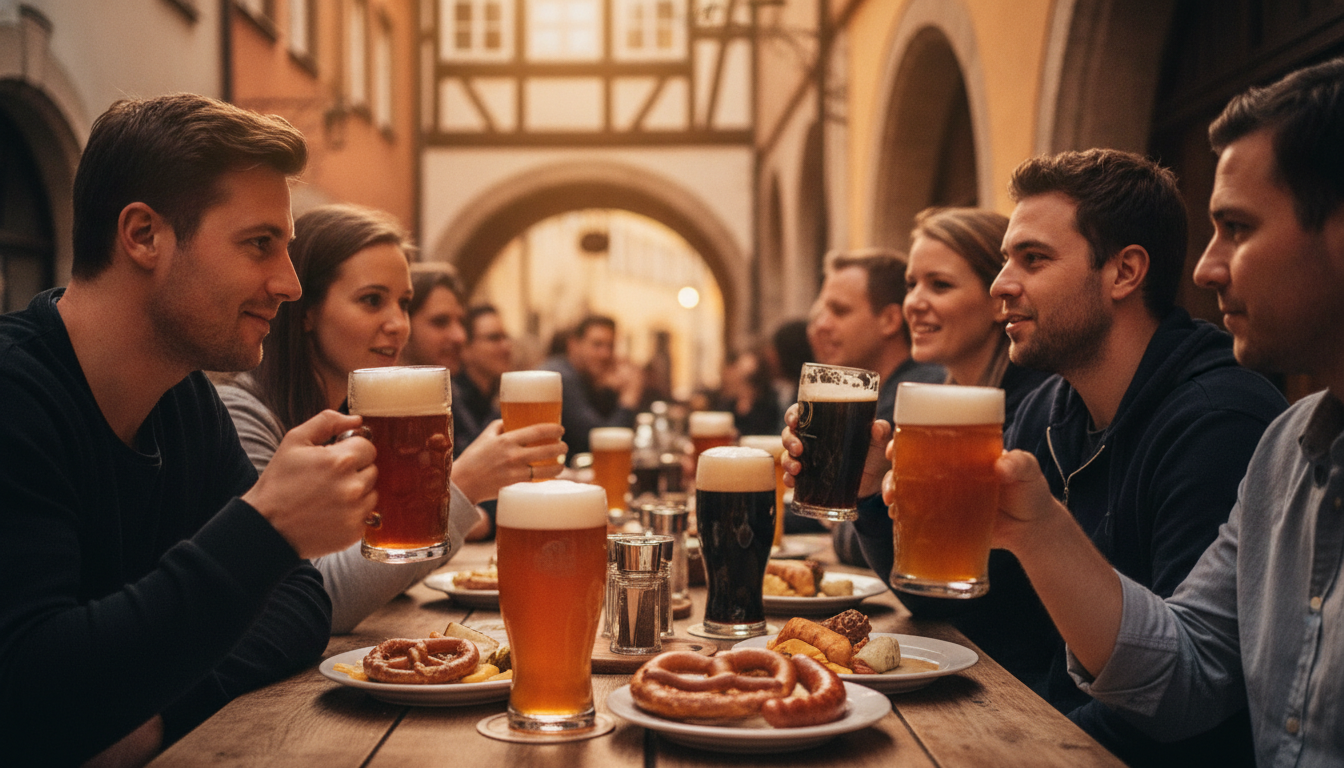
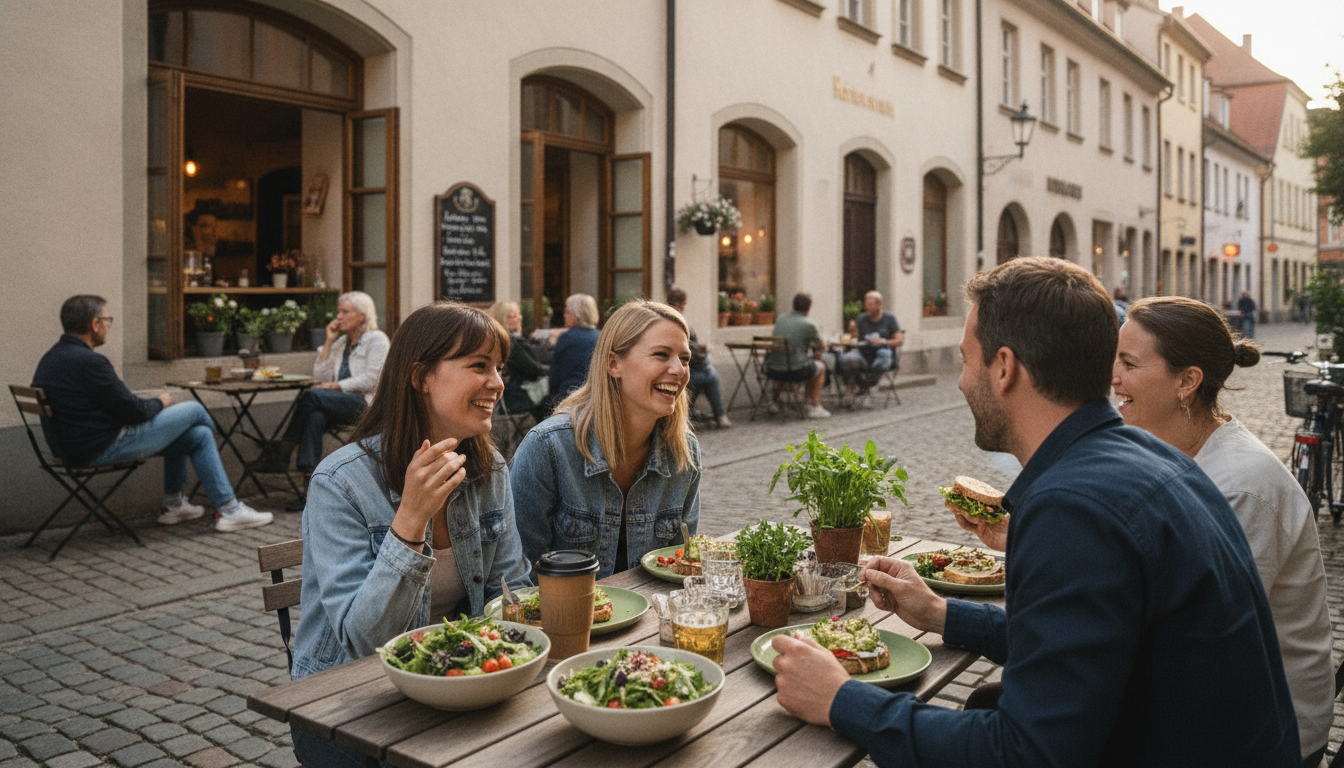
For those who don't know what a wine bar (Weinstube) is, the name gives a clue — wine plays a starring role. And what one does in a ‘Stube’ (parlour) we can all imagine — ‘Herein in die gute Stube’ (‘step into the best room’) is a well-known German phrase. A wine bar is the perfect place for good company, drinking and eating together.
Wine bars are usually housed in centuries-old timber-framed buildings, which are often listed. Regional home-style cooking meets cosy get-togethers in rustic vaulted cellars, all within a charming atmosphere.
You can experience this distinctive flair in Regensburg at Sauseneck.
That said, it should be remembered that not every wine bar in the country can be located within a wine region. Where this is the case, a selection of wines from the wine-growing areas is bought in and served. Here, different approaches can be taken:
Either all the wines on offer are sourced exclusively from the nearest wine region, or — the second option — the fine wines are chosen from several of the 13 wine-growing areas.
With this broader geographical selection, wines from abroad — such as France, Spain or Italy, but also from overseas — are often found on the menu too.
What's on Offer in Regensburg
Given the close ties between wine bars and their associated wineries, serving local wines is naturally part of the concept! Of course, all the wines on the list are carefully chosen, as wine bars often have limited space. Wines from various wineries in the surrounding area are poured in these establishments. This raises awareness of the wine, and tourists are estimated to take home the odd case or two.
At some wine bars, guest wines even get their own page on the menu.
For legal reasons, wine bars tend to have a fairly simple menu. Generally speaking, only dishes that require little preparation may be served alongside wine. This is the case at Brauereigaststätte Kneitinger.
In the French-influenced south-west of Rheinland-Pfalz and in small parts of Hessen, onion cake (Zwiebelkuchen) and flatbread tart (Flammkuchen) — the latter only during harvest time — served with Federweißer, the young wine, are regional classics on the menu.
A soft cheese spread known as Spundekäs, mainly served with hearty bread, can be found in almost all wine bars in the Rheingau and Rheinhessen regions in the north-east of Rheinland-Pfalz.
In Franken, particularly along the Main, ‘Kochkäse’, ‘blaue Zipfel’ or ‘angemachte Camembert’ feature on the menu.
The baguette with Griebenschmalz (crackling lard), known as Fettbemmchen, is served in the ‘Sachsen’ wine-growing region.
Generally, you'll also find mixed and Mediterranean platters, sausage salad with bread, dates wrapped in bacon and feta cheese. Popular in wine bars are sausage and cheese platters, also known as the Winzerplatte.
Surroundings and Wine Villages
The villages in the wine regions have been shaped by the cultivation of the surrounding vineyards for centuries. The historic village centres delight with lovingly maintained timber-framed buildings and romantic little lanes that invite you to linger.
Individual buildings or entire village centres are sometimes listed as protected monuments. But the surroundings of the wine villages are also well worth exploring.
Expansive field paths through the vineyards and hiking trails, which can be both challenging and romantic, await. Depending on the region, many castles, castle ruins and palaces lie along the way.
A sea of vines and often forest too — that's what you'll see when looking out over the surrounding landscape from up there: in autumn, you'll see a mosaic of striking colours, from dark red to rich yellow and orange tones, while in summer you'll see lush green everywhere.
Germany's Wine-Growing Regions
As mentioned above, most of the wine-growing regions lie in south-west Germany. All the wine regions are located in Hessen, Baden-Württemberg or Rheinland-Pfalz — apart from Sachsen and Saale-Unstrut. Why is each region so unique? Which wine-growing region produces the best red or white wine? Why, for example, is Goldriesling so special? We have the answers:
Rheinhessen, at 26,000 hectares, is Germany's largest wine-growing region. This makes up a good quarter of the entire area (100,000 hectares) in Germany.
Thanks to the mild climate and varied soils, excellent conditions prevail for white wines. Rheinhessen is home to the world's largest growing area for Silvaner.
The Pfalz is the second largest, at a good 23,000 hectares. Red and white wines thrive along the German Wine Route thanks to the consistently sunny weather and varied soils. The grape varieties Riesling, Müller-Thurgau and Dornfelder are most commonly grown here.
The longest of all German wine regions is Baden. However, at nearly 16,000 hectares, it's considerably smaller in area. According to an EU regulation classifying wine-growing zones by climatic characteristics, Baden is the warmest of all Germany's wine-growing regions. Blauer Spätburgunder, Weißburgunder and Grauburgunder/Ruländer are predominantly grown here — in other words, Burgundy-style wines generally.
The red grape varieties Schwarzriesling, Trollinger and Lemberger are found almost exclusively in Württemberg, a wine-growing region of nearly 11,000 hectares. Schillerwein, also known as Rotling, is a speciality of this region. It's made by pressing white grapes together with red grapes. Because of its colour, this wine is often mistakenly compared to rosé.
The Mosel, the largest steep-slope wine-growing region in the world, covers around 9,000 hectares and is home to the steepest vineyard in the world, with a gradient of a staggering 65 degrees.
Rheingau, Ahr, Franken and Others
The Franken region covers a good 6,000 hectares. It's also home to the largest Riesling-growing area. In Franken, white wine makes up the majority of production, accounting for more than 80% of total yield. Müller-Thurgau and Silvaner are the most widely grown varieties. The region is well known for its Bocksbeutel, a rounded, flat bottle with a short neck used for bottling higher-quality wines.
The Nahe wine region, with its 4,000 hectares, is a dream for winemakers. Due to past volcanic activity, around 180 different soil types can be found here. This diversity is also reflected in the wine. White wines such as Riesling or Müller-Thurgau, as well as red wines such as Dornfelder or Spätburgunder, all thrive here.
In the Rheingau wine-growing region, Riesling is the main grape used to produce white wine. In this 3,000-hectare wine region, Riesling accounts for around 80% of the wine produced. This is also home to Germany's largest contiguous growing area for Spätburgunder.
The Saale-Unstrut wine region is the larger of the two wine-growing regions located in the former East German states, and it's also the northernmost of all German wine-growing regions. Saale-Unstrut is around 2,200 hectares smaller than Rheingau, covering 800 hectares. Due to its northern location and weather conditions, mainly early to mid-ripening grape varieties are cultivated there, such as Müller-Thurgau and Silvaner. White wines account for 75% of the total yield.
At just 560 hectares, the ‘Ahr’ wine region is small. No other wine-growing region produces as much red wine. The slate soil provides excellent conditions for top-quality wines, which is why Spätburgunder thrives so magnificently here.
Smaller Wine-Growing Regions
Goldriesling: since it's only grown in Germany within the 500-hectare Sachsen wine region, it's truly something special. Sachsen is Germany's easternmost wine region. Alongside the distinctive Goldriesling, Traminer is mainly grown, as well as Weißburgunder and Grauburgunder.
Cultivating the Mittelrhein wine-growing region is quite labour-intensive and costly. But because the sun shines ideally on the steep terraces, the winemakers' efforts pay off. The white wine Riesling in particular benefits from this location, accounting for around two-thirds of total yield.
At just 460 hectares, Hessische Bergstraße is the smallest wine region. Nearly 50% of the annual total yield comes from Riesling. However, the small amount of red wine from this wine-growing area is also appreciated far and wide.
That concludes our general information on the 13 German wine-growing regions and on Regensburg in general. We hope this blog post has helped give you an overview of wine bars and wine regions. Enjoy exploring!

Max Schmidt
Lokaler Experte